

Survey highlights effects of under-resourced schools
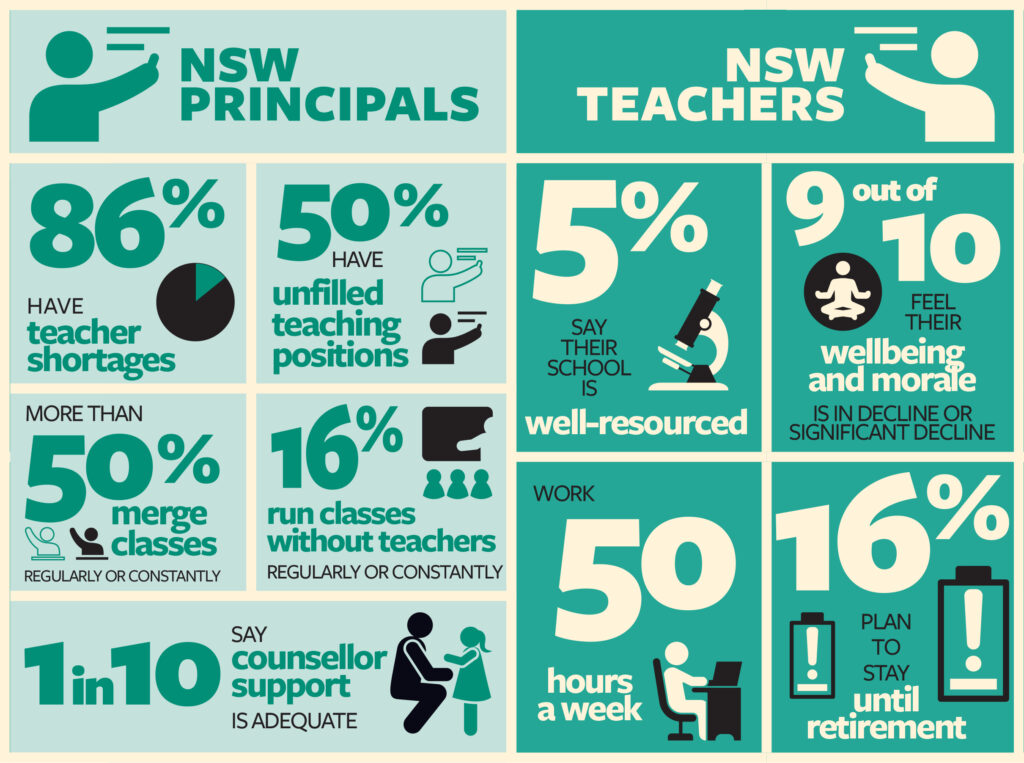
Acute teacher shortages, unsustainable workloads and alarming declines in student wellbeing and engagement, reported in the Australia Education Union’s 2024 State of Our Schools survey results, highlight the under-resourcing and urgent need for full funding in NSW public school schools.
To mark the release of the survey results, on 15 May more than 2000 miniature school cut-outs covered the lawns of Mrs Macquaries Point in Sydney, to represent the unacceptable situation that NSW public schools are underfunded by $1.9 billion this year.
AEU Federal President Correna Haythorpe said NSW public schools are funded below the Schooling Resource Standard (SRS), the minimum level governments agreed a decade ago was required to meet the needs of students. “The challenges are too great and the cost of inaction too high for governments to continue to fail on funding.”
WORKLOAD
Ms Haythorpe acknowledged NSW public school principals and teachers were doing an extraordinary job but said they are being asked to do too much with too little.
“We are in danger of losing many more teachers, with unsustainable workloads their number one concern,” she said.
The NSW results from the AEU survey show workloads remain unsustainable, with teachers working 50 hours a week, on average.
Only 16 per cent of NSW teachers are now committed to staying until retirement, the lowest level of any state.
TEACHER SHORTAGES
Some 86 per cent of NSW principals reported teacher shortages at their school in the past year, again the highest number of any state. Half the principals said they had unfilled teaching positions at the time of the survey.
“While the number of principals reporting teacher shortages has fallen from the unprecedented level we saw under the NSW Coalition Government, they remain an acute problem,” Ms Haythorpe said.
“Teacher shortages are having a detrimental impact on teaching and learning with schools forced to merge classes, run classes without a teacher and reduce the range of specialist classes offered,” she added.
WELLBEING
More than two thirds of principals and teachers reported a decline or significant decline in student wellbeing and engagement in the past 18 months.
Nine out of 10 teachers reported a decline or significant decline in their wellbeing and morale over the same period.
“Fully funding public schools is the only way to ensure every child gets the support they need to succeed, and we can recruit and retain sufficient numbers of teachers. There needs to be additional teachers and school counsellors in NSW schools,” Ms Haythorpe said.
TIME FOR GOVERNMENTS TO STEP UP
Federation President Henry Rajendra said the survey results highlighted the critical need for NSW and federal governments to reach an agreement this year to fund public schools at 100 per cent of the SRS.
“We don’t have a level playing field where every child can get the support they need to succeed,” he said.
“NSW public schools are grappling with a $1.9 billion shortfall this year alone. It’s time for the Prime Minister to step up and lift the federal SRS share from the current 20 per cent to 25 per cent by 2028.
“The Minns Government also needs to ensure that the accounting tricks used by the former Coalition government to artificially inflate the state’s SRS share by four per cent are not relied on in the next agreement and public schools are funded at a genuine 100 per cent of the SRS.”
FULL FUNDING URGENT AND CRITICAL
The AEU survey comes after the Review to Inform a Better and Fairer Education System, ordered by education ministers, warned that the underfunding of public schools is “undermining other reform efforts with real implications for student educational and wellbeing outcomes, teacher attraction and retention”. The Review’s expert panel concluded the need for full funding is “urgent and critical” and a prerequisite for student learning and wellbeing improvement.
In the survey, NSW principals said students who have fallen behind in literacy or numeracy and students with disabilities or learning difficulties would be the biggest beneficiaries if public schools were fully funded.
Teachers listed additional support for students with disability or behavioural issues and more time within their paid hours for lesson planning, assessment and reporting as changes that would most assist them to improve student outcomes.
Almost 7000 NSW public school principals and teachers were questioned for the survey, conducted in March and April this year.
The continuing impact of teacher shortages and need for full funding in regional areas has again been revealed in the findings of the recent State of Our Schools survey.
The survey found teachers in regional areas were more likely to have taught merged or split classes, witnessed a greater decline in student wellbeing and believe school counsellor support is inadequate.
The percentage of teachers indicating students were waiting for longer than two months to see a counsellor was far higher in the regions than in city locations. Resourcing gaps between city and country areas were also highlighted in the survey findings, with fewer regionally based teachers indicating a belief that their school was well-resourced.
Federation President Henry Rajendra said the survey findings showed shortages and workload were causing immense challenges for teachers, particularly in the regions.
“Teacher shortages affect kids and teachers in the bush. Shortages mean a continuation of split and merged classes. This creates greater workloads for our teachers and is a major contributor to the declines we are seeing in teacher wellbeing. Ultimately, it’s kids who are missing out.
“While teacher shortages have fallen since the departure of the Perrottet government, we know the number one reason why principals are forced to merge classes or make arrangements for minimal supervision is a lack of casual teacher availability.
“We are already experiencing unacceptable achievement gaps between high and low socioeconomic status students and those in remote and metropolitan schools; those gaps are the equivalent to three to five years of learning.
“Mr Albanese needs to be Prime Minister for the city and the regions.
“With a $1.9 billion funding gap he needs to lift the federal Schooling Resource Standard share from 20 per cent to 25 per cent by 2028.”
Mr Rajendra also believes local MPs have a responsibility for their students, calling for them to stand up and demand the fair funding needed to act on workloads, close achievement gaps and ensure students in the regions get the support and funding they need.
“Students in the bush have been through fires, floods and a pandemic. Fully funded schools with qualified teachers and improved access to school counsellors is an essential ingredient to the long-term recovery and success of public education.”
The Department of Education’s 2023 Alternate Supervision Arrangements Survey found there was a 60 per cent casual teacher shortfall in outer regional schools, 21 per cent greater than that of major cities, the consequences of which were almost 10,000 lessons a day requiring alternate supervision arrangements.
THE NEED FOR ACTION
There is currently no agreement between governments to close resourcing gaps and bring every school to 100 per cent of the Schooling Resource Standard (SRS), despite the facts that:
- not a single NSW public school is funded to 100 per cent of the SRS
- teacher shortages and workloads are leading to higher attrition rates
- when it comes to inequity in access to educational staff and resources, Australia is by far the most inequitable in correlation to wealthy comparator countries
- full funding is a nation-building investment that will pay off for our kids and our country.