

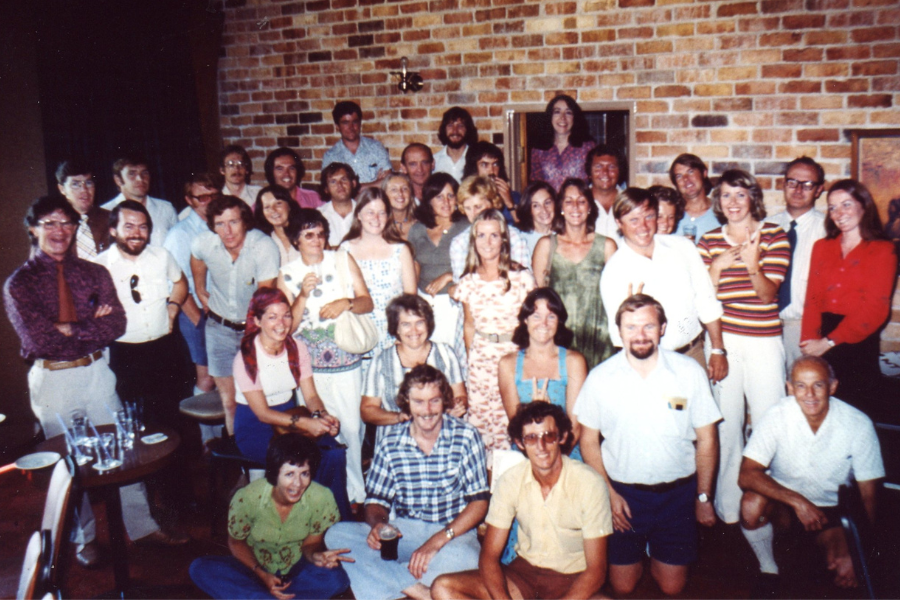
Tuesday 10 February marks 50 years since teachers at Warilla High School started the longest teachers’ strike in Australia’s history — the outcomes of their 28-day strike created a precedent that led to differential staffing for disadvantaged schools across the state.
The catalyst for the strike was Warilla High School, a school located in a disadvantaged area, left without a science teacher when the Department of Education moved a trained reserve science teacher to teach music at Berkeley High.
Striking teachers met every morning outside the school and voted on whether to continue their indefinite dispute for another day before going off to speak with members at other schools to garner support and funds to sustain the strikers.
Members marched on the Department’s local area office.
The strike continued even after the Industrial Commission ordered members back to work.
Strength in numbers
In their book recounting the Warilla action, A short history of Australia’s longest teachers’ strike, former Warilla High teachers Jim Bradley and John Childs said that “our greatest strength was the number of us that could be dispersed to all points of the compass to promote our case or, when required, gather in one place”.
During the dispute, Federation president Barry Manefield told the striking teachers they were the spear point of Federation’s campaign to maintain employment of teachers and reduce class sizes.
Over the course of the dispute more than 200 schools across NSW stopped work for at least half a day in support. A meeting of 400 parents and students supported the teachers’ actions and students from several local high schools marched down the main street of Wollongong.
Community support
At the time, industrial laws were not as restrictive as they are today. The law did not prevent secondary boycotts and so the union community supported Warilla teachers in their campaigning. Maritime workers stopped work and a tugboat crew left 15 ships tied up in Wollongong port to aid the campaign.
In Teachers and their times: a history and the Teachers Federation, former Federation president Denis Fitzgerald wrote of how “[a] Departmental official was taken to his office window by the leader of the local union movement and his attention was drawn to the vista of the port before him and the prospect that from one side of the harbour to the other ships would be tied up until the matter was satisfactorily settled”.
“The strikers returned [to work] having gained extra staffing for remedial mathematics, an extra science teacher and the acceptance of the educational principle of differential staffing for children in disadvantaged schools and communities. This was soon to be introduced as a staffing principle across all of NSW public schools.”
Local efforts determine campaign outcomes
The Warilla strike is an example of what can be achieved through local activism.
“No union blue can ever be won unless the members themselves first put their own bodies on the line,” Bradley and Childs wrote. “Any union starts with each individual’s commitment to being a principled member, prepared to follow the decision of the meeting after a democratic vote…40 of us did that, right to the end.”
Then-South Coast Trades and Labour Council president George Murray noted that “the worker only gets out of the struggle what he puts into it.” As Ports Committee secretary Stan Woodbury said, “If you fight, you might win. If you don’t fight, you’ll certainly lose.”
This article is based largely on content in A short history of Australia’s longest teachers’ strike, compiled by Jim Bradley and John Childs and Teachers and their times: a history and the Teachers Federation, by Federation Life Member and former president (1995–1997) Denis Fitzgerald.