


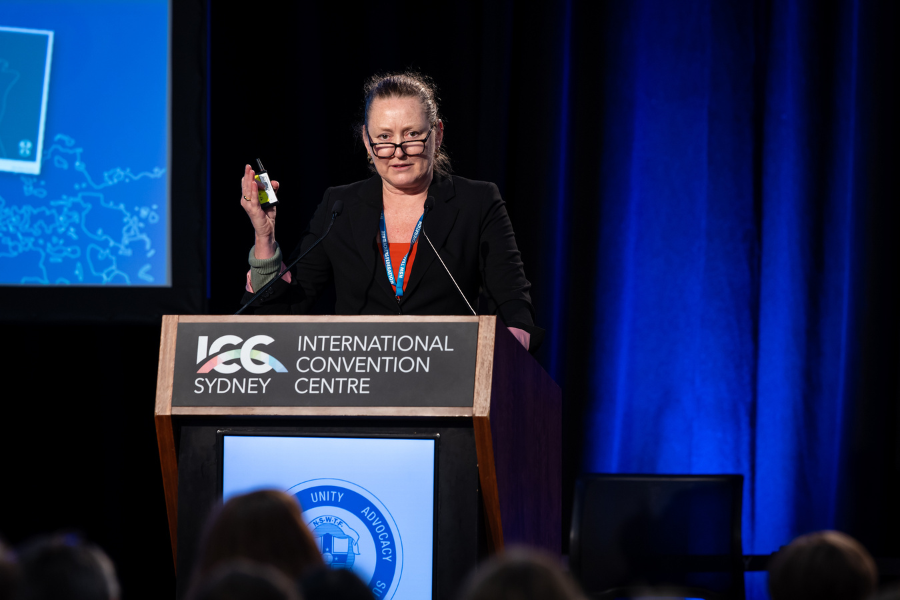
Shifts that undermine teacher professionalism are not inevitable and can be contested, Professor in the Sydney School of Education and Social Work at the University of Sydney Nicole Mockler told Annual Conference.
Emeritus Professor in the School of Education at Western Sydney University Wayne Sawyer and Prof Mockler described an ongoing decline in teacher professionalism, shaped by policy settings that don’t place enough value on teachers.
Prof Mockler said: “There’s enormous power in the collective and harnessing that power to transform the teaching profession into a place where teachers routinely flourish and where they’re sustained and supported at all points in their careers will also transform our capacity as a society to do our best for young people,” she said.
Australia ranks close to the bottom for teacher decision-making
Prof Mockler reported 65.3 per cent of Australian teachers agree that they have real opportunities to participate in school decision making.
“Now that might sound like a ‘two-thirds ain’t bad’ situation, but it actually places Australian teachers 55th out of 57 countries and jurisdictions that took part in [The OECD’s] 2024 Teaching and Learning International Survey,” she said.
Workload, standardised curricula and teacher efficacy
Em Prof Sawyer addressed the suggestion that standardised curricula [which reduces teacher efficacy] is a solution to reducing teacher workload. He recounted a UK survey, where respondents who did not use standardised curricula reported significantly higher levels of self-efficacy than those who do — and that there were no significant differences between their perceived workloads.
The evidence agenda and erosion of teachers’ sense of agency

Part of the debate over teacher professionalism relates to teacher judgement and the value of evidence that teachers use to inform their teaching practice.
Prof Mockler challenged the NSW Centre for Education and Statistics and Evaluation’s view of what constitutes valuable evidence.
“Telling teachers that in using evidence to inform their practice they should regard any research findings not generated by experiments to be equivalent to opinion … is dangerous and honestly, just doesn’t make sense,” she said.
“Reasonable evaluations of the quality of research evidence do not ever rest purely on issues of research design and method. Low-quality research can employ any method. High-quality research can also employ any method. Judgements about quality of evidence are a lot more complex than method.”
“My suspicion is that many teachers have been convinced, by enduring ideas about hierarchies of evidence, into feeling that there can be nothing rigorous or systematic about their judgement — that in order to be valid and reliable it needs to be generated elsewhere and exist in a numeric form,” she also said.
How to support robust teacher professionalism
Prof Mockler said teachers need to resist the individualisation of the teaching workforce, in favour of collective professional autonomy.
“Part of this is pushing back on ‘professionalism’ imposed from outside in favour of building it from within the profession,” she said.
Prof Mockler also suggested refusing to become relegated to the category of technicians.
“Teaching is intellectual work that relies on skillfully deploying bodies of expert knowledge, forging strong relationships with young people and using well-honed professional judgement to inform the myriad large and small decisions teachers make every day. Part of this is understanding the connection between teachers’ practice and their sense of moral purpose — we know that when that connection is severed, the demoralisation that results have dire consequences.”
Governments, their departments and schools must all take seriously the work to grow the agency and independence of teachers and principals, Annual Conference delegates declared today.
“Teachers and principals have the right to peer-regulate and self-regulate their work. Teachers and principals must be at the forefront of discussion and decisions in the core business of syllabus, pedagogy, assessment, setting educational structures and process through their union,” the Teachers’ work — syllabuses, pedagogy and assessment decision states.
In 2024, the International Labour Organisation published a report on how to tackle the global teacher shortage, a key recommendation to government being: “The status and dignity of the teaching profession need to be protected and elevated.”
In line with the recommendations in the United Nations Secretary General’s High-Level Panel on the teaching profession report (2024), Deputy President Natash Watt said: “What we need to be taking up with the Department are unnegotiated policies that interfere with or impede the professional work of teachers.” Delegates agreed and the point is included in the action section of the decision.
Professional work of teachers
The Annual Conference decision asserts: “Performative and technocratic approaches to ‘professionalism’ generate fertile ground for the alienation of teachers from the core of their work, the devaluing of teacher expertise and judgement, the introduction of reductive forms of knowledge, the subjugation of teachers as workers and ultimately narrowing of the curriculum they teach.”
“Fundamental to … educating children and students in the public education system is teacher agency over their profession, exercised in the context of strong collegiality. The systemic support required to recognise, respect and elevate teacher professionalism must include prioritising increased planning time as an entitlement, ensuring teachers can coordinate and collaborate in their work and enable the democratisation of key educational structures and processes.”
Syllabuses
The decision states syllabuses should be frameworks of knowledge, problem solving and critical thinking across socially valued learning areas or subjects, the policy states. “They should not include pedagogy.”
“The syllabus must be the driver of teachers’ work. When teachers are empowered to deeply know, interpret and apply the syllabus, they can make informed professional decisions that genuinely meet the needs of their students.
“Schools, principals and teachers must be supported by the system to prioritise teacher-led planning anchored in the syllabus.”
The decision stresses that teachers must be given the autonomy to use their planning time to ensure students access all syllabus outcomes, by engaging in the fundamentals of teachers’ work as described in Standard 3 of the Australian Professional Standards for Teachers at Proficient, namely: ‘Plan and implement well-structured learning and teaching programs or lesson sequences that engage students and promote learning.’
Federation maintains that the introduction and implementation of all syllabuses must be supported by non-school based teacher curriculum advisors, who have qualifications and teaching experience for each subject. “These positions in the system should be a protectable entitlement linked to system staffing. When new syllabuses are introduced to teachers, there should be at least a two-year lead in time to familiarise and plan before implementation with students becomes mandatory. Professional development for teachers must be available for all syllabuses and the Early Years Learning Framework through the life of the syllabus.”
Attempts to diminish teacher professionalism
The decision upholds that the prescription of lesson materials and the scripting of lessons are not workload reduction initiatives: “They are at best, misinformed attempts to control teachers and their work.”
Federation calls on the Department, to regulate the provision of teachers’ access to high-quality professional development, including ensuring:
- equitable access to school professional development funds
- teachers’ professional development needs are being met
- teachers are respectfully and professionally engaged in decision-making regarding their professional development and the elimination of wasteful and inappropriate spending of professional development funds
- professional development courses are provided or centrally vetted by the Department of Education.
The decision also states: “Federation is opposed to the outsourcing of professional development to private providers.”
The union maintains that it does not agree that professional development for members must align to imposed employer-created documents that have not been negotiated, such as the School Excellence Framework.
“Employer policies that are unnegotiated with the union interfere with teacher and principal agency and the creation of space that supports teaching work,” the decision states. “Currently unnegotiated key educational structures and processes include, but are not limited to, the School Excellence Framework, School Excellence Plan, Department Professional Development policies and curriculum monitoring procedures.”
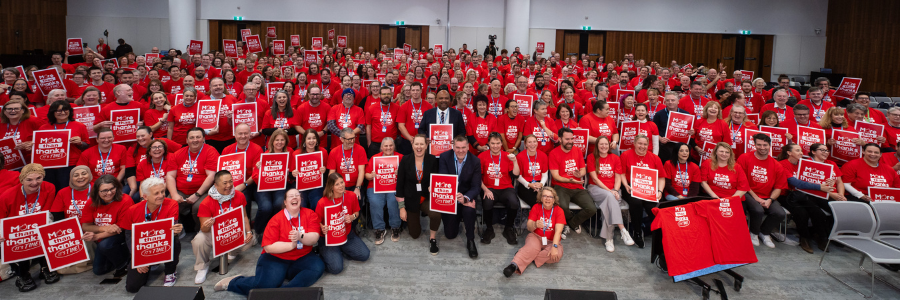
All proudly wearing the distinctive More Than Thanks – It’s Time campaign shirts, a red sea of teacher delegates gathered today at Annual Conference to show their ongoing commitment to the cause.
Since February of this year, the campaign has sought to gain:
- two hours of additional preparation time per week for all teachers
- additional preparation time for primary school executives equivalent with their secondary executive colleagues
- increased preparation time for small school principals (minimum 50 per cent reduction in face-to-face teaching time).
Federation President Henry Rajendra encouraged representatives present at the conference to pressure their local MP (especially those in Labor held seats) to advocate for the campaign’s demands. He also suggested that teachers should strengthen relationships with parents by attending their school’s P&C meetings, keeping them informed and reinforcing the message that we all want what’s best for the children.
“The power of having parents with you is a strong message. You spend time with their children and are best placed to understand [the parents’] thinking.”
Mr Rajendra went on to encourage the recruitment of fellow teachers to join the union, saying that their involvement is critically significant.
He also spoke to the role that social media plays and how having a strong visual presence can be highly valuable to the metrics of the campaign and in ensuring that more people, and the right people, see the numbers behind the issue.
Members watched this video, a message to the NSW Education Minister from members about why extra preparation time is crucial for the benefit of teachers and their students.
To bolster the campaign’s visibility, delegates assembled for a photograph. A video recording also captured them loudly and zealously responding to the campaign message “More than thanks” with “It’s time!”

“You can be assured, one of our priority recommendations will be the essential nature of co-design with teachers and community,” Schools for Our Future infrastructure inquiry chair Sharan Burrow told Annual Conference.
“There is no doubt that where principals, teachers, specialist staff, indigenous communities, parents and allied health professionals are involved, new builds and retrofits are much more suitable for maximising the benefits and the enjoyment of schooling.”
The Australian Education Union’s inquiry is investigating the importance of infrastructure, the condition and safety of public school facilities, future needs, equity, inclusion and funding. The panel will publish its report by October.
The inquiry has consulted with:
- public school teachers, principals, education support personnel and families
- state and territory governments and key departments of education personnel
- education stakeholders including unions, community organisations, researchers and youth bodies
- organisations representing Aboriginal Peoples and Torres Strait Islander Peoples, rural and remote Australians, young people experiencing disadvantage and students with disability.
Ms Burrow said the complexities of teaching and learning, the scope of curriculum offering, student needs, health and wellbeing support, community building and community access and support require fit-for-purpose infrastructure.
She said the inquiry’s nationwide consultations have revealed a broad set of must-have considerations:
- space: generous flexible classrooms with the ability to accommodate all teaching and learning choices, including breakout rooms with line of sight and dedicated spaces to enable the full scope of curriculum offerings
- light: natural light and light and colour choices that support sensory wellbeing
- sound: acoustics and soundproofing to maximise concentration and minimise disruptions
- full service: there is increasing support from teachers for wellbeing hubs with capacity for specialist services to provide student and community support
- early childhood: on site provision is seen to support both student learning and parental choice
- before and after school care facilities: support for parents and students that doesn’t compromise learning spaces
- school community meeting spaces: the need for halls/covered spaces that accommodate school students and the community to engage in and celebrate all school activities is vital
- pride of place: culture and community embedded in school art and design
- beyond indoor spaces: environment as a third teacher, trees, covered outdoor spaces and playgrounds
- sustainability: electrification with renewable energy, water tanks, insulation, double glazing and reliable heating and cooling
- toilets.
Tell the inquiry about your school’s infrastructure needs
Inquiry deputy chair Maurie Mulheron encouraged members and schools to write a submission to the inquiry by 31 July, outlining:
- how well current facilities are meeting the needs of students, teachers and staff
- what is required to ensure our schools are safe, modern, inclusive and fit for purpose into the future.
“We’re not looking for essays, just a page, half a page, photos,” Mr Mulheron said.
The stories will help build an evidence base for future campaigning for recurrent federal capital works funding — at present there is no ongoing federal infrastructure funding for public schools, while private schools receive extensive federal funding.
All governments must commit to ensuring that this generation of students has access to the public school infrastructure they need and deserve by right, Federation’s Annual Conference demanded today.
“This union of educators maintains our vigilance and persistence in pursuing public school infrastructure justice for our members and the students in their care,” Annual Conference’s Public Schools Infrastructure National Inquiry: Schools for Our Future decision states.
The 2011 Gonski review of schools funding, highlighted the inequity of capital resourcing between public and private schools and recommended the re‐establishment of a national capital fund for public schools.
School infrastructure is inseparable from the national education priority. So, Federation is calling for a capital funding standard against which all buildings and facilities in schools can be measured, with a focus on addressing the serious under-investment in public school capital expenditure.
“Applying the maxim that ‘what gets measured is what gets valued’, it is a glaring omission that in 2026 Australia remains without a national reporting standard for school infrastructure,” the Annual Conference decision states.
“The present lack of a national reporting standard for school infrastructure hampers governments from meeting the bare minimum of rational obligations for public investment, namely the effective and efficient assignation of capital works funding to areas of greatest need, thus leading to misalignment of public funds between areas of relative advantage and disadvantage at the intersections of Australian society. Such misalignment exacerbates inequities, which are corrosive to the very foundations of young people’s capabilities and prospects, and so, is neglectful of their human potential and rights.”
Federation demands the Department of Education must provide regular, ongoing infrastructure assessments of all classrooms, buildings and learning spaces, to be undertaken by appropriately qualified professionals, to ensure that learning environments remain safe, suitable and fit for purpose. Proactive assessments would assist in identifying maintenance, compliance and safety issues before they become significant risk to students and staff or adversely impact teaching and learning.
Schools for Our Future Inquiry
Federation is supporting the Australian Education Union’s Schools for Our Future Inquiry, which is examining the current state of public school infrastructure across Australia, assessing future needs and recommending long-term funding and policy reforms to deliver future-ready schools in every community.
Federation President Henry Rajendra impelled Annual Conference delegates to complete a school-based submission to the Schools for our Future Inquiry for their school, outlining the facilities and improvements required to meet educational needs in their context.
“Submissions are critically important, so as you list your tasks for day 1, term 3, this needs to be at the top,” Mr Rajendra said.
“When you get back [to your community], get together with some of your colleagues … get parents involved.
“[Your submission] doesn’t have to be an extensive piece of work.”
Submissions close 31 July.
Hold a workplace meeting and demand action on local infrastructure issues
Where there is inadequate, deteriorating and/or dangerous infrastructure in a workplace, Federation authorises members to hold a Federation meeting. The union encourages all members to pass a resolution to collectively demand that the NSW Department of Education address their infrastructure issues. In doing so, members reserve their right to consider a campaign of action to pursue the matter.

Challenging racism has never been more important, Annual Conference declares in its update to the union’s anti-racism policy.
The new policy, titled Anti-racism through public education: the cornerstone of social inclusion, was carried by Annual Conference today.
Senior Vice President Michael de Wall told delegates: “By all reasonable accounts, our public education system is making significant progress in combatting racism, but there is a history we must come to terms with and a present reality where there is so much more to do.
“Federation’s revised anti-racism policy, including its commitment to the National Anti-Racism Framework, which elevates the distinct experiences of Aboriginal peoples and Torres Strait Islander peoples, is a critical step towards further progress in the collective effort to end racism,” he said.
“Along with other public institutions, our public schools, our TAFE colleges and our related worksites must be the cornerstone of a more socially inclusive society free of racism and other forms of discrimination.”
Federation will:
- develop a range of information leaflets to assist members to challenge racism, provide advice on the implementation of Federation’s anti-racism policy and provide accurate definitions and links to quality resources to counter disinformation
- develop and promote Centre for Professional Learning courses that professionally develop members in Aboriginal education, multicultural education and anti-racism education.
“The only sustainable notion of a unifying national ethos is one built on social inclusion,” the new policy states. “This demands a significant investment of resources and energy in renewing those public institutions, services and spaces that facilitate social inclusion and a vibrant democracy. For teachers working in public education, the starting point for this investment is uncomplicated: a universal, free and secular high quality public education for every child, and free TAFE for young adults and older students entering post-school education and training.”
“Teachers in NSW public schools and TAFE colleges, in their role as teachers and unionists, play a leading role in supporting the building of intercultural understanding and inclusivity within society,” the policy notes. “They also have an ethical responsibility to work towards the elimination of racism and discrimination.”
The document warns political opportunism and the rise of extremist ideologies globally, characterised by government authoritarianism, exclusionary nationalism, suppression of dissent and the elevation of some within our communities above others, pose a profound threat to democratic societies and our public education communities.
“A healthy and functioning democracy requires resilience and vigilance,” the policy asserts. “As a social justice union, it is our collective responsibility to pursue human rights obligations with all levels of government and to hold these governments to account when they fail to meet them.
“Anti-racism is core to the work of teachers and fundamental to building safe and inclusive communities. Challenging racism requires truth-telling, cultural respect and justice. It demands a commitment to provide culturally responsive education that recognises diversity as a strength and values the many cultures, languages and beliefs that students bring to the learning environment.”
Federation believes that specialist teachers and support staff working alongside school and TAFE teachers is essential to the delivery of culturally responsive teaching, supported student access to curriculum and the advancement of learning outcomes and education priorities. Recurrent funding should be seen as an investment in democracy, contributing to the preservation of cultural heritage, the building of multilingual capability and the enhancement of student wellbeing through effective and inclusive education.
Federation will continue to campaign for the rebuilding of systemwide programs, including targeted EAL/D support, Aboriginal student support, anti-racism education, and Aboriginal and multicultural education programs.
The policy calls for curriculum and syllabus documents to provide positive opportunities for teachers to highlight the values of Aboriginal, multicultural and anti-racism education: “All teachers should be provided with opportunities to engage in ongoing high quality professional learning related to the Australian Professional Standards for teachers, aligned to the NESA syllabuses and Early Year Learning Framework that cover culturally responsive teaching, EAL/D pedagogy, intercultural understanding, anti-racism strategies, and trauma-informed care and practices.”
Annual Conference 2026, Day One
Annual Conference 2026, Day Three