

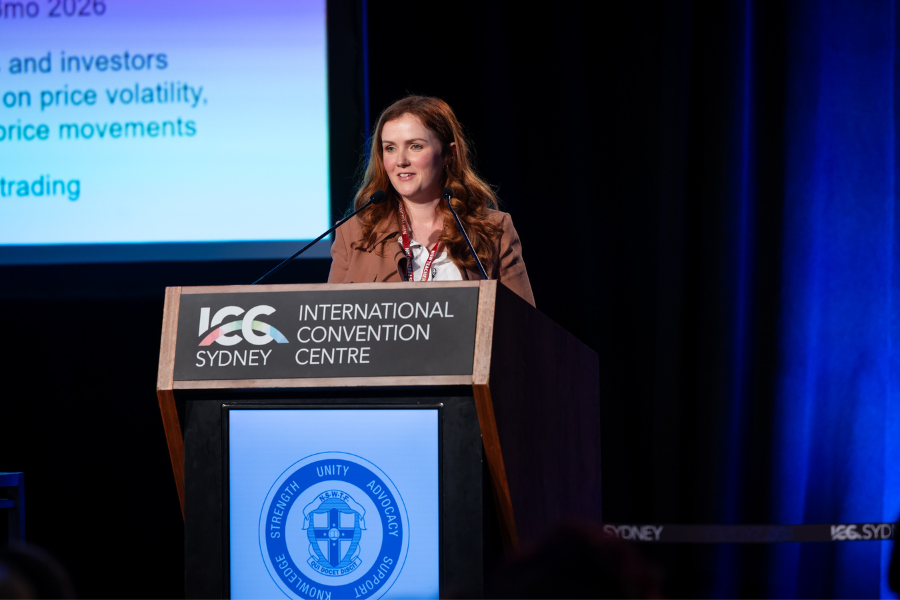
Essential services that have shifted from public to private ownership over the past two decades are driving Australia’s inflation crisis, McKell Institute chief economist Alison Pennington told Annual Conference.
Ms Pennington has calculated the average annualised inflation rate for every item in the consumer price index (CPI) basket over 20 years (2006–26). While average CPI ran at 2.8 per cent a year, the fastest-rising costs driving total inflation included:
- gas: 5.9 per cent per year
- electricity: 5.7 per cent per year
- medical and hospital services: 5.5 per cent per year
- water and sewerage: 4.6 per cent per year
- housing 3.9 per cent year.
They are all privatised services operating outside universal public systems or were services once delivered by government for free or at very low cost.
“So much of the economy now has been handed over to private interests, including services like education,” she said.
Public provision is the answer
Ms Pennington proposes the longest-lasting structural fix to inflation is public provision, because it is deflationary.
“Under times of big inflation, Australian companies are going to be facing … pressures to profit-maximise and raise prices and that’s why public ownership and delivery by our own governments subject to the democratic will of its people is the only solution that delivers … non-profiteering, controlling inflation and lifting the living standards of the people,” she said.
Ms Pennington is advocating for government investment in:
- public education — and “weaning private schools off the public teat as growth in private education has been inflationary (Secondary education averaging 5.2 per cent per year and preschool/primary education: 3.9 per cent per year over 20 years)
- nationalising the childcare sector
- expanding Medicare
- public owned renewables
- public-led housing programs.
The social wage has been eroded
Ms Pennington reminded delegates that in the 1980s, workers accepted wage restraint (to deal with inflation) in exchange for Medicare, better public education, better employment and pensions and universal superannuation, under the Prices and Incomes Accord.
But she said much of this social wage (collective good and services provided by government) has been “severely eroded”.
“The social wage that we fought for…has been chopped off and sold off.”
More solutions
Ms Pennington proposed other solutions “to build an economy that works for everyday people”, including:
- lifting compulsory superannuation as an alternative to interest rates
- legally capping what companies can charge
- taxing sudden, unearned profit spikes
- introducing a land wealth levy for fortunes over $20 million.
Alison Pennington is the author of the book Gen F’? How Young Australians Reclaim Their Uncertain Futures, and is Adjunct Senior Research Fellow in PPE with Latrobe University. Alison has held previous roles in unions, think-tanks, federal public administration and is a former senior advisor to Cabinet Ministers in the Albanese Federal Government.
For another article on Ms Pennington’s research, read Privatisation of gas, education driving total inflation over 20 years, new research finds.