

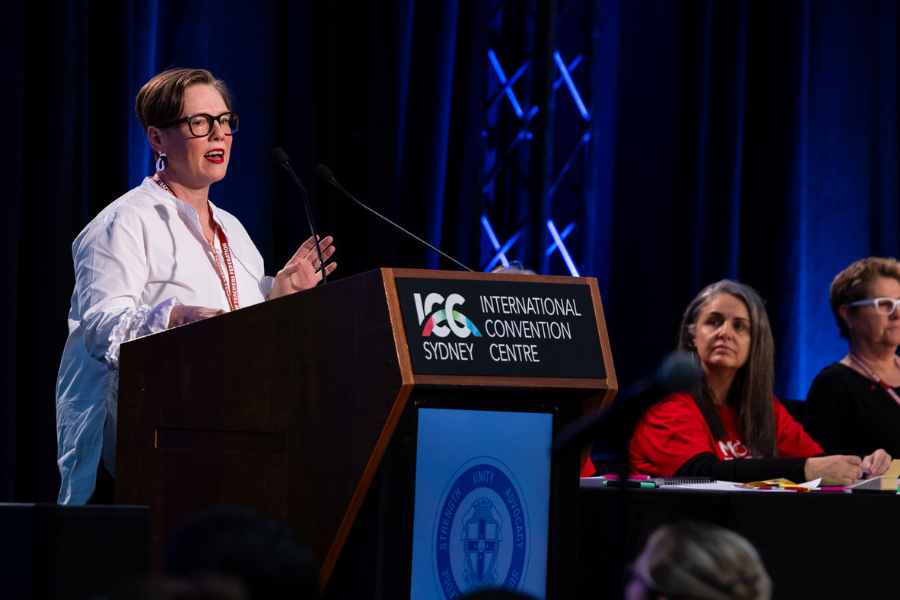
Shifts that undermine teacher professionalism are not inevitable and can be contested, Professor in the Sydney School of Education and Social Work at the University of Sydney Nicole Mockler told Annual Conference.
Emeritus Professor in the School of Education at Western Sydney University, Wayne Sawyer and Prof Mockler described an ongoing decline in teacher professionalism, shaped by policy settings that don’t place enough value on teachers.
Prof Mockler said: “There’s enormous power in the collective and harnessing that power to transform the teaching profession, into a place where teachers routinely flourish and where they’re sustained and supported at all points in their careers, will also transform our capacity as a society to do our best for young people,” she said.
Australia ranks close to the bottom for teacher decision-making
Prof Mockler reported 65.3 per cent of Australian teachers agree that they have real opportunities to participate in school decision making.
“Now that might sound like a ‘two-thirds ain’t bad’ situation, but it actually places Australian teachers 55th out of 57 countries and jurisdictions that took part in [The OECD’s] 2024 Teaching and Learning International Survey”,” she said.
Workload, standardised curricula and teacher efficacy
Em Prof Sawyer addressed the suggestion that standardised curricula [which reduces teacher efficacy] is a solution to reducing teacher workload. He recounted a UK survey, where respondents who did not use standardised curricula, reported significantly higher levels of self-efficacy than those who do — and that there were no significant differences between their perceived workloads.
The evidence agenda and erosion of teachers’ sense of agency
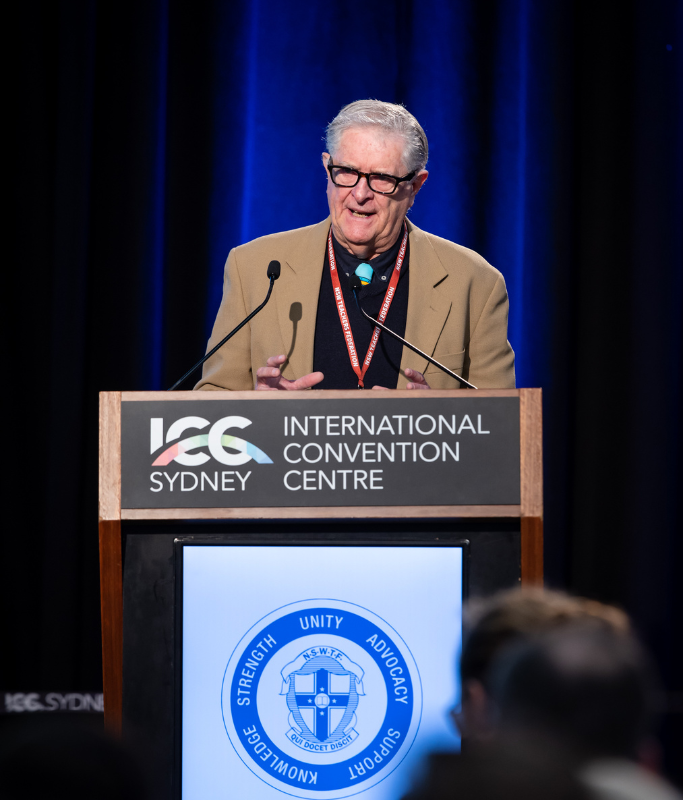
Part of the debate over teacher professionalism, relates to teacher judgement and the value of evidence that teachers use to inform their teaching practice.
Prof Mockler challenged the NSW Centre for Education and Statistics and Evaluation’s view of what constitutes valuable evidence.
“Telling teachers that, in using evidence to inform their practice, they should regard any research findings not generated by experiments, to be equivalent to opinion … is dangerous and honestly, just doesn’t make sense,” she said.
“Reasonable evaluations of the quality of research evidence, do not ever rest purely on issues of research design and method. Low-quality research can employ any method. High-quality research can also employ any method. Judgements about quality of evidence are a lot more complex than method.”
“My suspicion is that many teachers have been convinced, by enduring ideas about hierarchies of evidence, into feeling that there can be nothing rigorous or systematic about their judgement — that in order to be valid and reliable it needs to be generated elsewhere and exist in a numeric form,” she also said.
How to support robust teacher professionalism
Prof Mockler said teachers need to resist the individualisation of the teaching workforce, in favour of collective professional autonomy.
“Part of this is pushing back on ‘professionalism’ imposed from outside in favour of building it from within the profession.”
She also suggested refusing to become relegated to the category of technicians.
“Teaching is intellectual work that relies on skillfully deploying bodies of expert knowledge, forging strong relationships with young people and using well-honed professional judgement to inform the myriad large and small decisions teachers make every day. Part of this is understanding the connection between teachers’ practice and their sense of moral purpose — we know that when that connection is severed, the demoralisation that results have dire consequences.”