

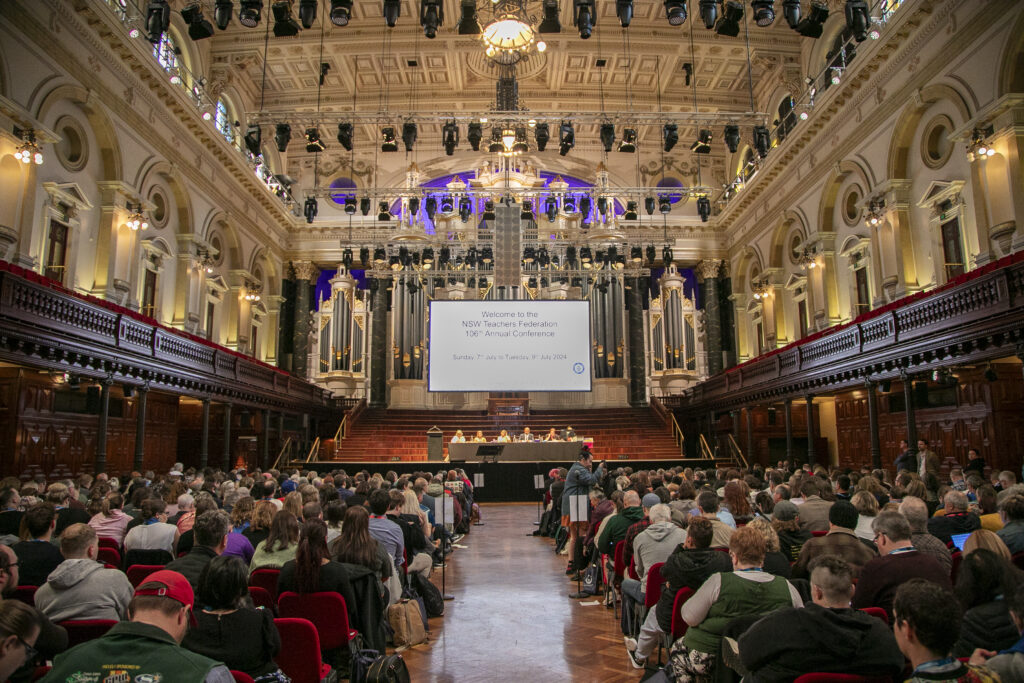
The issues that concern the teaching profession in NSW public education settings are being addressed by Federation’s peak decision making body at Annual Conference (7–9 July).
This democratic forum is attended by Presidential Officers, Professional Officers, Association Councillors and additional elected delegates (including representatives from the Aboriginal Members Roll).
The NSW Teachers Federation is committed to peace. Peace is always union business.
We remain opposed to all forms of war.
The Federation is appalled by the rising death toll in Israel’s War on Gaza. We maintain our condemnation of all forms of attack on civilians by Israel and Hamas. The killing of in excess of 38,900 civilians, including 15,000 Gazan children, since October 7 is staggering. World Health Organisation warnings of catastrophic hunger in Gaza, with 8000 children under five years old suffering acute malnutrition and reports that 17,000 children are without their parents in the war-torn territory are beyond concerning. The claim from Save the Children that 250 Palestinian children from the West Bank are missing in the Israeli military detention system, with families unable to confirm their whereabouts and well-being due to restrictions on visitation since the war in Gaza is also beyond concerning.
The Federation reiterates its decades-held position that All Wars Are Fought Against Children.
We note recent reports that the UN are to add the Israeli army to its blacklist of those who harm children in conflict.
Federation acknowledges the news reported in the Guardian on 9 June that defence officials have confirmed Australian businesses continue to contribute to the supply chain for items used in F-35 war planes.
We stand by the position of the Australian Council for Trade Unions, calling on the Australian Government to take immediate steps to secure peace by using all influence, pressure and diplomatic measures to achieve a permanent ceasefire, ending all military trade with Israel and enacting targeted sanctions.
We repeat, All Wars Are Fought Against Children. We call for an immediate cessation to conflicts across the globe.
Federation reaffirms its position from the 2023 Annual Conference that we join:
…the growing chorus of concern that the AUKUS security pact signed by Australia with the US and the UK, made in secret with no public consultation or parliamentary debate nor scrutiny, compromises the pursuit of an independent foreign policy and has the potential to drag Australia into foreign conflict and war once more.
We are reminded and stand by the 1982 Annual Conference position that stated:
Conference opposes the involvement of Australia in the US military strategy through bases, landing rights for bombers and facilities for nuclear-armed vessels. These facilities, apart from infringing the sovereignty of our country, make Australia a potential target in the event of a nuclear war.”
To educate for peace requires priority government funding for public education, our public schools and TAFE colleges.
Federation will continue to show leadership and be active in line with our commitment to peace, including the continuation of our work with the anti-war, peace and broader union movements to expose and oppose the threat inherent in this rise in militarism.
All Wars Are Fought Against Children.
President Henry Rajendra outlined the work Federation has undertaken in the past 12 months.
He described the union’s achievements as “unprecedented in terms of quality, size and impact”.
They include:
- the conversion of temporary engagements into permanent positions for school teachers
- improved job security for TAFE teachers
- highest paid public school teachers in the country
- reprioritisation of service transfers, as part of the new schools staffing agreement.
“We fought for the profession, our students and our system,” Mr Rajendra said. “It has been a massive 12 months of victories.”
“The strength of our union makes us a winning union.”
He acknowledged there was more to be achieved and flagged more would be said about the need to continue to campaign throughout the course of Conference.
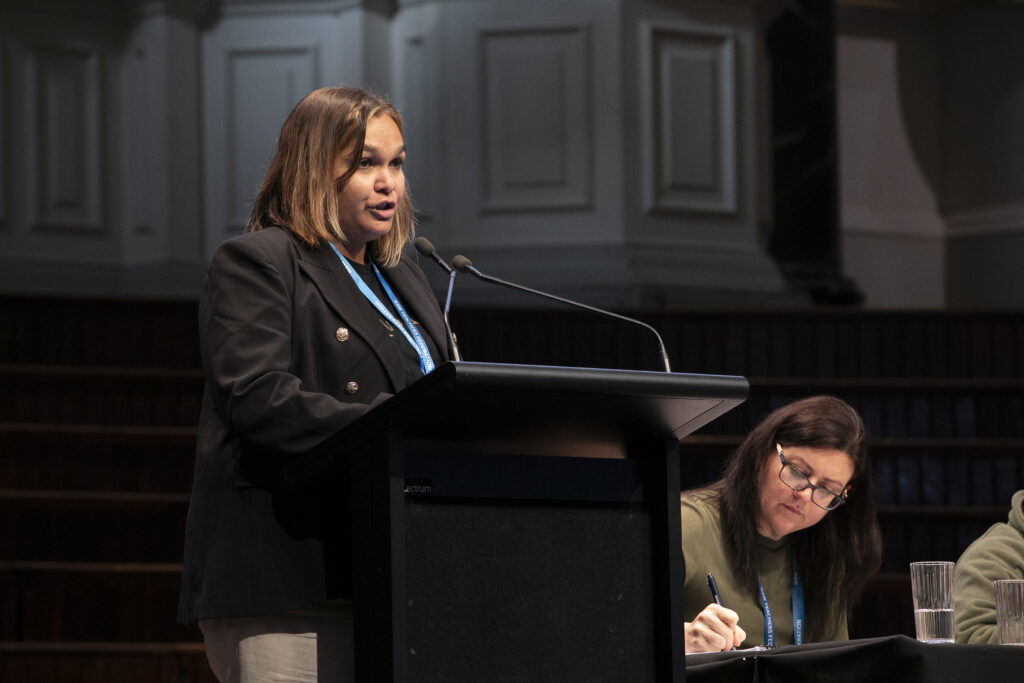
“Federation is committed to ensuring culturally safe workplaces,” the opening of the union’s new Aboriginal and Torres Strait Islander Education Policy states.
The policy lists a range of actions to be undertaken, related to community engagement, public preschool education, primary and secondary education, TAFE, Corrective Services.
The policy states: “Federation is committed to achieving social justice and human rights for Aboriginal People and Torres Strait Islander People, creating a public education learning environment founded on the active support of its membership. Federation will foster connections with our public preschools, schools, and TAFE colleges to ensure we deliver and achieve culturally respectful outcomes that empower teachers to share the stories of Aboriginal People and Torres Strait Islander People to all students in NSW early childhood, public schools, and TAFE Colleges.”
A Statement of Principles and Strategic Plan are included in the five page policy.
Aboriginal Education Coordinator Russell Honnery said the new policy was developed over four years, working with the Aboriginal Education Committee and the Aboriginal Executive Member. The policy was also discussed with the Aboriginal Members Committee, Aboriginal and Torres Strait Islander Councillors and Federation Executive.
The policy’s new name reflects the changing workforce, since the Aboriginal Education Policy was first written in 1980.
The policy acknowledges the Australian Education Union’s (AEU) recommendations from the Jumbunna Institute of Indigenous Education and Research’s report Making our words and actions meet: Understanding the experiences of Indigenous educators in the workforce, based on the 10 Gari Yala truths:
- Commit to unearthing and acting on workplace truths, however uncomfortable this might be.
- Ensure any Aboriginal and Torres Strait Islander-related work is Indigenous led and informed.
- Develop organisational principles to make it clear how Indigenous community engagement and employment should work in practice.
- Focus on workplace readiness (cultural safety) rather than worker readiness.
- Recognise identity strain and educate non-Indigenous staff about how to interact with their Indigenous colleagues in ways that reduce this.
- Recognise and remunerate cultural load as part of an employee’s workload.
- Consult with Indigenous staff on how to minimise cultural load while maintaining organisational activity.
- Focus on sustainable careers and career development, rather than just short-term appointments.
- Take action to address workplace racism.
- Look to high-impact initiatives; those that research shows are linked to better wellbeing and retention for Indigenous staff.
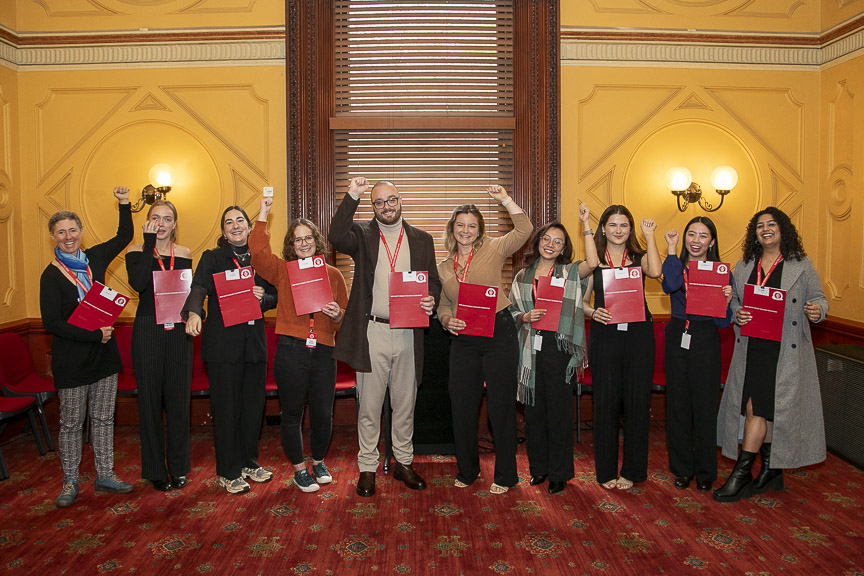
Federation awarded $4,000 Future Teacher Scholarships to students enrolled in NESA-accredited initial teacher education programs in NSW at Annual Conference today.
The scholarship program supports the next generation of activists and highlights Federation’s ongoing commitment to the teaching profession in public schools.
The 14 scholarship recipients were best able to demonstrate, in their applications, their understanding of, and commitment to, the value of public education and the positive difference unions make to society.
They can use the funds from their scholarship to assist with educational expenses directly related to teacher training, such as a laptop, textbooks, computer software and stationery.
Below we introduce the scholarship winners and reproduce an excerpt from their successful application.
Open category
Amelia Booth-Barker
Bachelor of Education (Primary), Southern Cross University
Both longstanding members of the NSW Teacher’s Federation, my father and grandmother have shaped my understanding of the way in which unions represent and protect teachers working conditions to ensure that the challenging profession is sustainable.
Anna Gonzalez
Bachelor of Education (Secondary Education: Science) / Bachelor of Science (Chemistry), University of Sydney
I feel so deeply proud of who I come from and grateful for this education system; dedicating my career to keeping it alive and thriving makes me excited for the future.
Sarah Mifsud
Bachelor of Education (Secondary) / Bachelor of Arts (Humanities), Australian Catholic University
Just as my teachers invested in my success, I am committed to nurturing the next generation of learners, instilling in them the same sense of resilience, determination, and compassion that defined my own educational journey.
Benjamin Nguyen
Bachelor of Science and Bachelor of Education (Secondary: Mathematics), University of Sydney
My involvement in the University of Sydney’s student union through my role as a general executive in the Education and Social Work Society … has deepened my understanding of the power of collective action in driving positive change.
Emily Long
Bachelor of Education (Primary) / Bachelor of Arts (Early Childhood Teacher), Macquarie University
If public education advocates for the rights of all children, then unions advocate for the rights of those children when they enter the workforce.
John Kaye Memorial Scholarship recipient
Birgitte Lund
Master of Teaching (Primary), Charles Sturt University
I am excited to embed sustainability, the environment and social justice in my teaching practice. I see primary teaching as an amazing opportunity to mould children to value these also and will endeavour to develop my students’ critical thinking skills, so that they are able to question, compare and analyse… I will ensure students make the connections between theoretical reasons for caring for our environment and practical actions that they can take to achieve this.
Culturally and linguistically diverse category
Bhatia Shagun
Master of Teaching (Secondary), Western Sydney University
It’s critical to use culturally responsive teaching strategies that acknowledge and take into account students’ varied cultural backgrounds, languages, and life experiences.
Hanako Yamada
Bachelor of Education (Primary), University of Newcastle
Through my own journey as a migrant and as a parent raising children with diverse backgrounds in Australia, I have developed a deep sense of empathy and understanding towards the challenges faced by individuals and families.
Rural/remote category
Isabella Clements
Bachelor of Education K-12 Teaching, University of New England
I have always held the public system of education in high regard. I quickly learned the upfront cost [of the private system] does not directly reflect the outcome of learning as I saw time and time again my own public school go far in academic and athletic competition.
First year student’s category
Eleanor McLeod
Bachelor of Education (Primary), University of Sydney
… now, when there is a strong need for more teachers, I understand that incentivising new teachers is only part of the solution, and that supporting experienced teachers should also be prioritised.
Claire Wood
Bachelor of Education (Primary), University of Newcastle
During my time as student, I have seen the disparities between public and private schools, and I believe that it is just not good enough. Public schools need proper funding. The opportunities available to students at school should not be determined by the school they can afford to attend.
Vuong Khanh Linh Ngo
Bachelor of Educational Studies, Charles Sturt University
Public schools are the great equaliser, providing children of all backgrounds with the opportunity to learn, grow, and reach their full potential…Public schools are engines of social mobility. Of course, providing this transformative educational experience requires an entire ecosystem of support — from committed teachers and staff to adequate school funding, to up-to-date resources and classroom technology.
Josh Gonzales
Master of Education (Secondary), Charles Sturt University
I am eager to continue contributing to the advancement of public education and the rights of educators through active participation in the NSW Teachers Federation. By collaborating with inspiring teachers, advocating for positive change, and promoting a culture of continuous improvement, I am confident that we can build a brighter future for generations to come.
Quinn Ritchie
Master of Teaching (Secondary) STEM, Western Sydney University
I have always been a firm believer in public amenity over private ownership…Public schools are so much more than a place for young people to learn — they are the heart of communities. The public education model is unique in its commitment to providing equitable access to education and fostering safe environments for open discussion, critical thought and lack of agenda or bias.
Students are welcome to join
University students studying teacher education in NSW can join Federation as Future Teacher members; fees are waived until members begin working in the NSW public education system.
Eligible students can join here
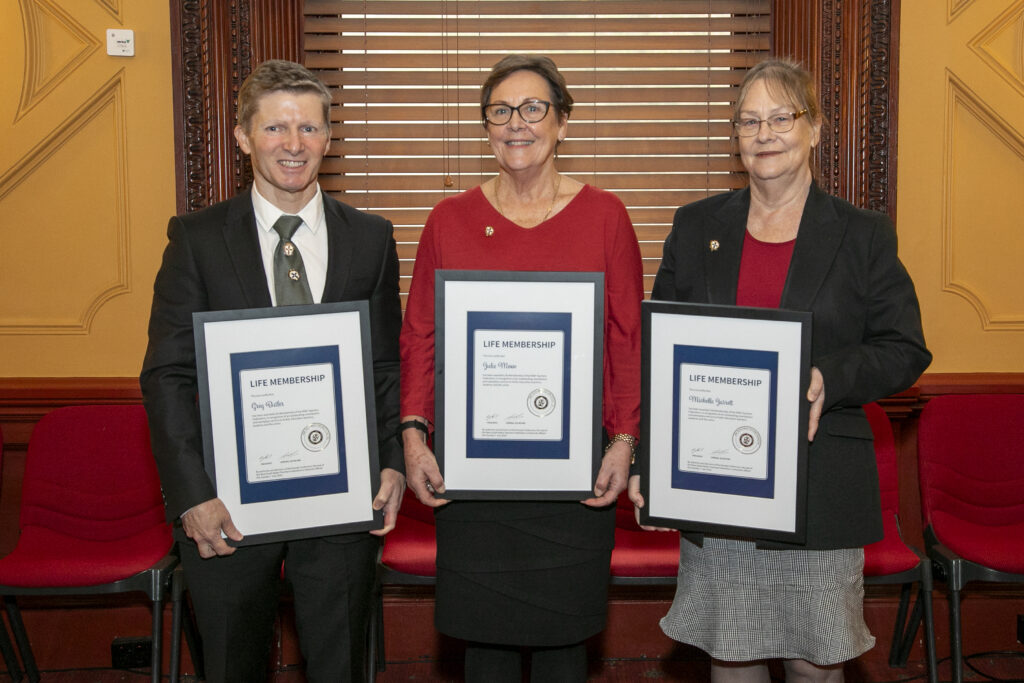
Three outstanding teachers were honoured for their service to the union, support for fellow members, commitment to public education and dedication to students in a ceremony at today’s Annual Conference (7 July).
Greg Butler, Michelle Jarrett and Julie Moon were bestowed Federation Life Members and presented with a Life Member badge and certificate by Federation President Henry Rajendra.
All three have made significant contributions in Federation school, association and statewide roles over several decades. Their ongoing, unwavering efforts have resulted in tangible benefits for members.
Greg’s legal knowledge and advocacy skills have delivered positive outcomes for teachers in industrial commissions, while his negotiation skills have secured improved pay and conditions over and again.
Michelle’s dynamic leadership skills have seen her organise and convene stopwork and strike meetings in the Lake Macquarie region since the 1990s, while her empathy and advocacy skills helped support colleagues daily.
Julie’s campaigning skills have been a major asset to Federation since the 1970s, while her commitment to mentoring women officers and standing up for casual and temporary teachers has been tireless.
Julie, Michelle and Greg have consistently gone above and beyond, doing whatever it takes to make a difference for teachers and public education. The anecdotes below are one of many stories each of our new Life Members can tell from their illustrious activist careers.
- Julie and her colleague Ted Kenny went to the Helensburgh home of the then Labor minister for youth and community services, Rex ‘Buckets’ Jackson, back in 1981. The minister greeted Julie and Ted at the door and ushered them into his loungeroom for an impromptu meeting, which was conducted while Mr Jackson was still in his pyjamas and dressing gown.
- Michelle travelled to Canberra twice to lobby federal politicians on education matters prior to the 2007 election. At the time, her local region, Lake Macquarie, was a declared natural disaster zone due to the storm which stranded an enormous ship, the Pasha Bulker, off the coast. Michelle’s own house was flooded.
- Greg joined Federation and attended his first campaign event not long after his teaching career began, at Miller High School in 1987. Around that time, the Greiner Metherell was planning to abolish staffing concession under the Disadvantaged Schools Program. Greg started to believe in a direct relationship between great teaching and teacher-activism there and then and has epitomised the belief ever since.
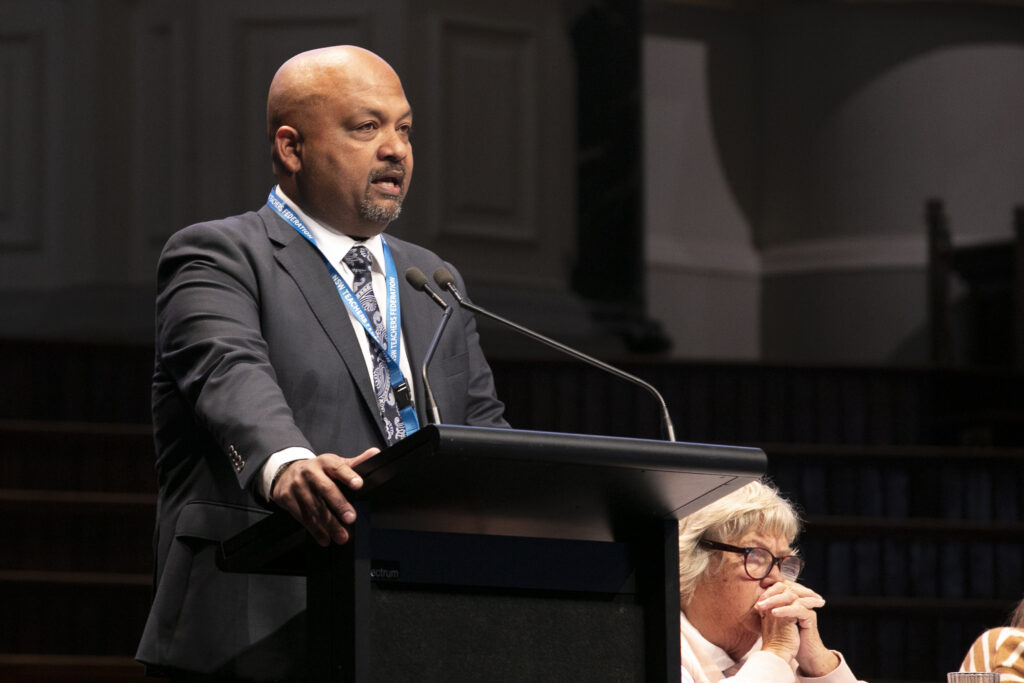
“Rebuilding our public education system will require vision, courage and concerted effort. Federation stands ready to lead this vital work to secure a strong future for the system, our students and teachers,” Federation’s Annual Conference declared today (Sunday).
The Conference decision For Every Child: Fully fund and rebuild the NSW public school system states rebuilding the system means:
- closing funding gaps to ensure all public schools are fully funded
- protecting and expanding permanent staffing entitlements
- re-establishing effective, centrally coordinated programs and systemic support
- addressing the teacher shortage crisis.
Reversing and dismantling the effects of Local Schools, Local Decisions
Conference stated the dismantling of Local Schools, Local Decisions (LSLD) and the rebuilding of a strong, centralised public education system must be an urgent priority of the NSW Government and its Department.
Urgent need for centralised system
Federation President Henry Rajendra said dismantling of the Local Schools, Local Decisions policy and rebuilding of a strong, centralised public education system must be an urgent priority of the NSW Government and Department of Education.
In seconding the motion, Executive member Michael Sciffer outlined the urgent need for in-built relief to be used as a mechanism to address the disruption to learning created by a shortage of casual teachers.
Governments must prioritise spending on public education
Since the recommendations of the original Gonski Review report on schools funding in 2011, Federation has been campaigning for the full funding of public schools.
The union continues to pressure the federal and NSW governments to reach agreement to fund all public schools to 100 per cent of the Schooling Resource Standard (SRS), the benchmark required for students to succeed at school. NSW public schools face a recurrent funding gap of $1.9 billion just this year alone.
Federation is also calling for the removal of the funding loophole created by the Morrison government, which allows the artificial inflation of the NSW government funding share of the SRS, by including costs not directly related to the learning needs of students such as capital depreciation and regulatory costs. For NSW public schools in 2023 this loophole equated to $640 million being included in the state’s overall SRS share, thereby depriving the system of $640 million in additional funding directly linked to student learning.
The costs of underfunding
Mr Rajendra called out the almost $10 billion capital infrastructure divide that exists between NSW public and private schools, noting that 12 per cent of all public school classrooms in the state are demountables.
“There is currently no ongoing commitment from the Albanese Government to fund years of successive government underinvestment,” he said.
Mr Rajendra said the NSW results of the Australian Education Union’s State of Our Schools survey of almost 7000 NSW school teachers earlier this year, highlighted the dire consequences of underfunding:
- workload
- teacher shortages
- decline in student wellbeing and engagement
- decline in teacher wellbeing and morale.