
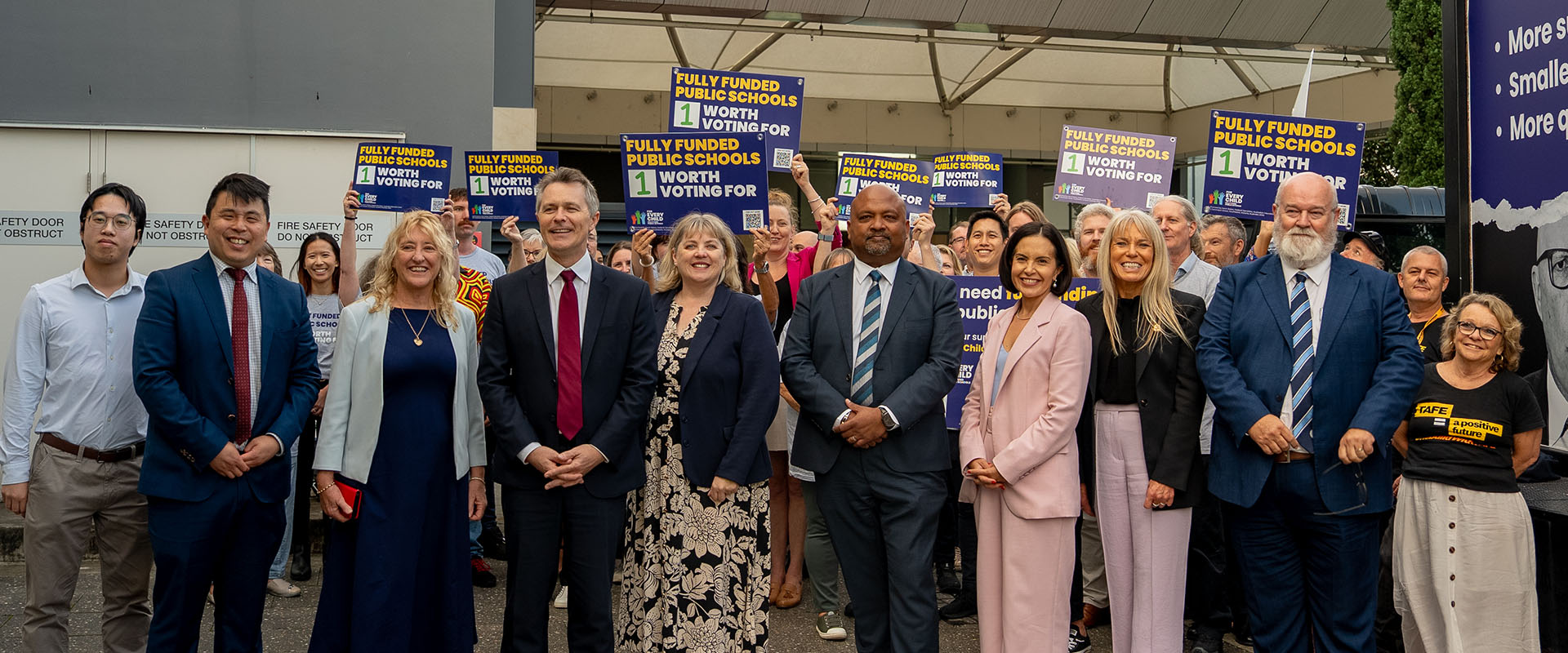
The election of a Dutton government puts at risk a new plan to fully resource public schools and the future direction of teaching and learning, voters heard at Federation’s Western Sydney Education Forum last night (10 April).
Coalition has poor track record on public schools
Federation President Henry Rajendra highlighted that the last time the Liberals/Nationals were elected, they put a stop to a six-year trajectory to lift all public schools to 100 per cent of the Schooling Resource Standard, the minimum standard agreed to by governments to meet the learning needs of students.
He reminded the crowd that ahead of the 2013 federal election, then-opposition leader Tony Abbott promised to honour the Gonski agreements but cut $30 billion in Gonski funding in his first Budget as prime minister.
A new opportunity for full funding
Earlier this year, Prime Minister Anthony Albanese and NSW Premier Chris Minns signed a new 10-year deal to fully fund public schools.
The agreement increases the Federal Government’s contribution to the Schooling Resource Standard from 20 to 25 percent, bringing public schools to 100 percent of the SRS when combined with the state contribution.
The deal also ends accounting tricks introduced under previous governments that allowed states to artificially inflate their contributions by counting depreciation costs.
Election result critical to ensuring schools finally fully funded
But speakers were insistent that despite the signed agreements between the Commonwealth, states and territories, public education advocates need to continue campaigning.
Moment to double our efforts
NSW Federation of Parents and Citizens Vice President and board representative for south-west Sydney Hema Fifita said: “We’re not here tonight to just pat each other on the back. This agreement is a breakthrough, yes, but it is also a beginning. Funding commitments still need to be delivered, embedded, and defended. The reality is that until dollars hit classrooms, until schools can plan with confidence, until there is stability for principals, teachers and students, we are not done.”
“This is a moment to double down, not let up, because the last time full funding was promised, under Gonski, an entire generation of students missed out. The goalposts moved. The political winds changed. And the opportunity was lost. We cannot let that happen again,” she said.
Deny Dutton the prime ministership
Mr Rajendra said only denying Peter Dutton the prime ministership would ensure that full funding was finally delivered to all our public schools.
NSW Deputy Premier and Minister for Education and Early Learning the Hon. Prue Car MP described the federal election as “the one more significant hurdle to get through” to ensure the new public school funding agreements between the Commonwealth, states and territories are realised.
“I feel we’re almost at the point where we could celebrate, but not quite yet, because if the Labor Government loses the election…the alternative is really, really bad. The alternative is a disaster for public education,” she said.
Federal Education Minister the Hon. Jason Clare MP said we had to “fight to keep” the school funding deals at the federal election. “You know that Labor builds and you know that Liberals cut,” he warned.
Australian Education Union Federal President Correna Haythorpe said: “In three weeks’ time…I don’t want to be in a situation — I know you don’t want to be either — where we are dealing with the destruction not only of a federal education department but a government that says teachers indoctrinate, they don’t educate.”
She raised Peter Dutton’s “pretty extraordinary comments” of the past few weeks, signalling what’s ahead if a Dutton government is elected.
Peter Dutton told Sky News (31 March:) “People ask… Why have you got a department of thousands and thousands of people at a department called the Department of Education in Canberra if you don’t run a school?” He has also flagged “conditions on our funding” to state governments for education if schools teach what he terms “indoctrination”.
Dutton’s narrative is damaging to the teaching profession
Ms Haythorpe said: “What I’m really concerned about is this narrative is damaging to the teaching profession — the narrative that says to the community, it’s okay to disrespect the teachers that are turning up every single day and giving 100 per cent for our kids on the ground…that is not okay, because we need respect and we need political leaders who understand how important that job is…and that’s what we’re fighting for.”
Dutton is using Trump’s playbook
“If you want to know more about this in terms of where [Peter Dutton’s] getting his lines from then… see a video that we’ve put together, which shows that the Dutton playbook is straight out of the Trump playbook,” Ms Haythorpe said.
Conversations with friends, family and colleagues critical
She said every conversation we have right now about voting to ensure fully funded public schools was “just so critical” to the election result and the future of public education funding.
“We managed to keep [our campaign for full funding for public schools] alive for the 13 years since the Gonski review was handed down, and because we’ve kept it alive, we are now in a position where we will see that funding rolling out in our schools, as long as we protect it over these next few weeks.”
Mr Rajendra emphasised the need to talk to “everybody”, including workplace colleagues.
“We can’t take it for granted that everyone is on top of the issues,” he said.
“We’ve got two weeks of a break coming up where we will have more opportunities to speak with family and friends and have that conversation about prioritising public education,” he also said.
You might find the For Every Child website’s blog helpful if you’re looking for talking points.
Election result will determine TAFE’s fate too
Mr Rajendra reminded the audience that Federation was also campaigning at this election to protect the gains that have been made for TAFE: fee-free courses, considerable funding commitments, the eradication of the curse of precarious employment and reprioritising of TAFE as the preeminent deliverer of vocational education.
Read more about what’s at risk on the Rebuild With TAFE website.