

President’s address and year in review kick off Annual Conference 2025
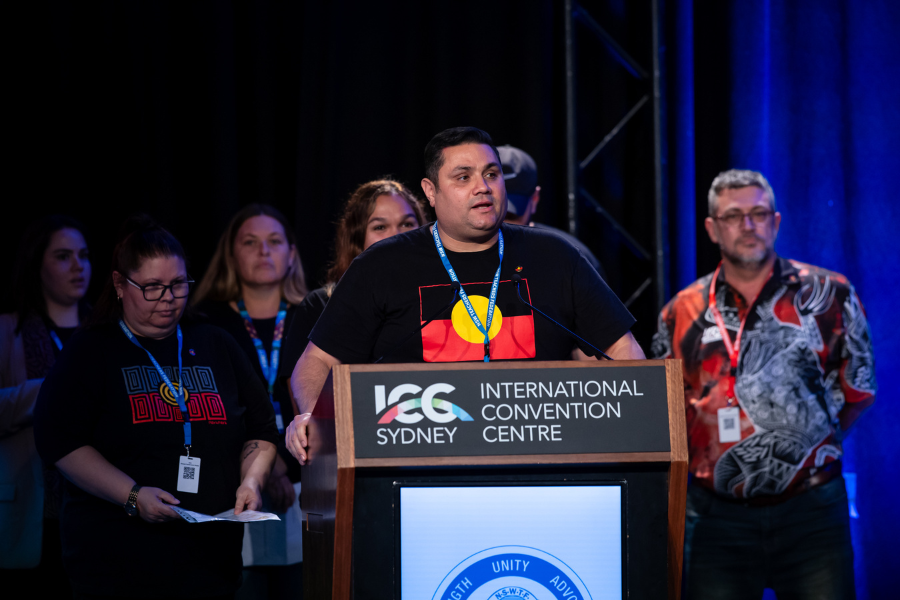
Federation’s three-day Annual Conference began in the International Conference Centre at Darling Harbour this afternoon, including a celebration of the work and achievements of the past 12 months.
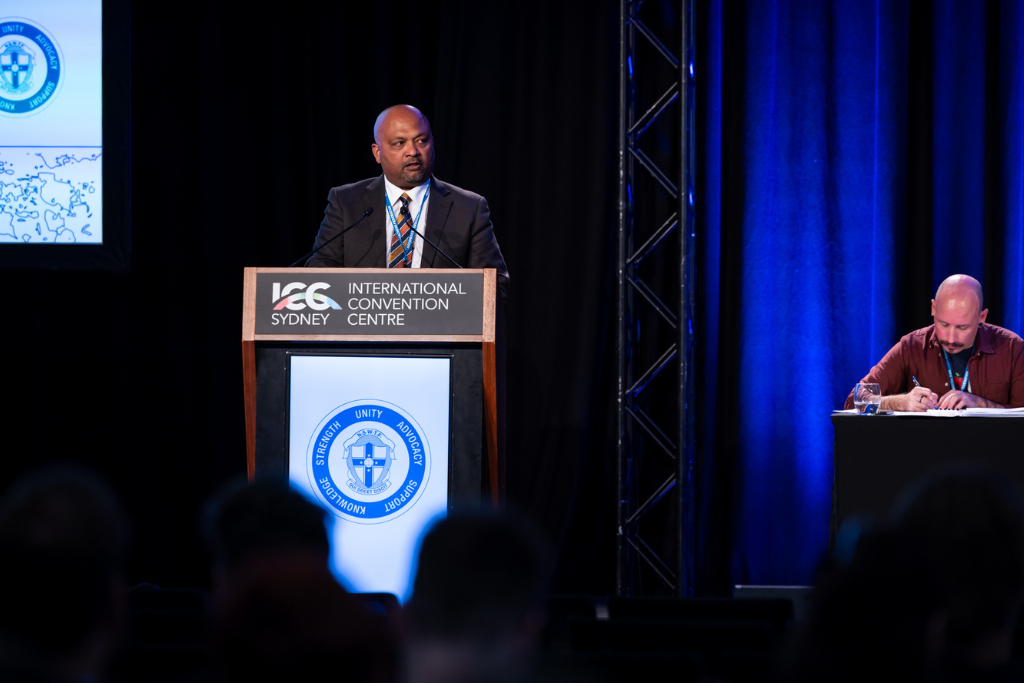
President Henry Rajendra’s speech, the annual report and a video acknowledged:
- keeping the Coalition out of power at the May federal election
- the Albanese Government’s commitment to lifting federal funding from 20 to 25 per cent of the Schooling Resource Standard. “Through the efforts of our union…we got both [state and federal] governments to agree to something that was never on the table this time last year,” Mr Rajendra said. “Not only did we convince the Albanese Government to increase their [proposed SRS funding contribution increase] from 2.5 to 5 per cent, but [also] dealt with the NSW Government’s… artificial accounting tricks.”
- the reversal of privatisation of vocational education policy
- the removal of TAFE NSW from the contestable vocational education and training (VET) funding market
- an additional 100,000 free TAFE places each year until 2027
- a three-year schools Award including:
- competitive salaries
- additional school development days
- an end to twilight professional learning sessions
- a one-hour cap on total meeting time before and/or after school per week
- new flexible work arrangements for family, work and care responsibilities
- enhancements to family and domestic violence leave
- an additional entitlement for special fertility leave
- the right to disconnect from digital communications. “The significant improvements are necessary to support and retain the teachers in our system, allowing a better balance of their family, work and care responsibilities,” Mr Rajendra said.
- A three-year TAFE Enterprise Agreement including cumulative pay rises of 9.8 per cent by February 2027 and better conditions for casuals, including a guaranteed offer of permanent employment after six months.
New Federation Life Members
Federation stalwarts have been honoured with Life Membership of the union today.
President Henry Rajendra presented Michael Hepi, Robert Long and Mary Schmidt with a Life Member badge and certificate.
Over the decades they have been great supports to members and the union’s campaigns.
Michael Hepi
As a principal member of Federation, not only has Michael prided himself on ensuring his school would be non-operational during any industrial action, he has been instrumental in supporting other schools to achieve the same level of participation.
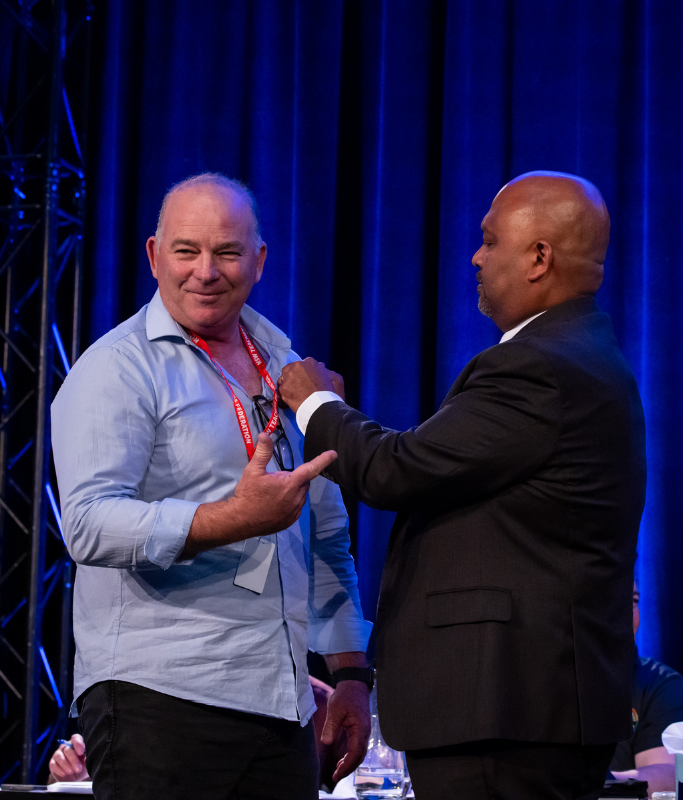
“I always found pleasure in dangling the school keys in front of all staff and stating: ‘If you’re coming to school, the keys are all yours’,” he said.
“Needless to say, industrial action attendance was always maximised.”
As a member of Federation’s Small Schools Restricted Committee he helped update the relevant staffing policy.
Michael has sat on various combined unions committees, in particular during the Your Rights at Work campaign.
He served as long-serving president of Coffs Harbour Teachers Association, as a Federation Councillor and member of Federation Executive.
Reflecting his desire to help the union to continually engage with the next generation of teachers, Michael has presented at various Trade Union Training courses and conferences, including Foundations for Workplace Representatives courses and Beginning Teacher and Principals’ conferences.
“Delegates: evolve we must,” Michael said. “Reflective of our diverse membership, with our core values and principles front and centre, and in solidarity will we thrive into the future.”
Robert Long
Through roles as a Fed Rep, TAFE TA Councillor, TAFE Teachers Association Assistant Secretary, TAFE Teachers Association President and ultimately as a TAFE Organiser, Rob has brought a unique combination of steel and heart to everything he has done. Whether chairing meetings, negotiating with management or standing on picket lines, Rob has been calm under pressure and utterly reliable.
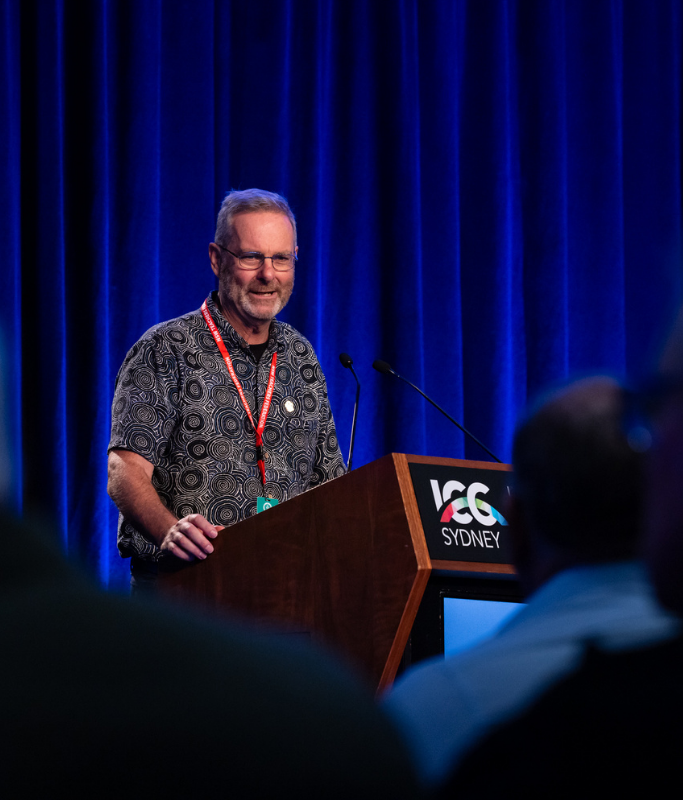
“My first Conference was in 2002 — 23 years ago,” Rob told Annual Conference. “If this is your first Conference, welcome — and buckle up for a great ride by 2048.”
Rob’s commitment has made workplaces safer, fairer and stronger.
He represented Federation at the Australian Education Union, Unions NSW, Hunter Workers, Goulburn Labour Council and South Coast Labour Council. His work also extended into broader campaigns such as fighting wage theft, defending green spaces and demanding climate action.
Rob’s impact isn’t just measured by the campaigns he has fought but by the people he has inspired to carry the torch forward.
Rob has shown all of us what true unionism looks like — not just in big campaigns, but in the quiet, consistent acts of solidarity that truly build a movement.
In his trademark colourful style, Rob had some words of advice for younger delegates – “work hard, play hard”.
“Somehow, you’ll have fun,” Rob said.
“Solidarity forever.”
Mary Schmidt
Speaking to Annual Conference upon accepting her Life Membership, Mary showed delegates a copy of Federation’s old, printed catalogue, which teachers “could purchase from the counter for two shillings”.
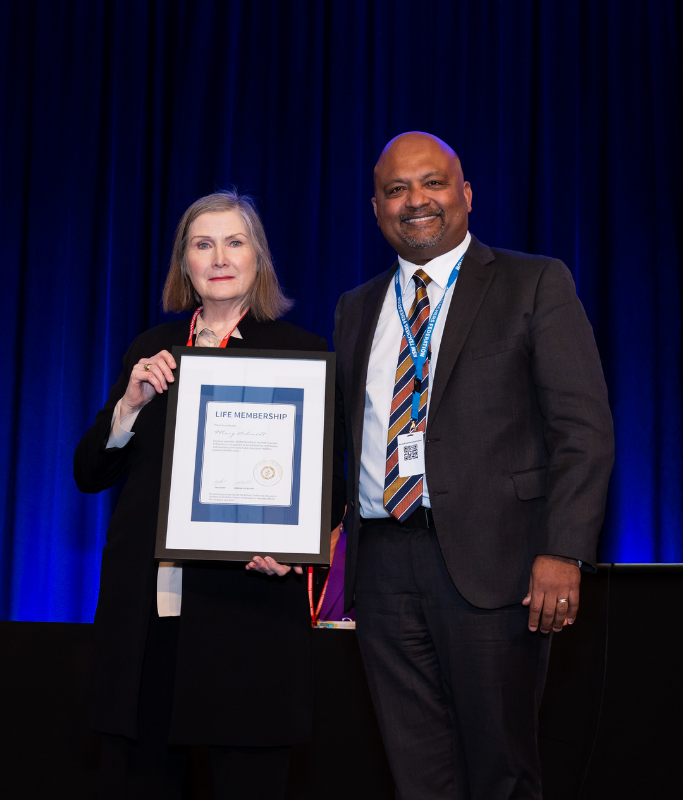
Since Mary commenced work as Federation’s librarian in 1975, she has developed the library to support the industrial and campaigning work of the union, the professional learning and recruitment of members and acted as a keeper of Federation’s unique cultural and heritage artefacts.
Mary told the room how she applied for the librarian position in 1974, when Sydney Morning Herald job ads were still divided into ‘Men and Boys’, ‘Girls and Women’ and ‘General’ sections.
“The librarian position at Federation was advertised in the ‘General’ section,” she told the room. “I took this as a sign the organisation was non-sexist and did not have a preference for a male or a female applicant. I found this encouraging.”
Her employment has not been without controversy. In 1982, she was named in NSW Parliament by Fed Nile MLC, for making copies of the book Young, Gay and Proud — which the NSW Department of Education had banned from distribution to students — available to Federation members.
The famous 1988 rally in opposition to the policies of the Greiner government, the enormous collection of historical artefacts the library has accumulated and maintained, and the library’s work supporting successive Aboriginal Education Officers and Women’s Officers were among the highlights Mary nominated from the past 50 years.
“Thank you for this great honour,” Mary told delegates. “It means a lot to me.”
Linda Burney joins Champions of Public Education honour roll
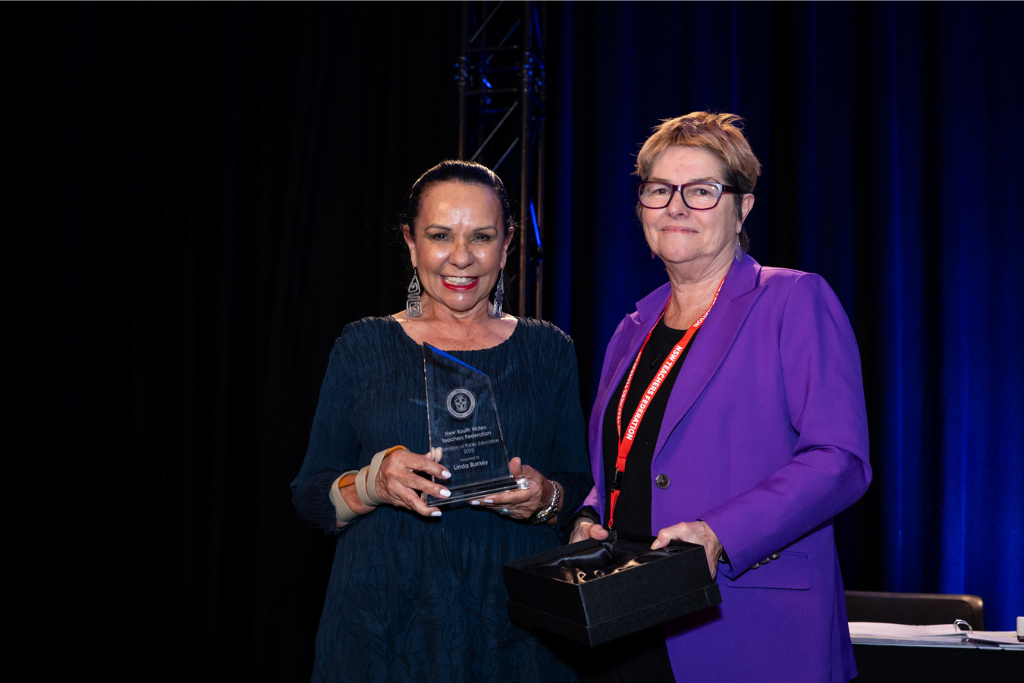
Annual Conference has recognised Linda Burney — who played a pivotal role in the development and implementation of the first Aboriginal education policy in Australia for the NSW Education Department in 1982 — as a Champion of Public Education.
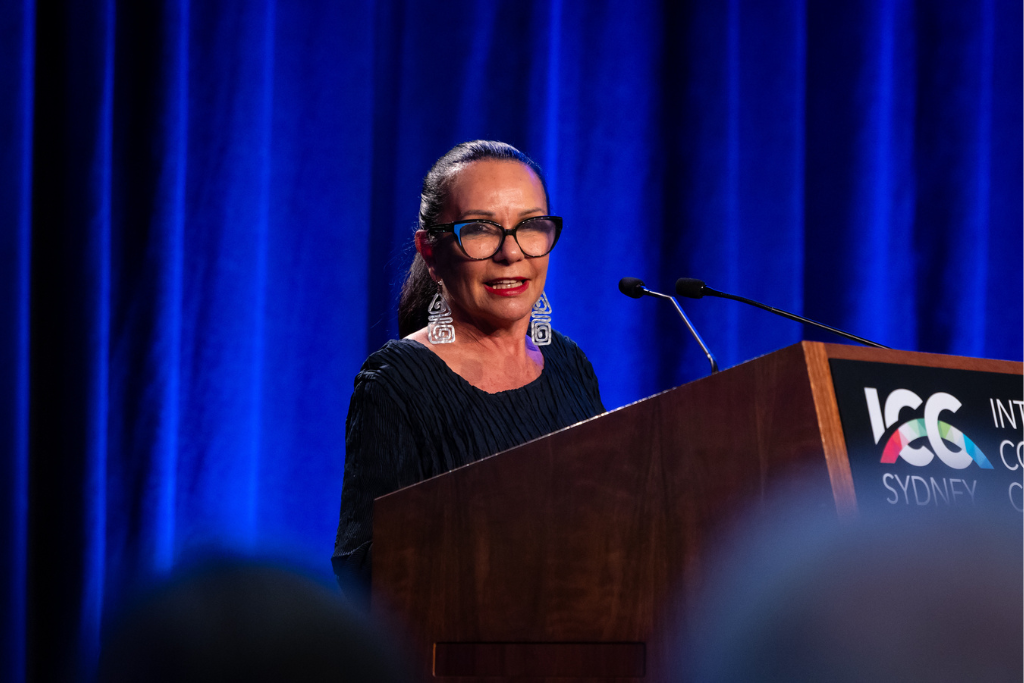
In 1978, Ms Burney was one of the first Aboriginal students to graduate from Mitchell College of Advanced Education (now known as Charles Sturt University) with a teaching degree. She joined Federation when she began teaching at Lethbridge Park Public School in 1979.
From 1981 to 1983 Ms Burney worked in the Aboriginal Education Unit (Policy) of the NSW Department of Education and was executive officer of the NSW Aboriginal Education Consultative Group (AECG) from 1983 to 1987.
Ms Burney served as president of the NSW AECG from 1988 to 1998. In the early 1990s, she was both the president of the national Body of AECG Chiefs and chair of the NSW National Aboriginal and Torres Strait Islander Education Policy Coordinating Committee.
At the NSW Department of Aboriginal Affairs, Ms Burney was the deputy director-general from 1998 to 1999 and director-general from 2000 to 2003.
In 2003 Ms Burney became the first Aboriginal person to be elected to NSW Parliament. She was also the first Aboriginal woman elected to the federal House of Representatives and the first Aboriginal person to serve as the federal Minister for Indigenous Australians.
Her valedictory speech to federal Parliament in August 2024 showcased her ongoing concern for the educational opportunities and social justice for Aboriginal and Torres Strait Islander peoples. “Despite significant improvements in many areas, First Nations young people still don’t start on a level playing field. Our people are more likely to have experienced homelessness than to hold an undergraduate degree,” she said.
Scholarships awarded to initial teacher education students
One way Federation supports the next generation of teachers is through our Future Teachers Scholarship program.
Today, $4000 scholarships were presented to the 2025 recipients, who may use the funds to assist with expenses directly related to their NESA-accredited initial teacher education such as a laptop, textbooks, computer software and stationery.
All applicants — student members of the union — were required to demonstrate their understanding of the value of public education and unions to our society, as well as their commitment to public education and unions.
Scholarships were only awarded to applications of a very high standard that addressed all criteria. Federation is proud to announce the 2025 recipients across a number of categories and share an extract from each of their supporting statements.
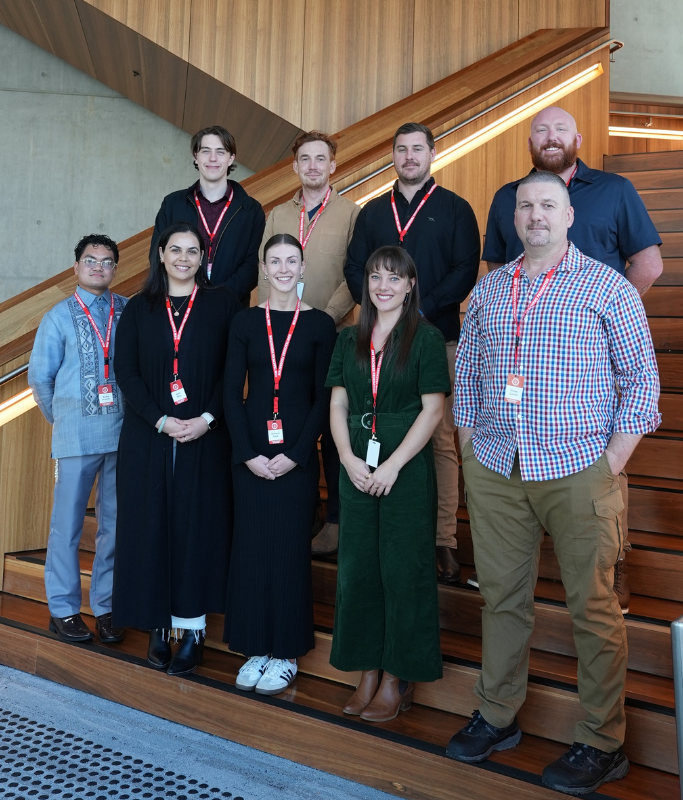
Aboriginal and Torres Strait Islander
Mali Kelly, Bachelor of Education (Primary), Western Sydney University
“As a proud Barkindji and Ngiyampaa woman raised in a small Aboriginal community and educated within the public school system, I have developed a deep appreciation for the role of public education in creating equal opportunities for all.”
Culturally and linguistically diverse
Andre Amorin, Bachelor of Education (K-12 Teaching), University of New England
“I have seen how ESL classes at my local public school help recent immigrants gain confidence in their English skills and access better job opportunities. This reinforces my belief that public education is about more than knowledge — it builds bridges between cultures and creates pathways to a brighter future.”
Weylin Martens-Mullane, Bachelor of Education (Secondary), University of Sydney
“Having grown up interpreting for my parents and bridging communication between the Deaf and hearing worlds, I understand how critical it is that schools are inclusive and responsive to the diverse needs of their students.”
Rural and remote
Brittany Frost, Bachelor of Primary Education, University of Wollongong
“The school wasn’t just a place to learn, it was a hub for connection, stability and support. That’s the kind of environment I want to contribute to. I want to help bridge the opportunity gap by creating inclusive, engaging learning environments and advocating for the resources these students deserve.”
Open
Patrick Dunn, Master of Teaching (Secondary), Charles Sturt University
“I see teaching not just as a job, but as a way to support positive change in society. I want my students to feel heard, supported and confident to speak up about what matters to them.”
Kyle Arnott, Bachelor of Education (Secondary), Charles Sturt University
“My inspiration to pursue a career in secondary education stems greatly from…wanting to be a positive role model for those that do not feel that school is for them.”
Jeremy Belcher, Bachelor of Education (Secondary), Australian Catholic University (not present at the ceremony)
“Teaching within a custodial setting demands emotional resilience, adaptability and significant preparation, yet without strong union representation, the unique needs of educators in these roles might be overlooked.”
First year
Cameron Copeland, Master of Teaching (Secondary) at La Trobe University
“If a single student thinks, ‘Someone from here can do that,’ I hope the ripple will travel far beyond my classroom…to be the same catalyst my teachers were for me.”
Environmental and Social Justice (John Kaye Scholarship)
Jade Culbert, Master of Teaching (Primary) at La Trobe University
“Social justice does not always have to happen through grand gestures; it often happens through daily care, consistency and support. As a teacher, I intend to bring these values into my classroom, helping students become informed, compassionate citizens who understand their power to effect change.”
Not a member? Student membership of the union is free. Click here to join.
TAFE Teacher Scholarship awarded
Federation has presented Simon Curran, a member at Wetherill Park TAFE College, with Federation’s inaugural TAFE Teacher Scholarship.
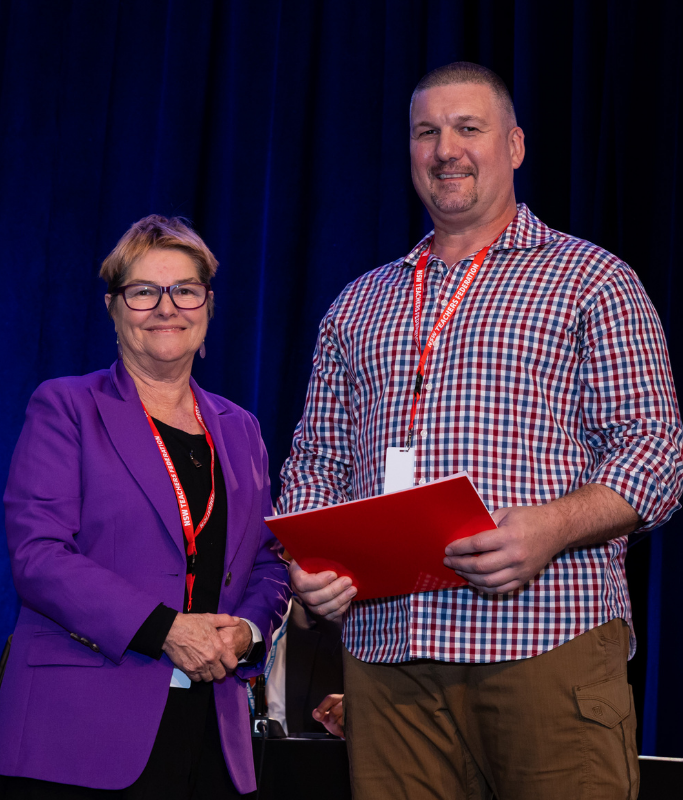
Federation established the $3000 scholarship in celebration of the contribution of NSW TAFE teachers and their commitment to public education and the union.
“In my opinion union membership is a statement of intent to collaborate with like-minded colleagues for the best outcomes… in terms of wages and working conditions, but also in terms of accountability and professional standards,” Simon wrote in his application.
“It is my ongoing goal to be the best TAFE teacher I can possibly become, hence my choice to engage in higher studies through CSU, and Federation membership is, in my opinion, an automatic component in that goal.”.
The scholarship was open to TAFE members holding a Certificate IV or a qualification in a specific trade area only, and who are enrolled in an accredited adult teacher education degree in NSW.
More needs to be done in the special education space
Direct and purposeful action is required to support the 28 per cent of NSW public school students diagnosed with a disability, Federation’s Disability Officer John Skene told Annual Conference delegates.
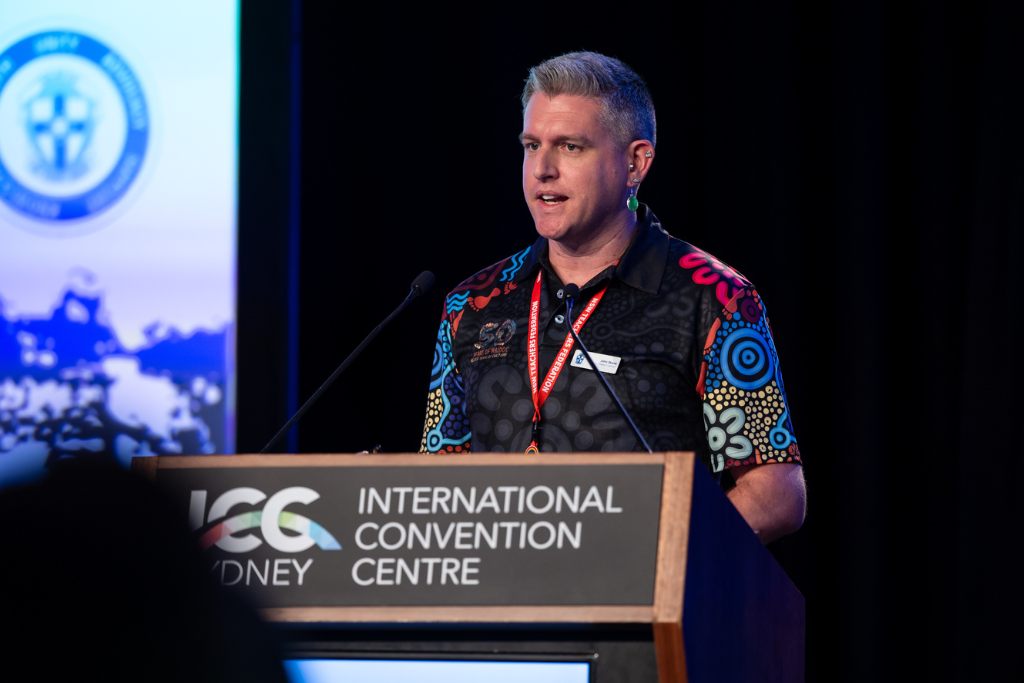
“In June 2018, Department analysis showed that only about 7 per cent — or around 6000 of NSW public school teachers — were approved to teach inclusive/special education classes and the number of new graduates each year was going down,” Mr Skene said. “In May 2023 this reduced to around 6 per cent (or about 5275). I can only imagine what the figure would be today.”
“Teachers with disabilities in the workforce is a new space for the Department. Some workplaces are doing well, others not so much,” he said. “We need to keep the Department accountable in supporting teachers with disabilities to have suitable, flexible and appropriate adjustments, ensuring measures are put in place effectively to allow teachers to feel supported and empowered in their work.”
Mr Skene said just 57 per cent of people with disability across the public sector reported positive wellbeing, according to the NSW People Matter Employee Survey, and the numbers are “substantially lower” within the Department of Education than the average.
“Work needs to be done here,” Mr Skene said. “People with disability report a high rate of bullying, with 24.4 per cent of respondents reporting they are experienced bullying in 2023. Again, we need to and can do better here.”
Focus areas
Mr Skene said some of the major items he has been working on to support Officers and members in their work include:
- updating and sourcing current and up-to-date policies and information
- creating resources
- submissions to parliamentary inquiries
- working with the Special Education Restricted Committee on policy updates and areas of need
- working with members across the state on the new Special Education Special Interest Group to network and uplift colleagues in specialist settings, ensuring that they know they are superstars and not alone.
Revamped seminar
“We have updated and revamped the Rethinking Ability: Organising for Intervention trade union training seminar, that’s available for Associations to apply for, to support the conversation around unmet need and disability matters in schools and assist members to build confidence and empower them to act,” Mr Skene said.
Look at a student with disability’s potential
“A change of culture and perspective is the work ahead of us — flipping the narrative to looking at an individual with disability’s potential, not as a deficit,” Mr Skene said. “Inclusion is a mindset, not a location.”
“In some Aboriginal languages, there is no word for ‘disability’. This reflects a belief system where difference is not seen as a deficit but simply part of the rich fabric of society,” he said.
“This worldview offers us a powerful lesson — one that we must take seriously in our classrooms, in our institutions and in our daily lives. Bridging the knowledge gap and embracing Aboriginal and Torres Strait Islander perspectives on inclusion should not be the exception; it should be the norm.”
A year of wins, challenges and opportunities for LGBTIQA+ teachers
Federation Deputy Secretary (Operations) and officer attached to LGBTIQA+ issues Mel Smith updated Annual Conference on wins for LGBTIQA+ people in Australia over the past year, rising threats to LGBTIQA+ people around the world and the union’s ongoing work in protecting and advancing LGBTIQA+ rights.
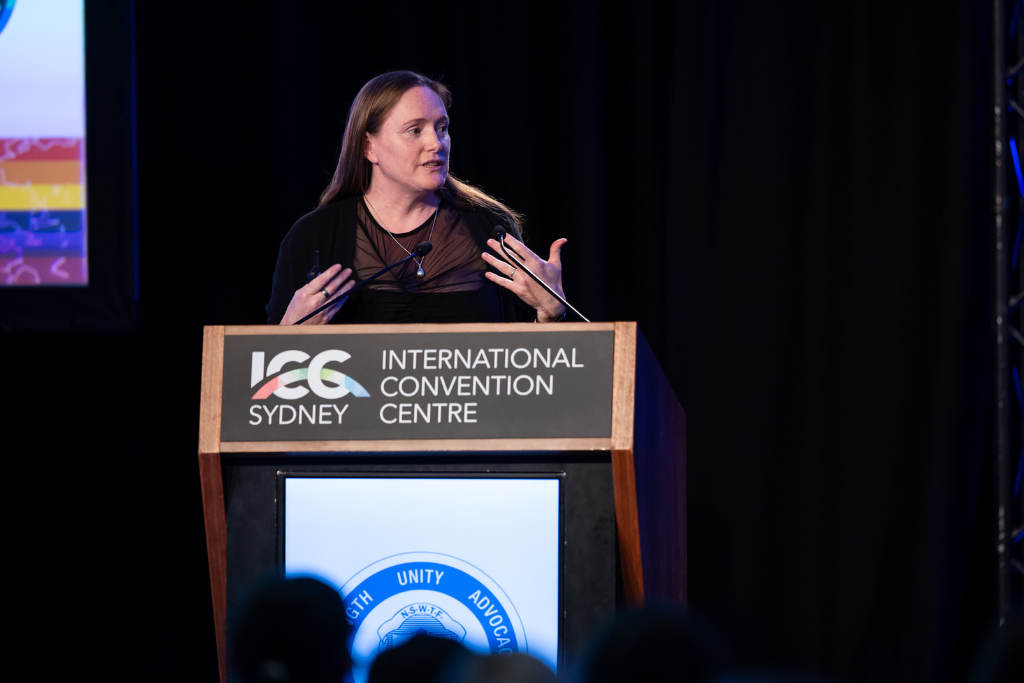
The NSW Department of Education’s new resources to support LGBTIQA+ students and staff in schools, the banning of gay conversion therapy in NSW and the addition of iconic LGBTIQA+ historic locales like Erskineville’s Imperial Hotel to the state heritage list and were some of the major recent victories Smith highlighted in her report to delegates on Sunday.
However, Ms Smith also noted areas of concern for the safety and wellbeing of LGBTIQA+ members. She drew attention to the NSW Public Service Commission’s annual People Matter Employee Survey, which found that non-binary people in the NSW public service were significantly more likely than average to report poor wellbeing at work.
Smith advised delegates that global teaching union confederation Education International decided not to encourage attendance at May’s WorldPride in Washington DC for international attendees, as “it’s not a very safe place to travel to at the moment if you’re a queer person”.
“Fascism is rising, and the hate and ostracism that people are feeling has increased,” Ms Smith said. “The impacts of laws that don’t recognise people who are transgender is really being felt in other countries and whether people feel safe travelling.”
Besides Federation’s ongoing work supporting local LGBTIQA+ Association Contacts, producing classroom resources for teachers looking to support their LGBTIQA+ students and celebrating milestones in the LGBTIQA+ calendar like IDAHOBIT Day and Sydney Gay and Lesbian Mardi Gras, Ms Smith directed delegates to the Australian Law Reform Commission’s review of the Anti-Discrimination Act as an opportunity to make a difference.
She encouraged delegates and members to complete the Commission’s community survey to defend anti-discrimination protections for LGBTIQA+ people, people with disability, people in de facto relationships and people who are pregnant.
“It would be great if our members gave feedback to the Commission about how intersex people, non-binary people, people who are breastfeeding deserve to be covered under the Anti-Discrimination Act,” Ms Smith said.
Finally, Ms Smith marked the sad passing in 2024 of Sphen, a penguin at SEA LIFE Sydney Aquarium whose long-term same-sex relationship with fellow penguin Magic became world-famous in 2018. Besides achieving international stardom as LGBTIQA+ icons, Sphen and Magic inspired the theme of Federation’s float in the 2021 Mardi Gras.
Federation later worked with SEALIFE on teaching resources (available in the Member Portal) based on the aquarium’s children’s book about the couple, Sphengic, A True Love is Love Story about Family.
Vale, Sphen.
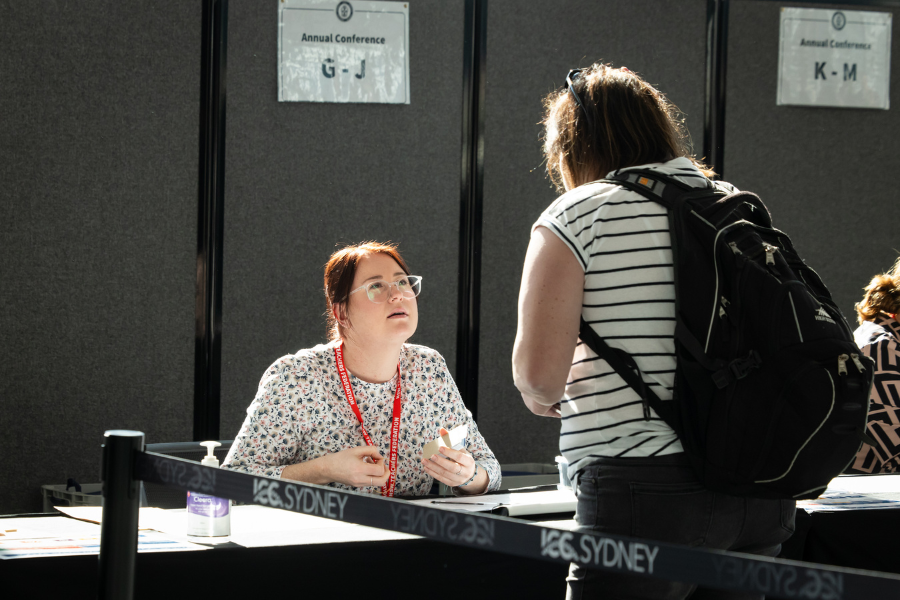
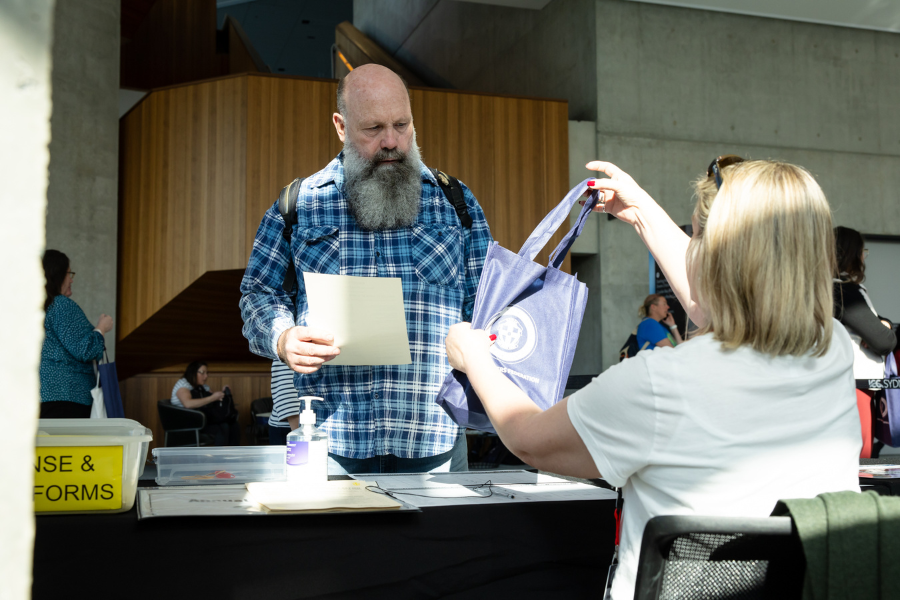
Annual Conference 2025, Day Two
Annual Conference 2025, Day Three