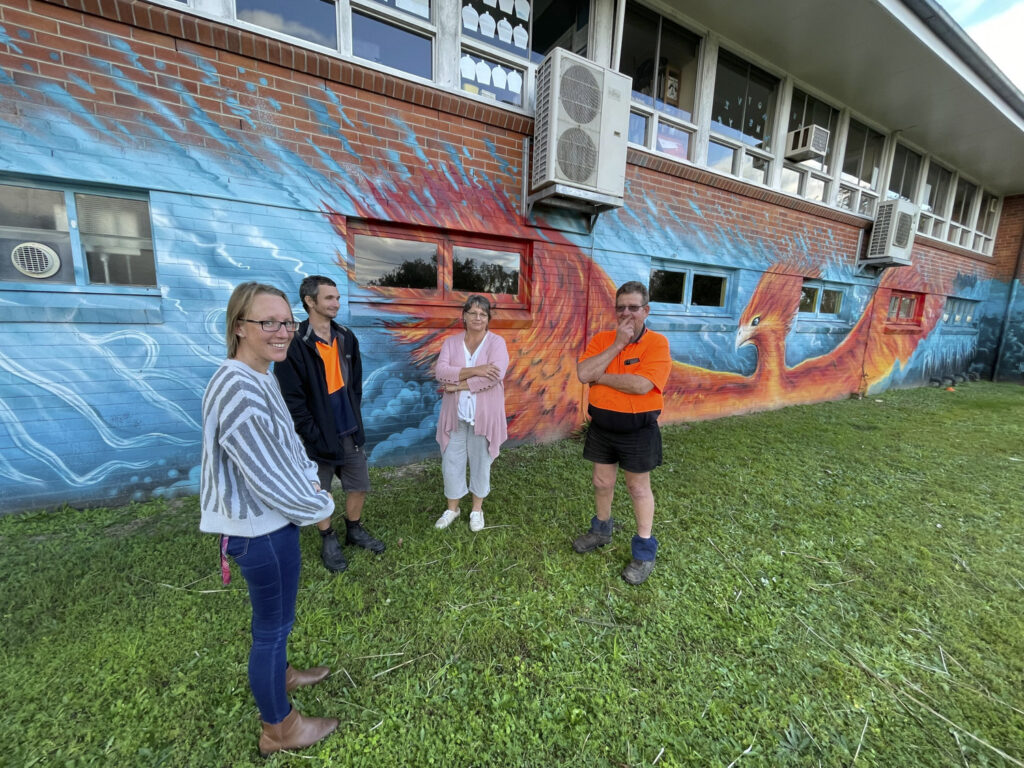
‘The phoenix was what was requested, because it was something that would signify us rebuilding; us rising from the ashes’
A golden phoenix spreads its wings across the front of Rappville Public School beneath the words “We will rise … from the ashes.” It speaks to the resilience of a small Northern NSW town and the important role the school plays in the community.
The striking mural, created by Byron Bay artist Nitsua, has become both a symbol of healing for the families of Rappville, population 142, and a splash of colour in a village left blackened by the Black Summer bushfires.
“We had actually planned a different design,” said teaching principal Kathleen Collis, explaining that a train locomotive reflecting Rappville’s timber town past was originally chosen.
“We had planned a mural to build engagement with our students and make the school more enticing for them, update it a bit.”
But in October 2019, an early wave of the Black Summer fires swept through the district, destroying 42 properties in the wider area, including homes belonging to students’ families. Farms, Braemar State Forest and pine plantations were reduced to a charred landscape.
“To add some colour, Austin [the artist known as Nitsua] offered to do a train on the railway building near the hotel, so then we thought we would come up with something different for the school,” Kathleen said.
“Through asking our students, the P&C and community members, the phoenix was what was requested, because it was something that would signify us rebuilding; us rising from the ashes.”
For Kathleen, recalling 8 October 2019 means remembering the day that turned to night as two fire fronts converged and raced toward Rappville, 25 minutes south of Casino on the Summerland Way.
Around 100 residents who chose to stay behind sought shelter at the school, bringing their animals with them. Goats took refuge in the boys’ toilets while family dogs were housed in the staff common room.
Those gathered stomped on embers and hosed down whatever they could.
“They were on extinguishers and hoses and did everything they could to put spot fires out and worked together to protect each other,” Kathleen said.
“The hard part was when the power got cut and the pumps didn’t work. That’s when the stress levels rise.”
P&C president Garry Marshall, a member of the local Rural Fire Service brigade, spent the night on the fire front.
“It was a bit of a blur, I didn’t know who was behind me,” he said. “I was just putting out spot fires, it was so indiscriminate.”
The fire and its aftermath were “bloody horrible”, according to Dave Newby, president of the community social club and a long-time supporter of the school.
He watched from the local timber mill, where workers were trying to save stacks of sawn lumber from spot fires, as homes burned against the horizon. The mill has since closed, with no usable pine remaining after the fire.
“I went and visited all of them [who lost homes] and it was so depressing,” Dave said.
“Going with them to their house sites and seeing just black sticks and rocks and dirt. People lost a lot of cattle. We lost 90 out of 120. Kathleen lost 60. How these animals died, it was horrific.”
The school, along with the local Commercial Hotel, became the centre of the town’s recovery. While the pub survived multiple flare-ups during the night, the school provided food, shelter and a place to gather. Families used the library and administration building while classes resumed as soon as conditions allowed.
“The aftermath of the fires was an ongoing development, as many families were without amenities at home,” Kathleen said.
“Our school staff, including P&C members who were personally affected, worked together to supply meals, showers and a meeting place for our local and surrounding community.”
The school was also supported by nearby Leeville Public School.
“We were very fortunate and grateful to our fellow small school, Leeville Public School, which created space for our students and staff for a week,” Kathleen said.
“After this we shared our school site for a further six weeks while recovery services were in Rappville.
“This took organisation, positive relationships with support agencies, and strong communication to manage the shared space while minimising the impact on our students.”
Rappville has endured much of what regional NSW has faced over the past decade.
Before the fires came years of drought that slowly drained hope from farming families. Then came the floods of 2017 and 2018, followed by the devastation of the 2019-20 Black Summer bushfires.
Just as the town was beginning to recover, the major floods of February 2022 swept through the Northern Rivers region, including Rappville.
The floodwaters entered nine homes. Kathleen, whose family has lived in the district for generations and who attended the school she now leads, said many residents are still affected by the experience.
“Even the weather forecast can send them on a crash course,” she said.
“People hadn’t even recovered from the bushfires before the flood hit. For them to be pushed back with compounded trauma and damage, it was a big hit.”
Once again, the school became a refuge.
“We had families using the library/administration building overnight for a couple of days due to damaged road access and significant impacts to their homes,” Kathleen said.
“We would have other families and community members join for meals during the day to connect and support each other, as there was loss of amenities, power and water supply to their homes.
“Our school team stepped up again and provided meals and a space to meet. The efforts of our P&C members were admirable. While also looking after their own families, they supported the school by cleaning amenities and providing additional bedding.”
Through all of the hardship, the school, with its phoenix mural standing proudly against the odds, has remained at the heart of the community.
For Kathleen, Dave and Garry, family ties to Rappville stretch back from 10 years to five generations. Once a thriving timber, cattle and dairy town, Rappville has seen its fortunes rise and fall over the decades.
The school’s enrolment reflects those changes. At its peak in the 1960s, enrolments exceeded 60 students. In the 1990s there were around 45 students. The school began this year with 17 students, but successive natural disasters have seen numbers fall to 14.
“Understandably, subsequent natural disasters have had a significant impact on Rappville,” Kathleen said.
“Some people have moved away. For those who have stayed or left, there is no one way of processing and recovering. Everyone is on a different journey of recovery and healing.
“From a school point of view, as the teaching principal, I am very fortunate to have a supportive team. Our staff and P&C have supported those in need through the school being an evacuation point during both the fires and floods.”
Barbara Collins, another member of one of Rappville’s long-standing families, is not alone in believing the school has been the town’s saviour.