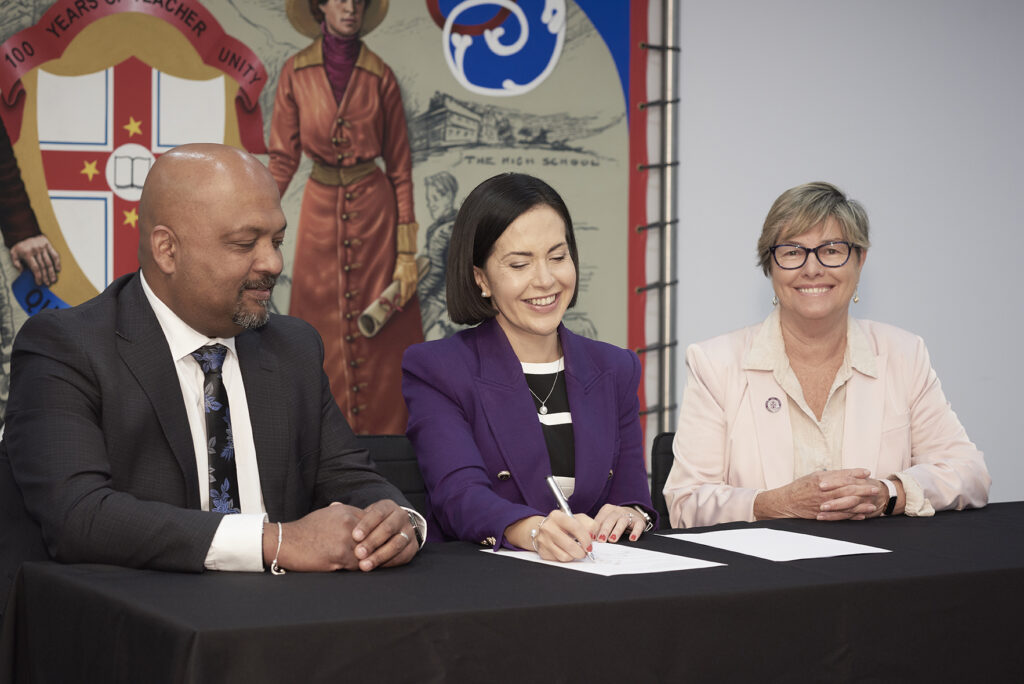


“Rebuilding the NSW public school system must be our collective priority and focus,” Federation President Henry Rajendra said.
“The NSW public school system must return to operating as a system, supported by a robust non-school based teaching service, rather than over 2200 individual schools operating independently, without the system support they need.”
HOPE FOR STAFFING ENTITLEMENTS
Federation is committed to ensuring the education funding recently transferred from school bank accounts to the Department of Education will be redistributed into schools as staffing entitlements and system support for public schools, the teaching profession and students, with no loss of teaching positions.
In correspondence to Federation on 1 May 2024, the Department wrote:
“I write to confirm the Department’s intention to undertake a review of the School Staffing Entitlement allocations to ascertain if they remain fit-for-purpose as we continue to wind back elements of the Local Schools, Local Decisions (LSLD) policy in order to rebuild systemwide support for schools, particularly in relation to staffing.
“Our intention is to identify cost neutral opportunities to convert flexible funding allocations into school staffing entitlement.”
President Henry Rajendra said: “The union welcomes the commitment by the NSW Government and its Department of Education to engage with the union to review and expand staffing entitlements. This will signal the beginning of the end for a significant feature of the Local Schools, Local Decisions policy and reinforce the importance of a strengthened statewide permanent staffing system supporting all schools.”
Mr Rajendra said that while much work was ahead reviewing staffing entitlements, the Government’s commitment was a significant and historic development, achieved by the determined campaigning of Federation and its members.
LSLD LEGACY IS ON THE WAY OUT
“The Department is rightfully beginning the process of properly dismantling the remaining infrastructure of the disastrous Local Schools, Local Decisions policy,” he said.
“The Local Schools, Local Decisions policy, introduced in 2012 by the previous Coalition government, was the greatest attack on our system since the Greiner/Metherell years. Under this policy, schools gradually became overwhelmed by managerial and administrative tasks that were often extraneous to teaching and learning, emanated from a Department stripped back and reconfigured to maintain a culture of compliance, ensured by an expanded managerial class of Directors, Educational Leadership (DELs), and characterised by a near meaningless preoccupation with the collection of data where the educational return was rarely commensurate with the labour required to gather and enter such data. This technocratic turn transformed the role of the school principal from educational leader to that of an administrative compliance manager bound to the excruciating detail of their local school budget.
“LSLD has led to a decade-long period of waste and duplication of Gonski funding. This additional recurrent funding, also known as flexible funds, was the opportunity to increase permanent teacher employment, by expanding school staffing entitlement that could have reduced class sizes and provided additional release time for all teachers. LSLD prohibited such structural improvements.
“At its core, LSLD was about dismantling the statewide staffing system, devolving staffing responsibility to the school level and an attack on permanency. Since the beginning of that policy in 2012, and its manifestations, Federation maintained that the devolution of education funding to school budgets was an exercise in blameshifting that absolved the Government and its diminished Department of Education of responsibility for staffing our public schools with qualified, permanent teachers.”
“Due to limitations in financial and systems data, we were unable to determine … exactly what each school’s RAM equity loading allocation was spent on”
Department of Education’s Centre for Education Statistics and Evaluation 2018 interim assessment of Local Schools , Local Decisions
Over more than a decade, the broken Local Schools, Local Decisions(later the Schools Success Model) and Resource Allocation Model policies have not improved teaching and learning, nor achieved more equitable outcomes for students or staff. There has been:
- a widening gap between the advantaged and disadvantaged
- a massive increase in casual and temporary positions in schools
- no lessening of red tape
- a dramatic increase in workload
- growing teacher shortages.
In the pursuit to rebuild the NSW public school system, in the past year Federation has achieved:
- the Right to Disconnect, giving teachers more control over their work/home lives
- a new Student Behaviour Policy
- conversion of 10,000 temporary teachers to permanent employment
- a new Staffing Agreement that reprioritises teachers’ service transfers
- reinstatement of service transfers for assistant principals, head teachers and deputy principals, which were taken away 32 years ago
- a salaries deal lifting NSW teachers’ pay from uncompetitive to the best paid in the country.