

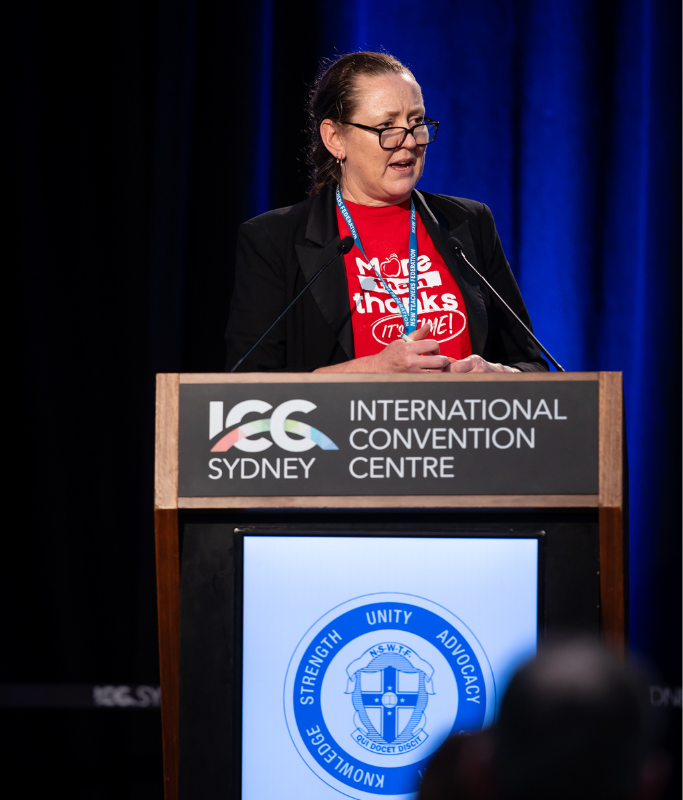
Federation has updated its special education policy with a nine-page document that encompasses our vision for an inclusive public education system where all individuals belong and thrive.
Federation Deputy President Natasha Watt told Annual Conference delegates: “We understand inclusion in a different way now.”
“Inclusion was used as a way to say that if you’re not interested in all kids in the mainstream classroom then you are not interested in including children with a disability in education,” she said.
“It was used as a moral pressure but actually what was going on at the time was that the state government was trying to cut money out of the public education, because specialist settings cost more than students going unsupported in mainstream classrooms.”
Ms Watt explained that all sorts of specialist roles were lost at the time, under the banner of what was then described as inclusion.
“There’s a whole lot of things that are missing from our system that used to be there, which is why the intensification of teaching, in part, has occurred,” Ms Watt said.
New features
The definition of ‘inclusion’ has been updated.
“Federation notes that there has been past and current use of the term of ‘inclusion’ that refers to all students being educated in the general education classroom with age-appropriate peers and without support. This is not Federation’s interpretation of the term,” the policy asserts.
“Quality public education for every student is contingent on resources that are needs-based. The pursuit of equality and excellence in learning and social outcomes for young people with disability requires a range of specialist teachers employed in positions that are industrially protectable.”
Federation also calls on:
- the NSW Department of Education to make special education qualifications a mandatory requirement for all positions within special education, providing fully funded pathways for training and retraining to meet system demand
- the Department and TAFE NSW to provide adequate support and structures for teachers with a disability to engage in their work to the fullest
- TAFE NSW, to:
- increase the number of disability teacher consultants, to better meet the needs of students enrolled in courses
- ensure appropriate support and processes are available to students with disability, to successfully enrol, engage in and complete courses while learning in an inclusive, safe environment
- review and fund suitable professional learning for all staff, to meet the diverse needs of learners in their classrooms.
Funding support systems
The policy states: “Federation rejects prevalence-based funding models that allow government to abrogate responsibility to all schools. There is no substitute for increased government investment that responds to the needs of students within the system. It is the legislative responsibility of government.”
Support classes in mainstream settings
The NSW Department of Education’s centralisation of the student placement processes and the increase in provision of support classes across the state, with more than 280 classes added into the system in 2026, is welcomed in the policy. However, the policy also states: “there is much more to be done to support the students and staff in these settings to best meet individual student need.”
Support classes in schools for specific purposes
Federation seeks the expansion of fit-for-purpose-built schools for specific purposes across NSW, to meet needs in all locations and contexts.
Universal early intervention and public preschool provision
The union calls on:
- the State Government to provide funding to students with disability in regular NSW Department of Education public preschool classes, to enable appropriate support systems for positive engagement, necessary inclusive practice implementation and timely access to early intervention services
- federal and state governments to significantly increase the number of early intervention support classes within co-located public preschools and to increase the number of early intervention teachers, commensurate with student need and in line with existing staffing formulae
- the NSW Government, to provide public preschools and schools with timely access to comprehensive supports for early identification and guaranteed access to high-quality government services and health roles (such as speech therapists, occupational therapists and registered nurses) provided and regulated by relevant government departments, including for the support of language development delays and other preventable disorders
- the NSW Government and relevant departments, to resource the coordination of multi-disciplinary teams, in conjunction with health professionals, to identify the needs of children with disability, facilitating early referral to appropriate services.
Inclusion programs with appropriate inclusive syllabuses and curriculum
“NSW Department of Education needs to provide a greater suite of resources and supports to allow teachers to better understand and engage learners of all abilities,” the policy states, “to ensure that inclusive practices are being suitably implemented across all settings.”
Address unmet need with action
Ms Watt said if there is unmet need in your school, then you can have an action around that. Some schools are doing this and winning on those actions.
Giving an example of a recent case, Ms Watt said where there were no support classes in a South Coast primary school, “they had an action…and they’ve won a little bit of resourcing.”
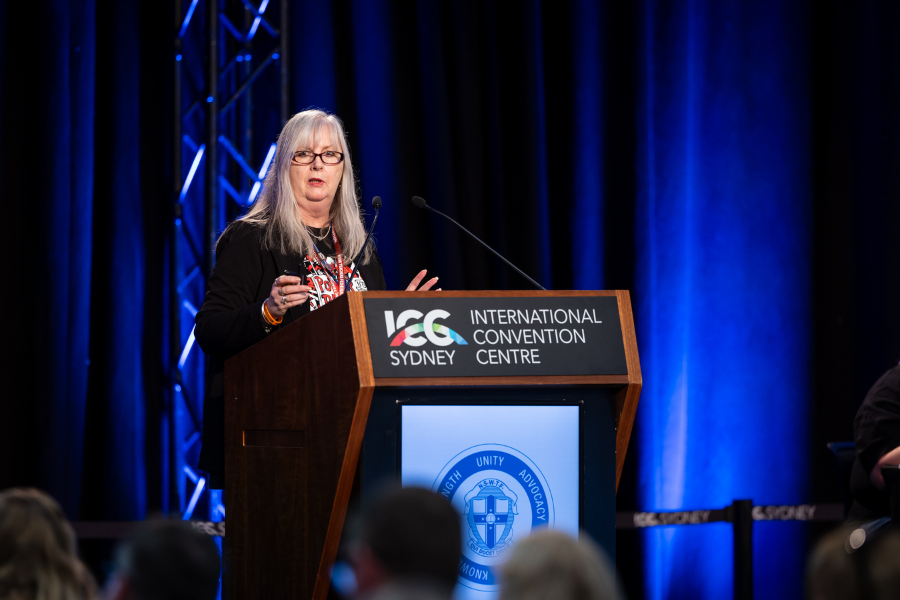
Far right extremism as well as a sharp spike in aggressive war mongering politics are contributing to widening inequality, deepening refugee crises and the erosion of human rights, warned Federation’s Multicultural Officer Mandy Wells in her address at Annual Conference today.
“War and ongoing conflict continue to cause untold suffering as well as test global political resolve. This, in turn, has resulted in the greatest increase to population displacement the world has ever seen — and the impacts on children and civilians are just so devastating,” she said.
“These broad but powerful contexts form the basis for Federation advocacy — and never before have we needed our voices to be louder in the pursuit of peace, equity and social justice.
“Every child deserves peace, safety, shelter, love and access to education. Your location and circumstances should not see those basic rights taken away. This is why peace is — and always will be — union business.
“With more bombs dropped, more children killed, more people rendered amputees and more people displaced on earth than ever before in history, we have to act for change!”
The increase in wars and conflict around the globe has caused millions of people to either struggle to survive in their home countries or move away to escape possible further harm — including to Australia.
Ms Wells informed delegates of how the current global tragedies is affecting teachers’ work lives: “Because our schools and TAFE colleges are microcosms of their communities, teachers in public schools and TAFE play a vital role in supporting all students — regardless of their background, trauma and capacity to engage in stage-appropriate learning.
“Students from a language background other than English have continued to increase, reaching 40 per cent of all public school enrolments in 2025. The contrast between national population trends and NSW Government school data highlights the significantly higher levels of diversity within the state’s public education system. This diversity is increasingly mirrored in TAFE settings — and translates into increasing need for additional teacher support,” she said.
Ms Wells continued, speaking on the financial role that the government will play: “The Federal Budget has continued its support for specialised employment programs and has increased funding and fee-free places for TAFE, as well as fee reimbursement processes for a range of visa holders in public schools. This will allow more students to continue to have access to pathways in public education, compared to the decade prior.”
To ensure that all Australians feel welcomed and accepted within our society, Ms Wells expounded on Federation’s continued endeavours to help eliminate racism.
“After Federation’s very successful Anti-Racism Conference in 2025, and in line with Federation’s February council decision, a partnership has been established to progress collaborative actions aimed at addressing racism within the NSW Department of Education’s workplaces,” she said.
“The objectives of the partnership will be to cast an anti-racism lens over all Department policies and procedures, with the intent of securing alignment with the recommendations of the National Anti-Racism Framework and to commence the implementation of any necessary changes that are identified.”
To further assist in the anti-racism space, Federation has recently launched an anti-racism special interest group, to offer a safe space for any members wanting to discuss, share and organise in the creation of inclusive and culturally safe classrooms and workplaces.
“Fundamental human rights protections and the right to peace and safety must always be a focus for any country wanting to promote fairness and inclusion,” Ms Wells said.
“Unity starts with respect for all — regardless of how you identify.
“Add your voice, join APHEDA and collectively act for what is right and just — so we make our classrooms safer — and our world a better place.”
Ms Wells’ passion for peace and for the success of a multicultural Australia was evident in her closing words: “We must continue to campaign, grow strength and grow our union. In holding a place of privilege — we must use our voice to call for the change we need to see.
“For every child, for our public education communities and for our profession.”
TAFE members have been commended in the Annual Conference decision Rebuilding with TAFE for refusing to take a backward step in their pursuit of a high-quality, well-resourced and respected TAFE sector.
Looking to the future, delegates stated: “The priority now for the Rebuilding with TAFE campaign is to secure a new transparent needs-based funding model for TAFE.” Such a model was recommended by the NSW Vocational Education and Training Review (2024).
Infrastructure funding
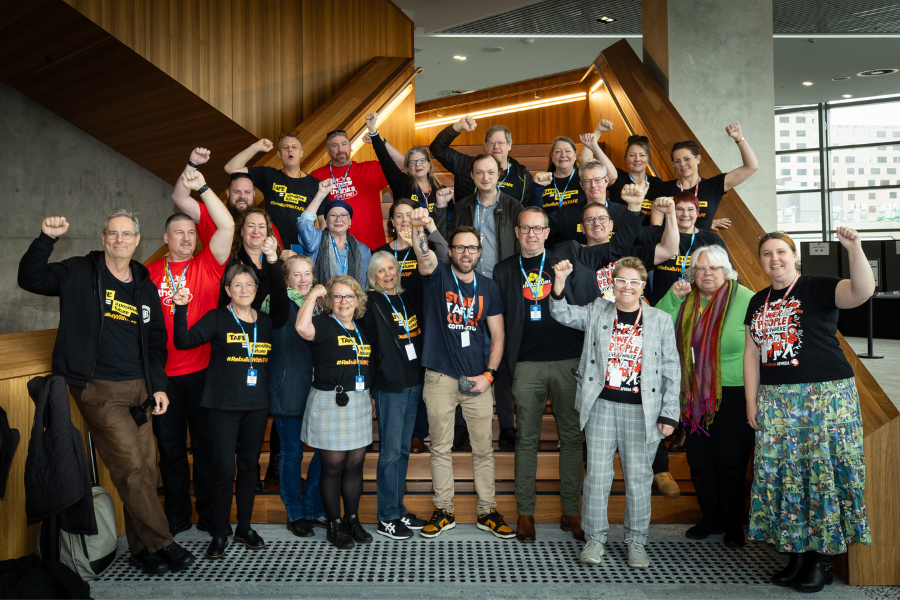
The Rebuilding with TAFE decision also asserted: “A vital component of rebuilding TAFE is to ensure infrastructure funding is sufficient so that students can learn and teachers can teach in safe, modern and well-equipped facilities that reflect current industry standards.”
The NSW Vocational Education and Training Review found that the asset replacement rate for TAFE NSW infrastructure had failed to keep pace with other public sector standards and that many parts of the state are reliant on outdated or inadequate training facilities and equipment.
Knowing what TAFE teachers think about the equipment they teach with will help the Australian Education Union enormously in pressing the case for proper investment. Please share your experience by completing the Rebuild with TAFE Equipment and Facilities Survey (5–10 minutes) before 30 July. If you have any technical issues with the survey, please contact aeu@aeufederal.org.au.
Beyond Smart and Skilled
Federation President Henry Rajendra said: “It’s great we’ve got more casuals converted to permanent. It’s had an immediate impact on the morale of the profession, and indeed the growth of our [TAFE] membership….However, we still have some significant issues our teachers have reported to us.
“There’s a lot of work ahead of us — we’re talking unofficial staffing freezes, reduced course offerings, merged classes etc,” he said.
The decision identified the ongoing need for:
- increased funding that attracts and retains highly-qualified TAFE teachers with increased wages and improved conditions
- a concerted long-term focus on reducing the administrative burden.
Growing union, growing strength
More Trade Union Training opportunities for post-school members will be made available.
Annual Conference delegates voted to increase Federation funding to enable:
- rural, regional and metropolitan Know Your Rights at Work courses
- more delegates’ rights training courses
- a new course for elected members involved in the rebuilding of consultative committees across the state.
Corrective Services
Annual Conference welcomed the reestablishment of the Corrective Services Teachers Association, following the NSW Government’s Review of Educational Services in Corrections, which identified the need for additional qualified teacher positions in public prisons across NSW, including the reintroduction of Senior Correctional Education Officer roles.
Before the end of 2026, Federation will invite all Corrective Services Teachers Association members to participate in a two-day Trade Union Training campaign course focusing on:
- building capacity and leadership of the Association
- ensuring that the new educational model results in increased access to public education for inmates across NSW.
Over the three days of Annual Conference, delegates considered ideas for the profession that germinated in local Associations from across the state.
Any Motion from Association listed for consideration at Annual Conference has already been debated by a local Association.
On the first morning of Conference, delegates vote to determine the order of in which the motions will be considered.
This year, Motions from Associations passed by Annual Conference were titled:
- Real inclusion requires expansion of support settings and services
- Reform of the Teacher Improvement Program to guarantee procedural fairness and a robust union voice
- More support for temporary and casual teachers
- AI Integration through consultation, transparency and professional learning.
Contribute your ideas about the future of the teaching profession by attending your local Association’s meetings. Click here to find meeting dates for your Association.
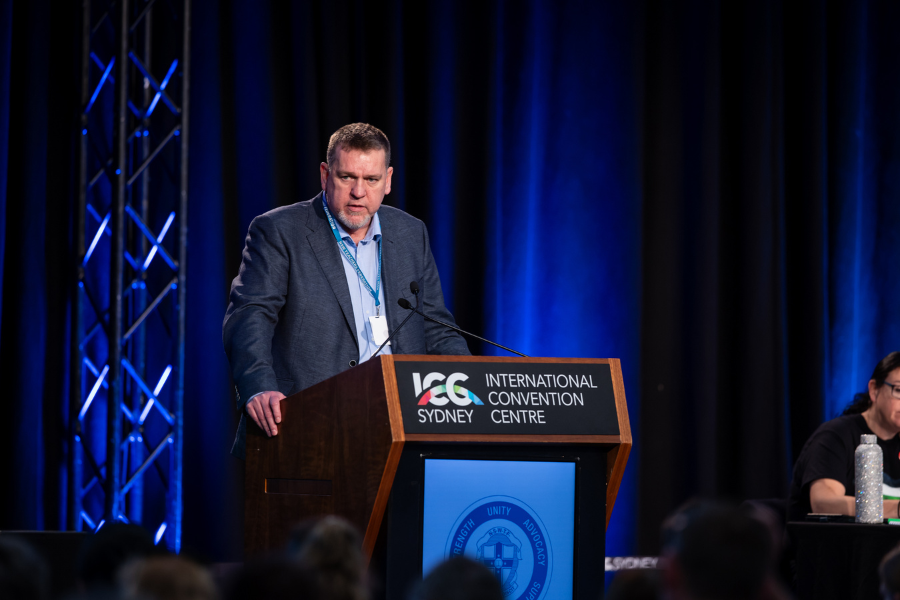
An operative principle of teacher unionism in public education is to bring members together to collectively and democratically deliberate, decide and act upon everyday problems, issues and questions in the workplace.
Annual Conference delegates noted in the Strategic organising for teacher union renewal in public education decision, that: “In the context of Federation’s formative, centralised and representative democratic structures, these local, substantive democratic practices are the foundation of collective agency and how teachers work in union to advance the teaching profession and public education in the broader interest of their students and communities.
“Federation Workplace Committees are pivotal to building union power in the workplace and must be a major focus of any capacity building strategy.”
Federation Senior Vice President Michael de Wall told delegates: “At its core, ‘strategic organising’ is about teacher union power, what it looks like, why we want it and how we can continue to build it together in every workplace and Association.”
“The local union leadership of our Federation Representatives, Women’s Contacts and Workplace Committees is critical to recruiting potential members and engaging them in meaningful action on local issues and the priority campaigns of the union.”
“In the context of our democratic decision-making forums, such sources of teacher union power are fundamental to asserting our collective professional agency, advocating for public education and making a positive difference in the lives of our students through high quality teaching and learning in the classroom.”
Associations, Council and Conference
The decision also recognised the importance of Associations, Council and Conference.
“Beyond the worksite, Federation’s formative, centralised and representative democratic structures are how members participate in and contribute to union decision-making and wider action,” the decision states.
“The strength and success of a Teachers Association is determined largely by the extent to which it can engage, organise and mobilise a critical mass of schools in a defined geographical area, non-school based worksites or TAFE colleges.”
Power through diversity, equity and inclusion
Delegates agreed that teacher union renewal demands a reaffirmation of Federation’s commitment to diversity, equity and inclusion.
“Progress towards greater union power demands that Federation structures are inclusive and representative of the wider membership,” the decision asserts.
“This requires building a culture of equity and the development of an understanding of the intersection of gender, class, Aboriginality, race, culture, (dis)ability, age, sexuality and identity and how they impact on members, their students and society.”
Not only is ongoing learning essential for your continued professional development, but as a teacher and Federation member it’s your right, Centre for Professional Learning (CPL) Director Margaret Vos told members.
She reminded members that as part of the 2024 Award agreement, schoolteachers have the right to access funded (external) professional learning and TAFE teachers have similar rights under sections 24 to 26 of their current enterprise agreement.
The Performance and Development Framework and the Personal Development Plan (PDP) process have not changed since its joint creation in 2013. Teachers are to assess their needs and aspirations in determining their professional goals. Setting one’s goals is a matter of professional judgement, exercised in collaboration with one’s supervisor. Goals are to be negotiated, not imposed.
“You are in control. You can change your PDP at any time to suit changes in your professional learning needs,” Ms Vos said.
Professional learning is union business
One of the main principles that the Centre for Professional Learning adheres to is that professional learning is union business, she said.
“We operate under the belief that a teacher’s professional work cannot (and should not) be separated from the industrial or the political.
“Striving to become a better, more professionally confident teacher makes you a better union activist and vice versa, so visit our website to discover our range of helpful courses, read our informative online journals, or listen to our engaging podcasts at cpl.nswtf.org.au/.
“Then, when you’re ready to take the next step, apply for a course at cpl.nswtf.org.au/courses/.”
Course offerings support implementation of new syllabuses in NSW
“Every teacher in NSW should have ‘Engage in professional learning that supports the implementation of new syllabuses in NSW’ on their list of professional development goals,” Ms Vos said.
The Centre for Professional Learning provides members with high-quality professional learning and support around pedagogy, andragogy, curriculum and assessment. Courses are created by teachers for teachers and are presented by academics and public education teacher experts.
The Centre for Professional Learning is a NSW Education Standards Authority-recognised professional development provider, existing to enhance the professional growth of Federation members, with learnings that are in line with Federation policies and are linked directly to the new syllabuses and the Teaching Standards.
While a large suite of courses are offered through our Surry Hills location, this year the Centre for Professional Learning has taken courses out to regional areas like Wollongong, Wagga Wagga, Tamworth, Canberra, Blacktown, Newcastle and Broken Hill. And for those who can’t attend in person, CPL also has a selection of online courses.
Annual Conference 2026, Day One
Annual Conference 2026, Day Two