

A $368 billion-plus commitment to nuclear-powered attack submarines is the wrong use of our taxes, Federation Deputy President, Natasha Watt said, addressing the Sydney hearing of the independent public inquiry examining the security partnership between Australia, the United Kingdom and United States (AUKUS) on 10 August.
“As teachers, we work daily with the consequences of underinvestment in public services,” Ms Watt told the inquiry, coordinated by the Australian Peace and Security Forum.
Public schools not fully funded
“Teachers in public education systems know that schools are not yet at the minimum Schooling Resource Standard reported back in 2011 as part of the Gonski review. Public schools in NSW will reach the minimum standard to 2034 — that is 23 years to fund public schools at the minimum level required.”
Lack of ongoing capital works funding
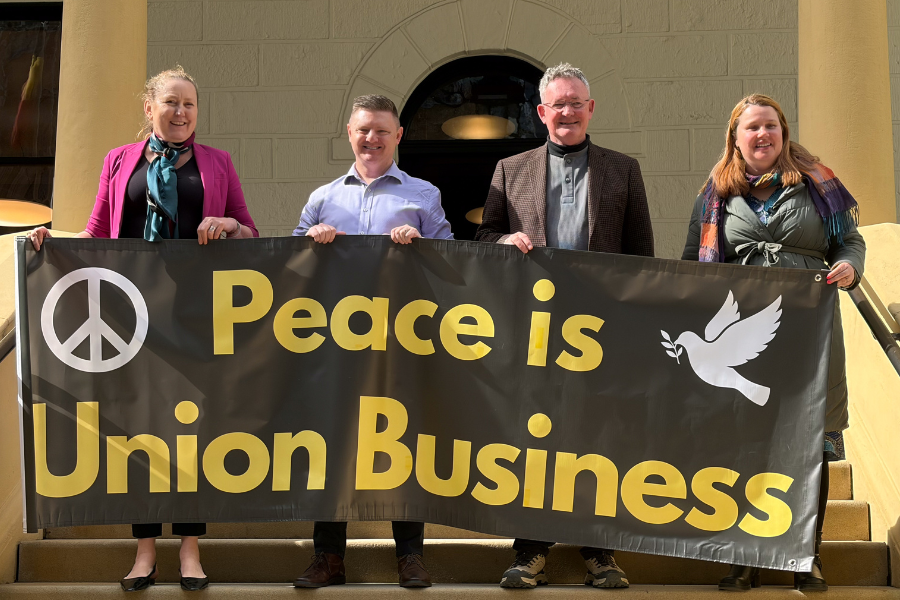
Ms Watt lamented there is also no ongoing capital funding program for public schools.
“Our students deserve quality school buildings regardless of their location, their setting and their context,” she said. “This must always be properly funded.”
“Our submission calls out that there is a $5.4 billion funding gap [in 2023, alone] between the non-government and the government sector on school infrastructure, which is an outrage.” Read about the Australian Education Union’s Schools for our Future infrastructure campaign.
The housing crisis is not an abstract issue for teachers in our system either. More than 90 per cent of teaching positions across the state are in areas where housing is unaffordable on a teachers’ salary. Not a single local government area is affordable for two top-of-the-scale teachers seeking to buy a home. This is a workforce, recruitment and retention issue.
Ms Watt referred to a media report that stated potentially 2400 homes would need to be built for American naval personnel and their families.
“If governments want to invest in Australia’s future defence security, they should do it without sacrificing its own people,” she said.
Skills crisis and TAFE infrastructure
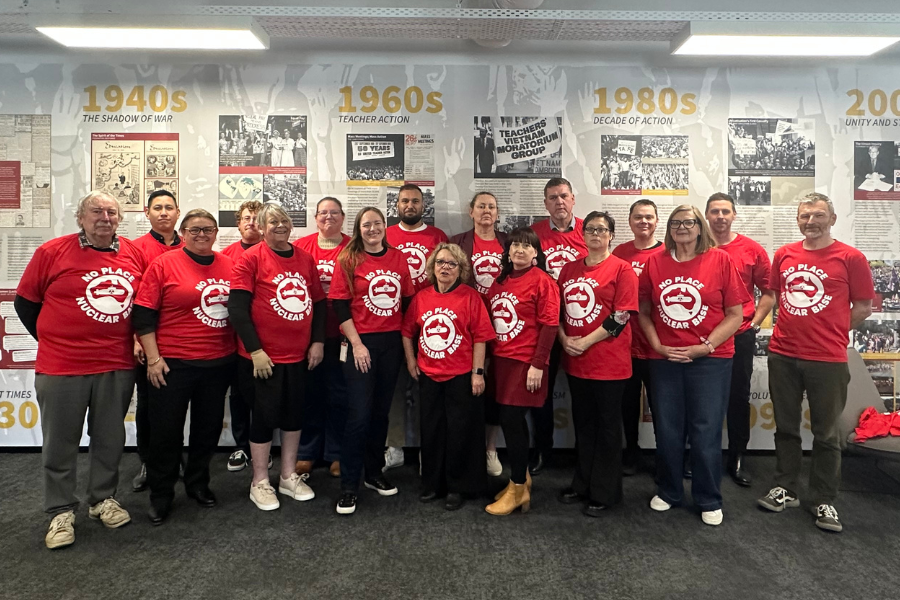
Federation’s TAFE Lead Organiser, Kelly Marks told the AUKUS Public Inquiry panel about the “urgent and necessary” need for enough qualified TAFE teachers and industry-standard equipment for their students.
“There are not enough electricians in the training pipeline to enable us to meet net-zero [greenhouse gas emission] targets and we have a shortage of TAFE teachers qualified to train the next generation,” Ms Marks said.
“Other skills shortages include nurses, plumbers, bricklayers and early childhood educators — critical skills for a functioning economy and society — that deserve the full attention of governments, not a $368 billion disgrace that benefits nobody but the interests of the United States government and those who stand for profit.
“The AUKUS agreement is an answer to a question that nobody asked. It’s a solution to a problem that doesn’t exist — and why does that matter? It matters not just because we believe it’s a dangerous exercise but also because there are real challenges that citizens are facing here in NSW — the solutions to which require significant, sustained investment form governments.
“AUKUS is a distraction from the real crises: the housing crisis, the climate crisis and the skills shortage crisis.”
Ms Marks read a statement from Federation’s Aboriginal members, which included: “Aboriginal and Torres Strait Islander peoples in Australia are against the impositions of foreign military bases, nuclear waste, pollution and war on ceremonial lands and traditional lands and waters.”
Other unions addressed the inquiry hearing, including National Tertiary Education Union (NTEU) ACT Division Secretary, Lachlan Clohesy, who said:
“NTEU supports spending for the public good and believes that AUKUS and its accompanying arrangements represent an unprecedented commitment of public funds without sufficient oversight or scrutiny.
“NTEU believes that universities exist for the public good and require the autonomy and public investment necessary to pursue education and research in the public interest, rather than being subordinated to military or industrial priorities,” he also said.
Port Kembla is no place for a nuclear base. Not here, not anywhere.
In May, a “secret” NSW government report identified Port Kembla as the preferred and most cost-effective east coast location for an AUKUS nuclear submarine base. The option of Newcastle as the location remains open.
Illawarra Teachers Association has passed a number of motions regarding AUKUS and has written to local federal MP for Cunningham, Alison Byrnes expressing opposition to any plans to build a proposed nuclear submarine base at Port Kembla or anywhere else.
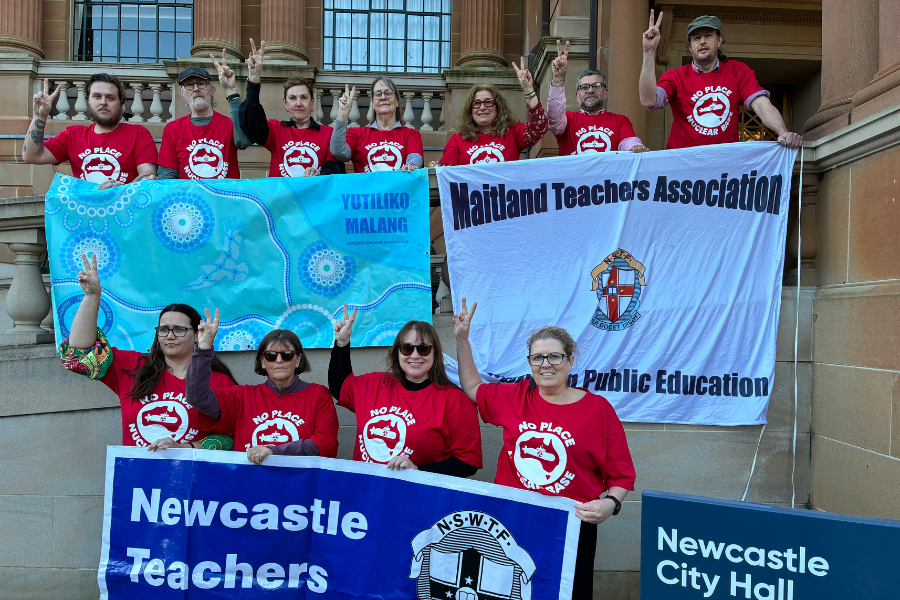
On 8 August, Federation Deputy President, Natasha Watt and Illawarra Teachers Association President, Elizabeth Scott travelled to the Hunter to attend the Newcastle Beginning Teacher Conference. As a gesture of solidarity, Elizabeth, on behalf on Illawarra Teachers Association, presented “No Place for a Nuclear Base” campaign t-shirts to executive members and Peace Contacts from several local associations.
The Hunter region activists wore the t-shirts to a rally on the afternoon of Tuesday 11 August, at the AUKUS inquiry in Newcastle.
On 12 August, Federation members joined members of other unions and local community groups, including Wollongong Against War and Nukes, at the AUKUS Inquiry hearing in Wollongong.
That afternoon, South Coast Labour Council Secretary, Arthur Rorris took two of the Commissioners, Peter Garrett and Karina Lester, on a tour of Port Kembla.
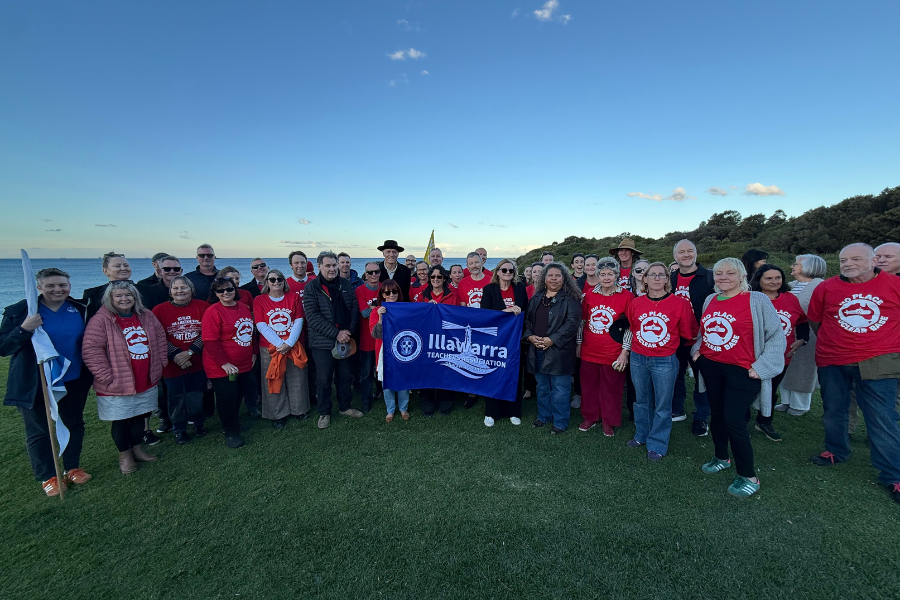
Federation members, representatives of other unions and local community members gathered opposite Port Kembla Public School and the nearby Five Islands Secondary College — both public schools are located within a three kilometre radius of the port.
The two commissioners spent some time meeting with the group, taking questions and comments.
Peace is everyone’s business
Elizabeth told August Council: “We are battling a global power. This is everyone’s business.”
“Please make it your Teacher Association’s business: move a motion; write to your local federal member of parliament; invite a guest speaker to a meeting, for example it could be a member of an Illawarra region or Hunter region association; order some anti-AUKUS t-shirts; educate yourselves on the issue, for example look at the AUKUS Public Inquiry website and read some submissions, e.g. Natasha Watt and Kelly Marks for Federation, Arthur Rorris for the South Coast Labour Council and Sally Stephens AM (War, Militarisation and Violence Against Women).”