

Guest speakers: Scott Eacott and Adam Rorris
Addressing housing affordability for teachers should be a high priority for policymakers, guest speakers told Annual Conference.
“Anything that compromises the ability of the system to deliver full teacher staffing requires attention… Housing unaffordability or housing scarcity is a significant compromise to full systemic staffing,” Professor of Education in the School of Education at UNSW Scott Eacott told Conference delegates.
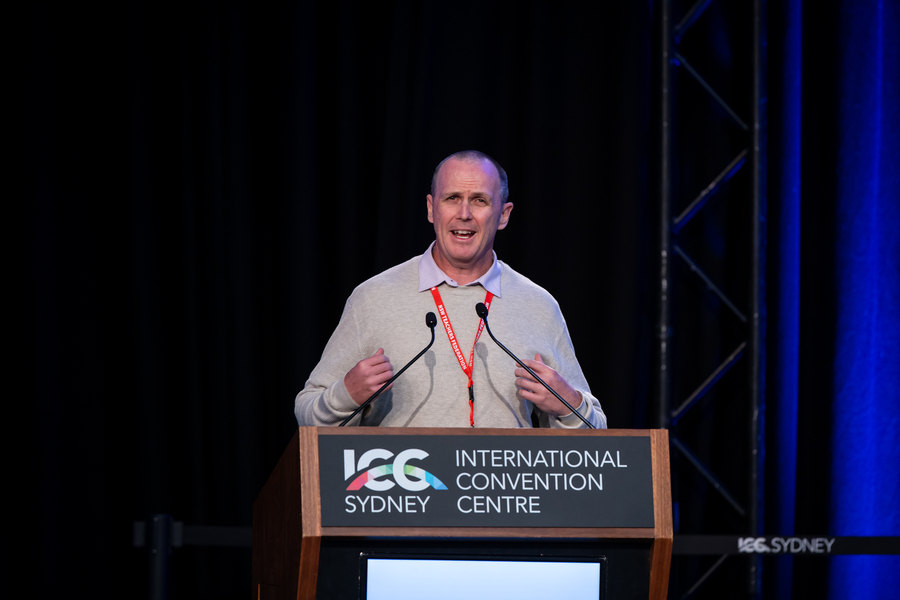
The co-author of the recent Socio-economic analysis of teacher housing in NSW paper, Professor Eacott said the daily activities of 61 per cent of Australian schools (73 per cent in disadvantaged areas) are compromised by lack of staff and that staffing disruptions have a negative effect on student outcomes.
The paper, co-authored with education economist Adam Rorris, warns the sustainability of the public-school workforce is under threat as housing has become increasingly unaffordable or scarce in many locations.
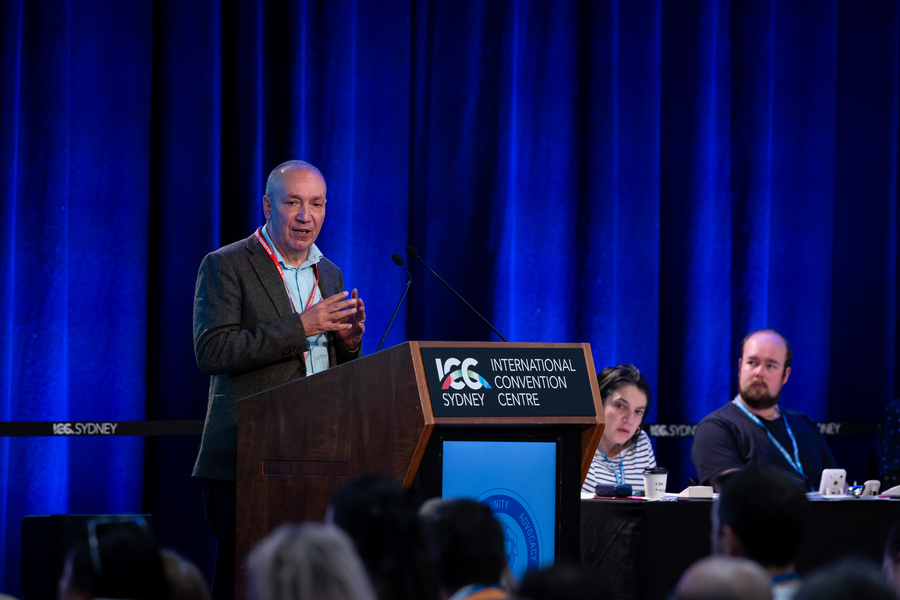
“We need enough teachers living where they are needed and the housing of teachers is vital for that to happen,” Professor Eacott said.
Housing can be unaffordable on a teacher’s salary
Some 85 per cent of local government areas (LGAs) in NSW have a median housing sale value that is unaffordable for a top of the scale teacher and with rental vacancy rates around 1–2 per cent there are some serious issues around the state, Professor Eacott said.
The paper states that 90 per cent of teaching positions in Sydney — the equivalent of more than 50,000 full-time equivalent positions — are in LGAs where housing is unaffordable on a teacher’s salary.
Median housing prices for non-strata properties are unaffordable for:
- a top of the scale teacher in 85 per cent of LGAs
- dual top of the scale salaries in 44 percent of LGAs.
Median housing prices for strata properties are unaffordable for:
- a top of the scale teacher in 100 per cent of LGAs
- dual top of the scale salaries in 42 percent of LGAs.
Median values in Sydney are $1,691,731 for a house and $823,467 for a unit. These are 13.45 and 6.55 times the annual top of the scale salary — far beyond what is considered the affordable threshold of three times a person’s income, even if factoring in two top of the scale salaries.
The report states: “Even renting is becoming more difficult, with low vacancy rates throughout the state comprising the ability of teachers finding a situationally appropriate home within commuting distance of school,” the report states.
For a single graduate teacher, housing in 1 in 2 of NSW’s LGAs costs more than 30 per cent of average weekly after-tax income — the threshold at which housing is no longer classed as “affordable” — including nearly all LGAs in metropolitan Sydney. Housing in a further 25 per cent of LGAs costs between 25–50 per cent of weekly income.
Opportunity for change
“Right now housing affordability is grim, but there’s an opportunity,” Adam Rorris told delegates.
Mr Rorris pointed to Austria, which has grown its cooperative housing stock to about 25 per cent, as an “incredibly hopeful and empowering” alternative approach to housing.
The widespread provision of public and cooperative housing in Vienna has “had a lasting effect, not only on the people who live there, but on other people who benefit from the balance it provides in the housing market, which prevents [housing prices] going crazy,” Mr Rorris said.
Only 17 in 1000 people in Australia have access to not-for-profit, public or social housing, compared to Austria, Sweden, Netherlands and Denmark, where it’s in the range of 100 to 200 per 1000 people.
“Your union has a long history of engaging in issues and struggles that begin of the now…but with a vision for the future. Housing is exactly one of those issues, which calls for such immediate action to alleviate the immediate problems we face now,” Mr Rorris said.
“There is a profound pathway here that will change the way we can deliver housing in this country, by bringing into play a not-for-profit housing sector that can provide for you, for your kids, for your fellow younger kids who can’t get into this market right now — a pathway to secure high quality housing that will have intergenerational benefits for everyone.”
Conference delegates later passed the decision “Housing for teachers — a social contract”, based on the report’s recommendations. See story below.
Federation to explore affordable housing for teachers
Federation will seek to partner with a community housing provider to trial building affordable housing for teachers and explore encouraging industry super investment in affordable housing.
A decision passed at Annual Conference states the union will “explore the immediate possibility of piloting a partnership with a large (tier 1) community housing provider for the provision of delivering affordable large-scale housing in one location projected to experience teacher shortages linked to housing shortage”.
Noting that “housing for teachers is unaffordable in Australia,” Federation will also “pursue with AWARE Super a strengthening of its investments with community housing providers that are active and looking to expand their portfolio of affordable housing for teachers and other essential workers” and explore the concept of a “just social wage compact” to make housing affordability a priority of both governments and the union movement.
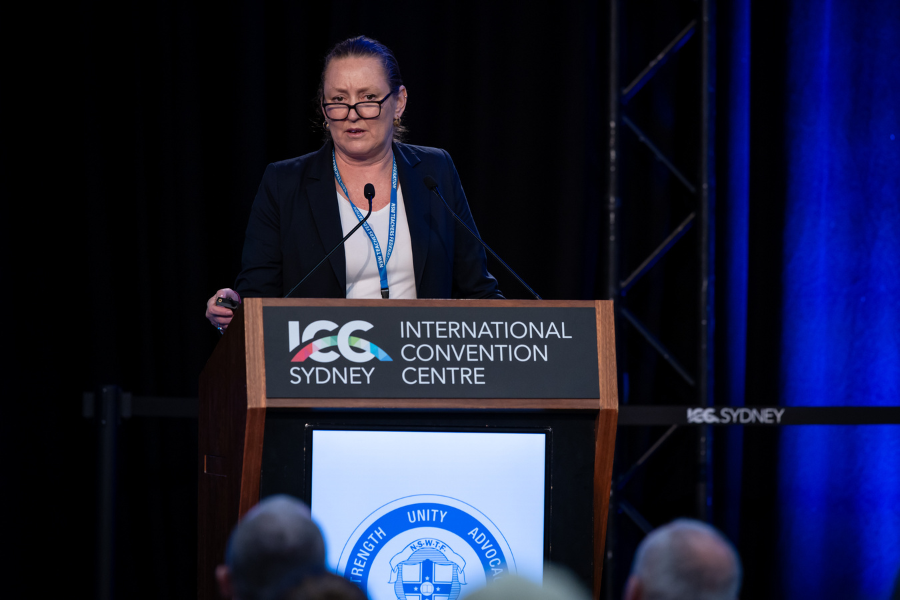
Federation Senior Vice President Natasha Watt pointed delegates to a decision of Federation’s Council in May that found “accessible and affordable housing for teachers and their families in the public education system must now be considered part of a just social wage”.
“Accessible and affordable homes for teachers in public education cannot be left victim to the open market and its collaborators,” the May decision states.
The Annual Conference decision also committed Federation to “pursue working conditions for all teachers that ensure economic security,” including “policy and campaigns that utilise gender impact assessments to ensure teachers have housing security and access to affordable housing”.
Federation noted the gendered impact of rising socio-economic inequality, with the ongoing gender pay gap, unpaid caring responsibilities and extended parental leave periods leaving many women more vulnerable to housing insecurity and homeless.
Earlier in the day Conference heard from authors of a Federation-commissioned paper, A socio-economic analysis of teacher housing in NSW, Scott Eacott and Adam Rorris. See story above.
Teachers doing the ‘wrong work’, impacting on student learning and longevity
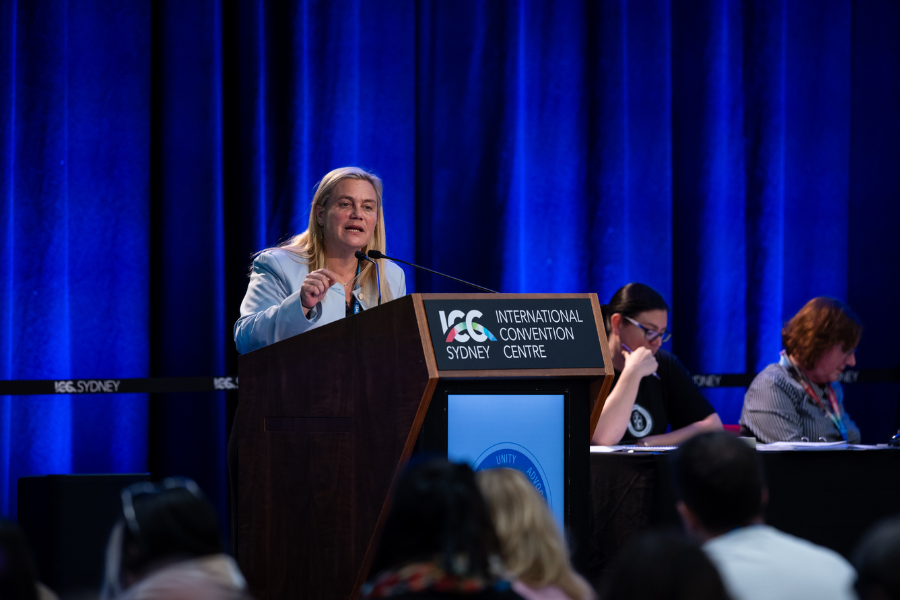
“It remains stubbornly the case that it is taking longer to document a lesson than to teach it,” Federation Deputy President Amber Flohm told Annual Conference.
“Teachers are spending their evenings and weekends completing paperwork that serves no educational purpose while having no time for professional development that would genuinely improve their practice.”
The latest analysis of a survey of 13,000 teachers reveals teachers are spending the majority of their non-teaching time on administrative tasks such as data collection and entry and programming compliance. Meanwhile, professional learning, engaging with parents and carers and collaborating with colleagues on curriculum development — work that teachers identify as having the greatest impact on students — is relegated to minimal time allocations.
Ms Flohm said many compliance requirements imposed by the Department and schools exceed what the NSW Education Standards Authority (NESA) mandates. NESA guidelines state there is no requirement for detailed teacher evaluation and reflection in compliance evidence, no requirement about how evaluation is completed, and no expectation that teachers write comments regarding each aspect of each lesson.
“Yet the Department continue to impose these burdensome requirements, often going far beyond what’s legally necessary,” Ms Flohm said.
Teachers are doing the ‘wrong work’ at the expense of intrinsic motivation and reward, taking them from the work they value, teaching and learning with their students.
Recent data shows this overload is contributing to teacher shortages, particularly in regional areas where schools struggle to fill and replace departing teachers.
The union is calling on the Department and schools to strip back compliance requirements to statutory minimums and eliminate what it describes as “layers of unnecessary bureaucracy” imposed beyond NESA requirements.
Ms Flohm said the findings challenge recent policy directions toward standardised teaching approaches and pre-made curriculum materials.
“Teachers don’t want to be delivery agents for someone else’s materials,” she said. “They want time to do the creative, intellectual work of adapting learning to their students in front of them and their specific needs.”
Solidarity has no borders, Federation’s Multicultural Report declares
“Every child deserves peace, safety, shelter, love and the right to an education,” Multicultural Officer Mandy Wells said, delivering the Multicultural Report to Annual Conference.
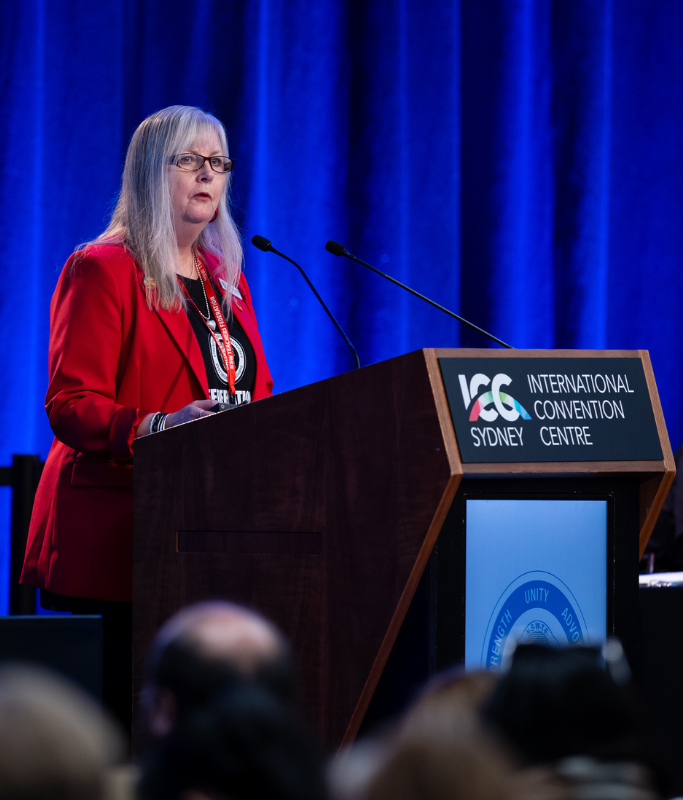
She urged governments to increase funding for humanitarian aid and to do more for refugees and asylum seekers.
“War, persecution, famine, environmental disasters and a woefully inadequate response to the people suffering these events has seen millions forced to live in poverty and struggle to survive, or having to move on to escape further harm,” she said.
“But instead of investing in aid and investing in solutions, the world’s richest countries continue to invest in war.”
“Our federal government is not investing enough. We are a wealthy country that should do better. That’s why peace is and always will be union business.”
Ms Wells pointed to wins Federation has secured for the 39 per cent of NSW public school students who speak a language other than English at home, including:
- improvements to the number of dual qualified teachers holding English as an Additional Language or Dialect (EAL/D) staffing positions
- strengthened policies for English Language Proficiency funding
- a review of locations and accommodation provisions for Intensive English Centres
- greater access to scholarship programs to enhance numbers of qualified EAL/D teachers
- increased funding and support for Anti-Racism Contact Officers.
Federation was also involved in consultation around multicultural policies for TAFE and the Adult Migrant English Program and celebrated the achievement of more permanent positions and fee-free TAFE placements.
The union also advocated for the creation of a federal Human Rights Framework, contributed to state and federal multicultural education and anti-racism policies, and campaigned alongside other unions “for an end to war, detention and offshore processing, and government policies that allow all seeking refuge to settle in Australia safely, with dignity and support”.
“What sort of world do we want to see?” Ms Wells asked delegates in closing. “Because we hold a place of privilege, and we must use our voice as one to be the change we want everyone to see.”
“Federation remains on the right side of history in its policy positions, and will maintain the collective strength and unity that will see us continue to achieve our goals and a more fair and inclusive society.”
Federation’s gender priorities reflected in Schools Award
The significant gains in the most recent Schools Award settlement for NSW teachers were the result of many layers of Federation policy, Women’s Officer Leeanda Smith told Annual Conference delegates.
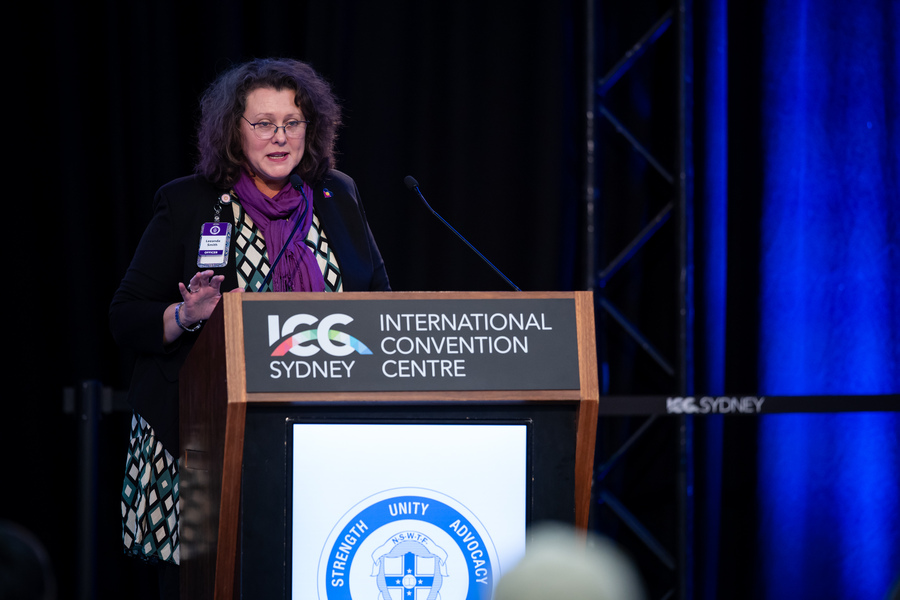
Federation policies enacted at previous Conferences, including ‘Valuing Diversity’ in 2021, ‘Gender, Sexuality and Identity’ in 2022, ‘Gender Equity and Equality in the Public Education Workforce’ in 2023 and Affirmative Action’ in 2024 all laid the groundwork for the wins enjoyed by teachers in the latest Award, Ms Smith said.
“Each of these Annual Conference decisions were building a clear policy position so the work on addressing the structural barriers that exacerbate inequality could be done,” she said.
Women’s Program
“Federation continues to develop the Women’s Program to provide access points for women, no matter where they are in their activist journey,” Ms Smith told delegates.
Women members can get further involved in Federation’s Women’s Program through:
- Women’s Caucus at Council and Annual Conference
- Country Women Observer Program
- Training Union Training courses — Workplace Women’s Contacts, Association Women’s Contacts, Women and Union Leadership
- Anna Stewart Program — Council, Relief Officer
- Women’s and Anna Stewart Program Restricted Committee
- Women’s Conference
- Resources in the Member Portal.
Gender Equity Action Plan
Smith said Federation would monitor the Department and TAFE NSW’s development of a Gender Equity Action Plan, focussing on:
- recognising and supporting leadership for all genders
- creating structures that remove gender barriers
- building equitable opportunities for career development and participation
- prioritising health, wellbeing, and safety for everyone in our schools, workplaces and communities.
Women’s Conference
Delegates were reminded about Women’s Conference on 23 August, which will celebrate 50 years of the Women’s Program.
The Conference’s keynote speaker will be author Dr Anne Summers, whose book Damned whores and God’s police is also celebrating its 50th anniversary since publication.
Cultural safety training among focus areas for the year ahead
The inclusion of Sorry Business leave in the new schools Award, better access to flexible working arrangements and increased leave for family members of people experiencing domestic or family violence are examples of what Federation’s Aboriginal and Torres Strait Islander policy has achieved over the past year, Aboriginal Education Officer Russell Honnery told delegates.
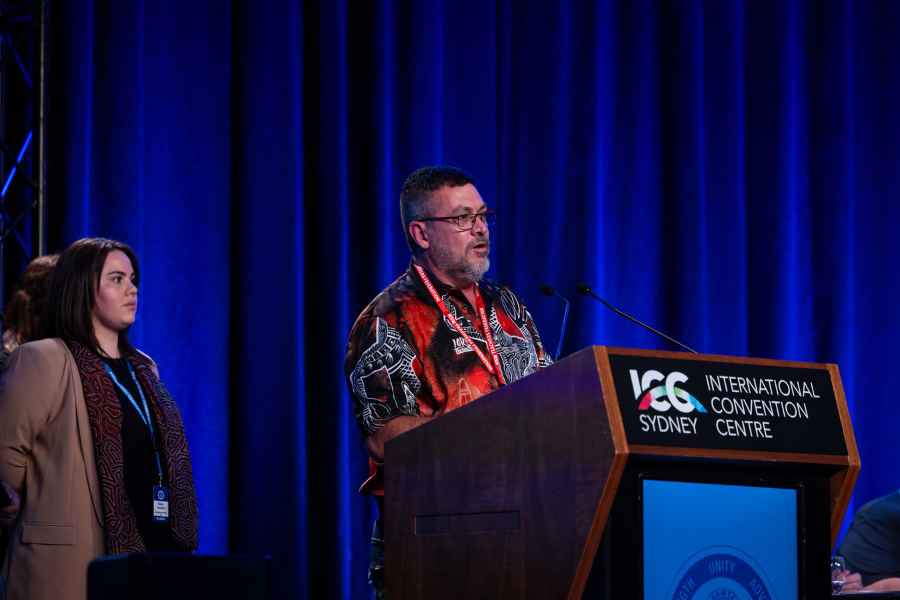
Mr Honnery identified workplace cultural safety training, action on workplace racism and recognition and remuneration for cultural load as part of an employee’s workload as priorities for the coming year.
“It should not just be expected for a teacher or an employee to offer their cultural knowledge,” he said.
Growing Aboriginal Members Roll
Federation’s Aboriginal Members Roll now lists 1617 members, Mr Honnery reported, with TAFE, Officers, Consultants and Advisers Association (OCAA) and student membership all growing over the past 12 months.
Fight for fair and equal education
He took delegates through the centuries-old struggle by Aboriginal and Torres Strait Islander people to access quality education: from 1821, when an Aboriginal student at the Native Institution in Parramatta scored top marks in their exams — ahead of non-Aboriginal students — to 2024, when Aboriginal and Torres Strait Islander students made up nearly 10 per cent of all NSW public school students.
Racism: silence equals support
Mr Honnery spoke about an ongoing survey by the University of Technology, Sydney’s Jumbunna Institute for Indigenous Education and Research, examining the rise in racism across Australia since the Voice to Parliament referendum, as evidence more needs to be done to protect Aboriginal and Torres Strait Islander members in their workplaces and the wider community.
“I’m not looking forward to the results, as many people after the Referendum thought they had the right to openly say what they had been thinking,” he said.
“This is not on. Racism should not be tolerated at all. If you witness it and say nothing, you are supporting it.”
NAIDOC Week
As Annual Conference this year coincides with the 50th anniversary of NAIDOC Week, Mr Honnery directed members’ attention to this year’s NAIDOC theme ‘The Next Generation: Strength, Vision and Legacy’ and ‘Ancestral Lines’, this year’s official NAIDOC poster by Ngarbal Gamilaraay artist Jeremy Morgan Worrall.
“Each person in the painting depicts a series of lines akin to songlines, that represent what they know, who they were and what they have passed on,” he said.
“Above them is the essence of the land they live on and protect and care for. It is a depiction of my home: the cold skies of Tenterfield with its swirling clouds and giant moon. A place around the fire is where the next generation find their strength, vision and legacy.”
CPL resources can enhance your professionalism
Federation created and maintains the Centre for Professional Learning (CPL) for members, so utilise this valuable resource, CPL Director Margaret Vos told Annual Conference.
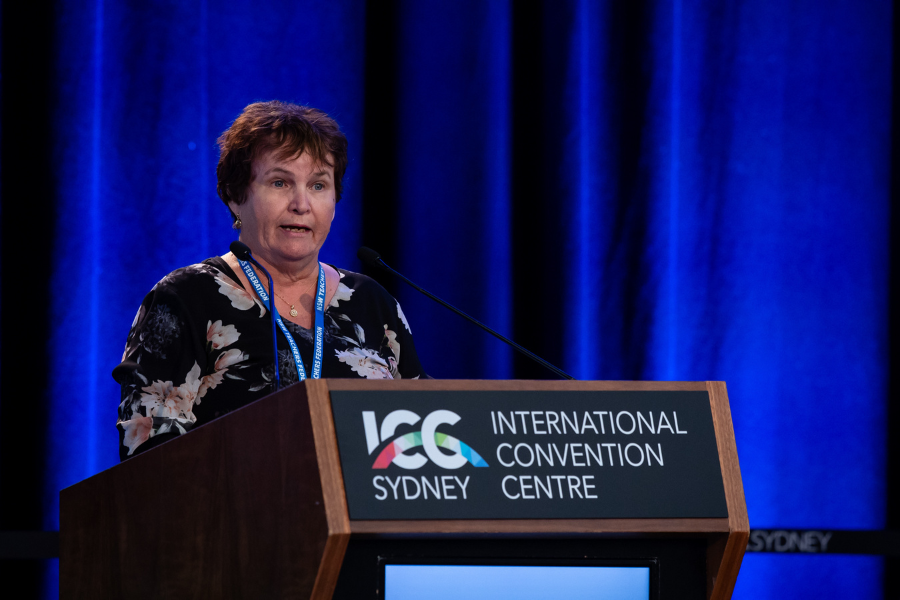
“Come to our courses, read the JPL articles and listen to our podcasts, log the hours for your maintenance of accreditation, use our resources in the Knowledge Centre [in the Member Portal] and most importantly, spread the word,” she said.
“The CPL is committed to enhancing the professionalism of teachers. As [Stanford Graduate School of Education professor emerita] Linda Darling Hammond said: ‘If you don’t have a strong supply of well-prepared teachers, nothing else in education can work.’”
The CPL maintains links with 15 universities and 41 academics and researchers, who either work in the field of education or in areas related to the key learning areas and syllabuses that our members teach.
“Many of the academics are involved in current educational research,” Ms Vos said. “As a result, the CPL is aware of the latest research in the field of education and therefore we can be proactive about sharing relevant academic research with our members.”
The Journal for Professional Learning
Ms Vos said she wants to increase the readership of the “nationally recognised” JPL among Federation members. She said the “amazing articles” are read by academics at universities and members in other branches of the Australian Education Union.
“I encourage you to read JPL articles because reading them will enhance your professionalism,” she said. Read the latest edition of the JPL here.
Way forward
Ms Vos said the CPL was working hard on implementing the recommendations of a review of the CPL, including:
- continuing to provide high quality professional learning
- creating a range of new courses, including for TAFE teachers
- a return to regional areas
- a merge with the Centre for Public Education Research.
Socioeconomic school segregation a “fundamental fracture,” Conference hears
The most effective intervention the NSW public education system can make for the learning of disadvantaged students is to win back middle- and high-income families, Federation Vice President and recipient of the Eric Pearson Study Grant Michael Sciffer told Annual Conference delegates.
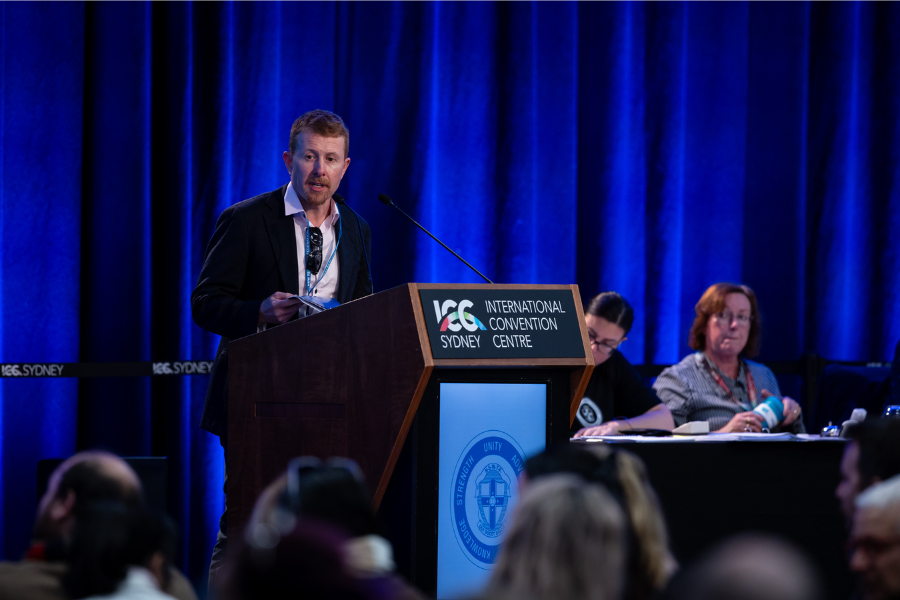
“The segregation of NSW students between public and private schools is a fundamental fracture in society. This will require restoration of the traditional focus of NSW public education: excellence for all students,” he wrote in his 2025 Eric Pearson report, NSW public education: a reflection on socioeconomic school segregation.
The Eric Pearson Study Grant is an annual $23,000 award to a Federation member to examine an area of industrial and professional relevance to Federation as a union and/or group of members.
By year 9 a low SES student in a low SES school is half as likely to achieve minimum academic benchmarks than the same type of student in a high SES school. This is because up to 30 per cent of learning at school is explained by the socioeconomic composition of its students.
The Australian schooling system is among the most segregated of Organisation for Economic Co-operation and Development (OECD) countries. At the national level, the public system over-enrols low SES students, Catholic schools over-enrol middle SES students, independent schools over-enrol high SES students and selective schools enormously over-enrol high SES students.
The Department needs to systemically support initiatives to guarantee excellence for all students and maximise enrolment flows across transitions from preschool to kindergarten and from year 6 to 7.
Member momentum to help rebuild TAFE
The union has declared its intention to “rebuild the ability of TAFE to attract and retain the best teachers” at Annual Conference today.
“Federation members’ campaign to Rebuild TAFE in NSW has seen TAFE emerging from more than a decade of damage inflicted by the contestable funding model,” the Annual Conference decision Rebuilding TAFE states. “For too long, Smart and Skilled hollowed out our public TAFE system — undermining secure employment, diminishing course offerings and prioritising cost-cutting over quality education.”
“We need to rebuild the confidence of students again. And we are rebuilding. This year, for the first time in more than a decade, we have momentum. And it has come because Federation members — particularly TAFE members — never gave up.”
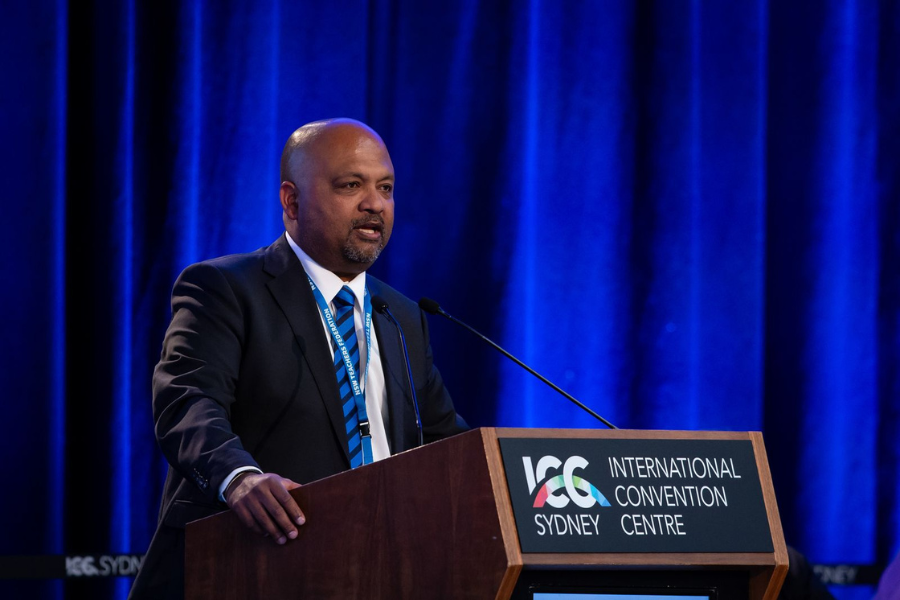
Federation President Henry Rajendra said securing stable long-term employment for TAFE teachers was crucial to the union’s density and organising power.
“We want to build power in our TAFE workplaces,” he said.
“When we get workplace permanency, we can better recruit members and when we recruit members we can better organise them to know their rights at work and push for them.”
In the 12 months before the last federal election, Federation won a series of transformative policy and funding improvements for the NSW public vocational education and training (VET) sector. In March 2024, the NSW Government committed to Federation’s recommendation that TAFE be removed from the contestable VET funding market within 12 months.
Federation also won a commitment from the Albanese and Minns Governments to fund a five-year National Skills Agreement, pouring $12.6 billion into revitalising TAFE in line with national priorities like gender equality, Closing the Gap, the transition to net zero, care sector support, sovereign capability and digital workforce development.
Most prominently, Federation won a significant expansion of the federal Free TAFE program, securing hundreds of thousands of additional free TAFE placements in NSW from the Minns and Albanese governments.
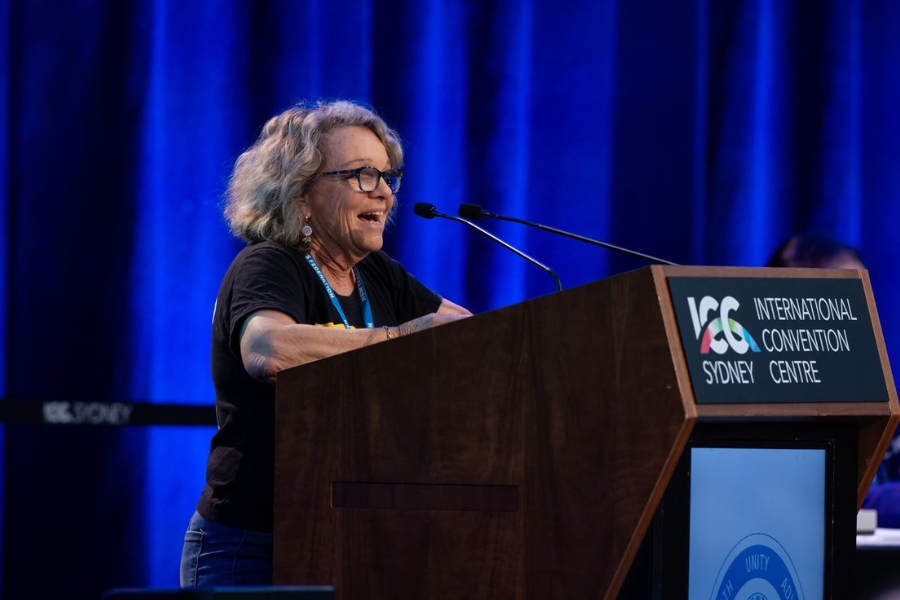
“The attempt to run TAFE as a business means classes are still being cancelled in regional centres as 15 centres are deemed ‘not viable’,” Federation Vice President Sharryn Usher said.
“We want to enshrine in legislation that contestable funding will never, ever again threaten our TAFE teachers, students and communities”.
The motion committed Federation to “negotiate a new, fit-for-purpose statewide staffing agreement” for public VET teachers, “demand equitable resourcing across all [TAFE] campuses,” partner with Aboriginal communities to deliver culturally responsive VET education and develop a ‘Never Again’ campaign “to ensure that NSW TAFE is never again subjected to a contestable funding model, or privatisation by stealth”.
“That’s about knowing your history,” Mr Rajendra said. “We have to own that. We can’t go back to what happened in the past.”


Annual Conference 2025, Day One
Annual Conference 2025, Day Two