

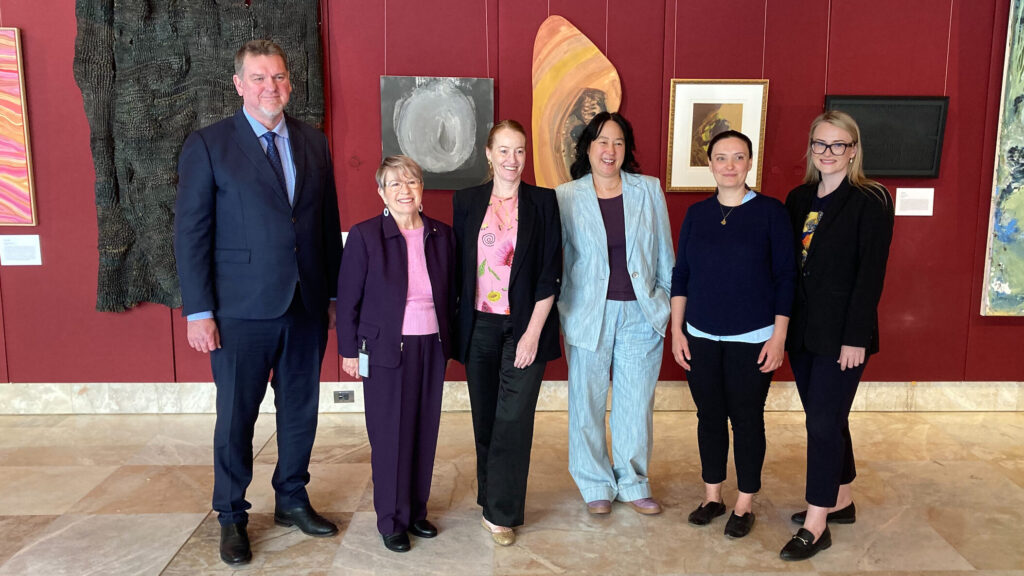
A Human Rights Act would bring an immediate change in the dynamic of conversations around school funding, Senior Vice President Michael de Wall told the NSW Legislative Assembly Committee on Community Service’s Inquiry into Human Rights Bill 2025 recently.
Mr de Wall explained that federal-state funding agreements will take five or six years to get public schools up to the minimum Schooling Resource Standard.
“There are cohorts of kids who have unmet needs now,” he said. “[For students] with disability in particular, I think a human rights framework might bring forward the urgency to actually invest more quickly than is currently planned in high areas of need.”
He told the hearing that teachers’ working conditions are students’ learning conditions.
“[Teachers] need the time to actually differentiate their programs for the diversity of needs within their classes. Sign our letter to Education Minister Prue Car asking for more preparation time
“They also need the resources to undertake that work.
“We also have infrastructure issues. Children are learning in environments that are unwelcoming and, in some cases, falling down around them. Read about the Australian Education Union’s national inquiry into public school infrastructure needs
“There are significant matters and there are long-term plans that have been put together in ad hoc political fashion over time. A clear standard of human rights would bring a very fresh set of eyes to those discussions and the needs that need to be prioritised.”
Mr de Wall gave the case for the urgent need for a Human Rights Act.
Aboriginal education
“Right now, as we speak, in classrooms across NSW…there are students of Aboriginal background, who come from families that carry the weight of intergenerational trauma, in classrooms trying to learn with their teachers and their peers.
Special education arrangements lacking
“We also have thousands of students with disability who, under current arrangements, are eligible for a placement in a class with extra support, and those students are in the mainstream without that support. At the same time there are students in some of those classes who are eligible for a placement for a school for specific purposes, and there is no SSP in their area for them to go to.
Failed social policy
“Some [students] are hungry, and some are coming to school stressed and worried about their own existence let alone what they need to learn,” he said. “In that sense, for us, it’s not only a case of the right to education…it’s also, for us, about outside the school gate. It’s about failed social policy beyond the school gate, because kids bring that to school with them. So, we think the positive duty and a more strategic outlook means that it’s not a matter of why now; it’s more a matter of why not before now?”
Unmet educational needs in the bush
Mr de Wall stressed to the inquiry, that challenges in education are exacerbated in rural and remote areas.
“We’ve got too many stories of families where one kid goes to the local school in town and the child with a disability has to be put in assisted transport and go 25 kilometres away, to another town,” he said.
“I’ve had conversations with teachers in the Blue Mountains and Lithgow, Cessnock and Grafton, in the last 18 months, where they’ve said, ‘We desperately need a school for specific purposes.’
“If you’re around the Blue Mountains/Lithgow area, you’ve got to go east to Penrith or west to Bathurst.