

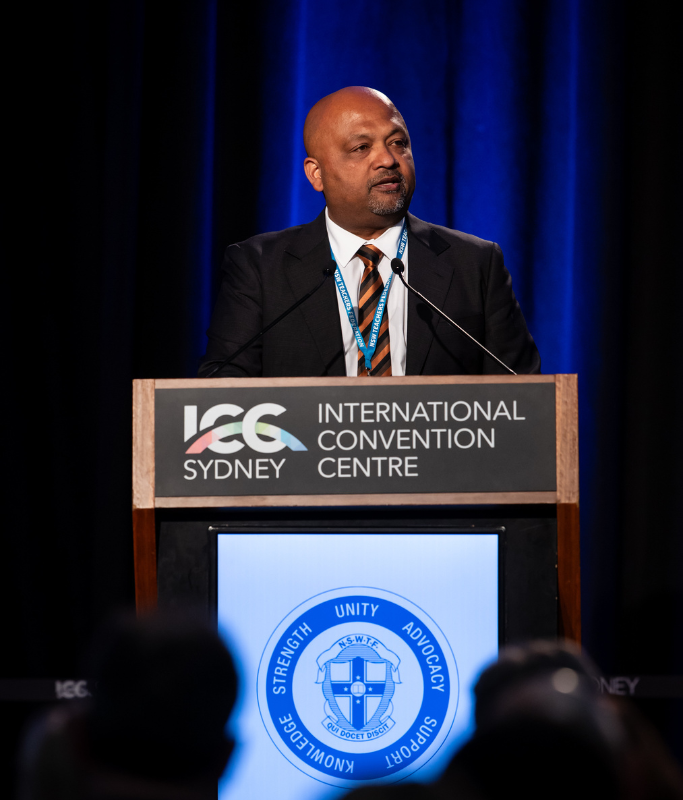
If improving teachers’ working conditions is continually deferred because there aren’t enough teachers, there’s a risk of entrenching the very conditions that make it harder to retain experienced teachers and attract new graduates to the profession, Henry Rajendra said in his Presidential address this morning.
Teachers are overworked and stretched beyond capacity and Federation is campaigning for two additional hours of preparation time for all teachers.
“Federation remains committed to a staged and transitioned approach to achieving this game-changing, education-impacting reform,” Mr Rajendra said.
“If the government is willing, we are fully committed to negotiating an implementation timeframe informed by the Department’s own workforce data on the basis of improving teacher supply confidence without blowing out vacancies.”
Since the historic salaries reset in October 2023, unfilled vacancies have dropped by a whopping 71 per cent and improving. Teaching degree enrolments — our key pipeline into the profession — have grown in the one year since that pay rise by 23 per cent in NSW, compared to just 4 per cent in Victoria and 11 percent in Queensland.
Mr Rajendra reminded members that achieving success out of the More Than Thanks — It’s Time campaign was “on us”.
He said success in the campaign required an uplift in member participation in the following areas:
- schools to vote on the More Than Thanks — It’s Time workplace motion, which declares collective commitment to campaign for additional preparation time for teachers
- addressing parent meetings (speaker notes available here)
- meeting with MPs “not just once, many times” (speaker notes available here) and taking parents with you, as parents are critical allies in the campaign
- take photos of each activity and email to Federation at communications@nswtf.org.au, so we can share them on our social media channels (social media presence is absolutely necessary for campaign success).
Delegates were shown an inspiring video that acknowledged and celebrated members taking a year of campaign action, a year of solidarity, a year of standing up together, a year of progress. It also set the stage for the next 12 months of collective action.
Mr Rajendra’s speech also covered:
- the Australian Education Union’s federal capital funding campaign, Schools for Our Future
- Aboriginal education and rights
- LGBTIQA+
- TAFE
- students with disability
- women
- teacher housing campaign
- peace
- the environment
- vocational education and skills
- multicultural education
- regional, rural and remote education
- attendance and supervision
- generative artificial intelligence.
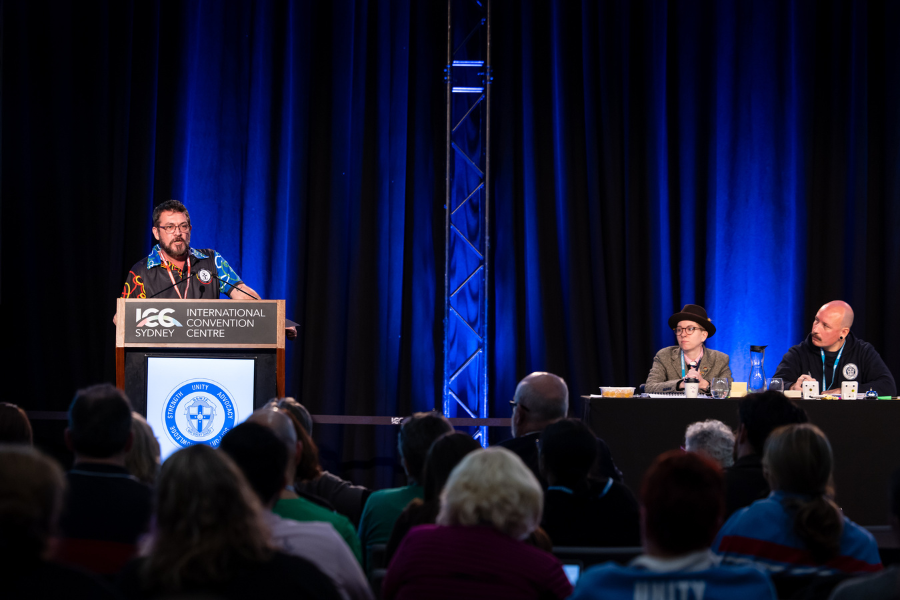
As NAIDOC Week kicks off today, Aboriginal Education Officer Russell Honnery delivered the Aboriginal Education Report to Annual Conference delegates.
This year marks five decades of this annual event dedicated to amplifying and celebrating Aboriginal and Torres Strait Islander peoples and cultures.
Russell said this year’s theme ‘50 years of Deadly’ acknowledges the strength it has taken to reach the half-century milestone, “not by chance, but because generations of people refused to be silenced”.
“It recognises the organisers, artists, activists and communities who carried NAIDOC forward year after year, ensuring it remained grounded in culture and community,” he said.
“It is a platform for truth-telling, a celebration of identity and a statement of continuity. Today, Aboriginal people and Torres Strait Islander people are leading change across every field… telling their own stories, in their own way, on their own terms.”
Russell reported the union has welcomed 75 new Aboriginal financial members and another 18 Aboriginal student members in the past three months and promised 2027 would be a big year with Federation holding its 30th Aboriginal and Torres Strait Islander Conference.
Delegates were asked to sign this petition opposing amendments to the NSW Crown Land Management Amendment Bill. Federation stands with the NSW Aboriginal Lands Council and the Aboriginal Education Consultative Group (AECG) in opposing the Amendment Bill, which will hollow out Aboriginal peoples’ rights under the Aboriginal Land Rights Act 1983 — one of the most significant land restitution frameworks in Australia.
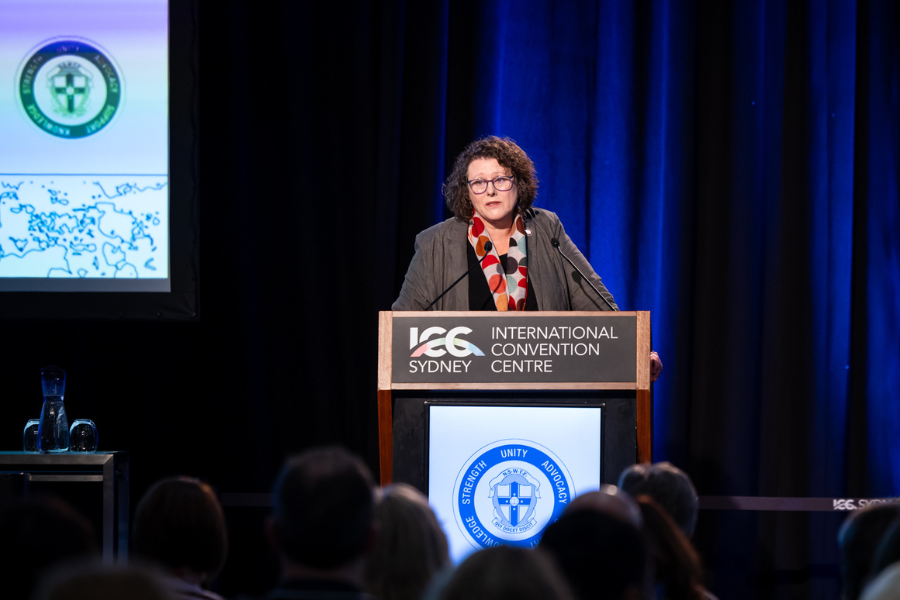
Women’s Officer Leeanda Smith challenged Annual Conference delegates to help alter the perception of unionists and the nature of women’s roles within activism.
“If you ask people to describe a unionist, what do they say? The media portrayal is the bloke in hi-vis or a bunch of blokes at a protest — angry and shouting. But the majority of union members in Australia are women. They’re teachers, nurses and healthcare workers.
“We’re all here because we want to make a difference. We want to improve lives and working conditions. So, I’m appealing to you to analyse them and reflect on what the points of engagement in the actions of this union are.”
Knowing that perception can be a barrier to participation, Leeanda posed questions to inspire the gathered delegates to develop the political education of those they work with and turn members into active participants.
“What is the range of activism? It’s not just about being loud or storming the barricades. How do we make people feel comfortable to be part of our union community? What are the points of access for our colleagues, the majority of whom are [women] with competing priorities of family, care and work?”
Acknowledging that more than 73 percent of total members are women and are making amazing contributions to the union, Leeanda lamented that women only represented 52 per cent on Federation’s Executive, 59 per cent were on Council, 66 per cent at Annual Conference, and that women only comprised 54 percent of Officers.
Leeanda spoke on the importance of honoring the women who have come before, on the fight for women’s rights, by continuing with their progress.
“We should always be asking if our decision-making bodies have active representation that understands and reflects the membership — and to that end, we have the Women’s Program,” she said.
The function of the Women’s Program is to identify structural barriers and ways of removing them, to ensure that there is both access and representation. The Women’s Program exists because Federation is committed by the Affirmative Action Policy and offers a variety of access points, as well as a range of ways to develop activism:
- Women’s Caucus at Council and Annual Conference
- the Country Women Observer Program
- a range of Trade Union Training, e.g., Workplace Women’s Contacts, Association Women’s Contacts, Women and Union Leadership
- the Anna Stewart Program
- Women’s Conference.
Leeanda encouraged those in attendance to register for this year’s Women’s Conference. The 2026 theme is ‘Safe. Respected. Essential!’.
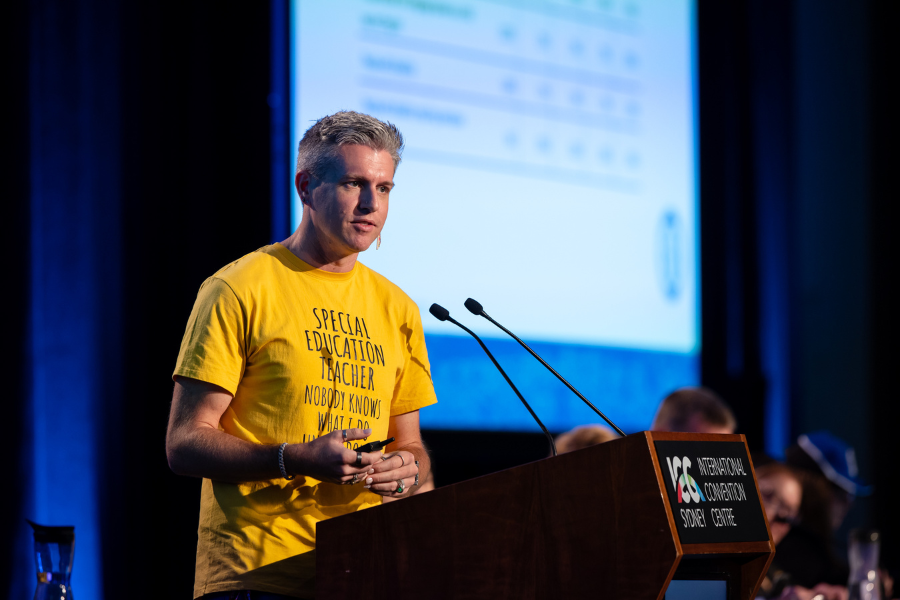
“What does inclusion look like at your school?” Disability Officer John Skene asked when delivering the Disability report.
“Is it tokenistic or is it structured? Do your support classes engage with mainstream classes or do they sit to the side only becoming ‘your problem’ when something happens to the students with disability?”
John implored everyone to become part of the conversation, saying that disability is no longer just the responsibility of special educators. “Supporting students in an inclusive system … is now everyone’s business,” he said.
“Every single student brings a difference — whether its learning ability, disability, gender, culture background, language, age and many more — and we need to start to structure and frame planning in this manner.”
He highlighted the value that diversity within modern classroom settings can have on planning: “Start with the highest need and build upon it to support all learners in your classroom. Changing one small thing for a few can have a widespread impact on the many.
“Plan for inclusion, don’t retrofit it after the fact,” John said. “Use the experts in your school or the experts in the SSP down the road.”
Staffing
There are 265 teacher vacancies across support classes, mainstream and SSP settings. In Special education/TAS, 40 per cent of positions are vacant.
“There is still work to be done by the Department of Education to help support the positive positioning of special education within our system, for example providing suitable and achievable pathways for learning, development or retraining and strengthening planning for students by reducing 25 plans to [no more] than three,” John said. The three plans would be the Learning and Support Plan, Health Care Plan and Personalised Learning Pathway (for Aboriginal students and Torres Strait Islander students), with other plans optional.
Teachers with disability
John detailed how there was also a need for inclusion when it came to teachers with disabilities. He quoted the Department’s Breaking Barriers report, an internal review: “Disability inclusion is not just a legal and ethical obligation — it is vital for addressing teacher shortages, improving student outcomes and building a more equitable workplace. The social model of disability adopted in this report underscores the importance of removing environmental and systemic barriers, rather than placing the burden on individuals to adapt.
“With growing government commitments to disability employment, findings from the Disability Royal Commission and a significant teacher shortage, the Department has an opportunity and a responsibility to take more deliberate action.”
The work ahead
“A changing of culture, a changing of perspective is the work ahead of us. Flipping the narrative to looking at an individual with disability’s potential, not as a deficit. Special education is the pedagogy and specialty. Inclusion is the mindset, not the location.”
Join the Special Education Teachers Special Interest Group
Membership of Federation’s Special Education Teacher Special Interest Group has grown 650 per cent in the past year. If you haven’t already, sign up here.
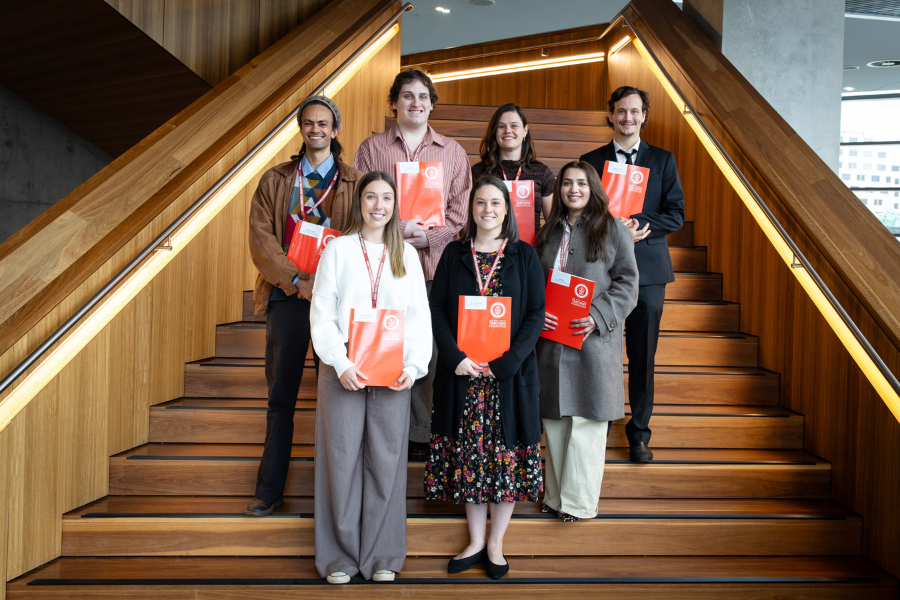
Federation has awarded eight $4000 Future Teacher Scholarships to student members of the union.
The financial aid provided as part of the scholarships is one of the ways Federation supports student members throughout their initial teacher education. Not a member? Student membership of the union is free. Click here to join.
Applicants were asked to demonstrate their understanding of the value of public education and unions to our society, as well as their commitment to both.
The Future Teachers Committee only awards scholarships to applications of a very high standard. After scoring, ranking and discussing all 62 applications, the committee determined that eight people would be awarded 2026 Future Teacher Scholarships. We congratulate them and share an extract from each of their applications, demonstrating the future of public education is in good hands.
Aboriginal and Torres Strait Islander future teacher
Chelsea Mifsud, Master of Education (Primary), Western Sydney University: “Working alongside Walpiri Elders, families and educators taught me the importance of listening first, building trust and ensuring education reflects local voices and priorities. These experiences continue to shape my commitment to culturally safe and responsive practice.”
Culturally and linguistically diverse future teacher
Faiza Nagi, Master of Teaching (Secondary) STEM, Western Sydney University: “English is not my first language and I strongly believe that linguistic diversity is an asset. Language is closely connected to one’s identity and provides a sense of belonging… The more respect we show, the stronger and more positive relationships we build.”
Future teacher from a rural or remote area
Holly Chapman, Bachelor of Education (Primary), University of Canberra: “I believe education plays a vital role in ensuring that younger generations understand and value these communities and the contributions they make to our nation. As a future teacher, I hope to help students develop not only academic skills but also an appreciation for the significance of rural life and the communities that sustain it.”
Open to all future teachers
Dylan McBurnie, Master of Teaching (Primary), University of Technology, Sydney: “By collectivising our power and organising our political strength, unions provide the first and strongest line of defence against those who seek to dismantle systems of public good.”
Rachael Anderson, Bachelor of Education (Primary), Southern Cross University: “Through attending meetings as a student member of the NSW Teachers Federation… what resonated with me most was the strong sense of solidarity in the room; members advocating not only for themselves, but for their colleagues and the sustainability of public education.”
Future teachers in their first year of studies
Lily Grant, Bachelor of Education (Early Childhood and Primary), University of Newcastle: “My teachers recognised my individual learning needs, provided the support I needed to learn and most importantly, believed in my ability to succeed… Their encouragement inspired me to pursue a career in teaching, so that I can offer the same opportunities and support to my own students.”
Jack Jones, Bachelor of Education (Early Childhood and Primary), Macquarie University: “Growing up, I was surrounded by conversations about fairness, advocacy and the importance of public education. Teaching was never simply seen as a profession, but as a way of serving the community and creating opportunities for future generations.”
John Kaye Memorial Scholarship
The John Kaye Scholarship is awarded to an applicant who demonstrates a strong commitment to the environment and/or social justice causes. This year it has been awarded to Tekle Setargew, Master of Teaching (Secondary), University of Wollongong: “Education helps you to understand yourself, how you relate to people around you and your own place in the world… Every human mind has the potential, and need, to be intellectually and creatively stimulated.”
Not a member? Student membership of the union is free. Click here to join.
President Henry Rajendra has presented three union members with Life Membership, in recognition of their long-standing support to Federation members and our campaigns.
David Ferguson
David’s activism and leadership have consistently delivered practical outcomes, improved conditions and protected entitlements — all while building confidence and capacity in those around him.
Early in his career, David supported Federation’s significant statewide campaign to win release from face-to-face (RFF) teaching for primary and casual teachers.
At Inner City Teachers Association, David was elected as Casual and Unemployed Teachers Contact in 1989 and for four years co-edited and published a monthly bulletin.
In the early 1990s, he provided an affidavit to the NSW Industrial Relations Commission salaries case, which achieved increased salaries for casual teachers.
David became a Senior Curriculum Officer at the Board of Studies (now the NSW Education Standards Authority) in1993. He was handed an individual contract, which included clauses preventing access to sick leave for three months and no transfer of Department leave entitlements. He refused to sign, immediately called Federation and triggered a dispute that resulted in the first Education Officers Award covering the Board.
David served the Officers, Consultants and Advisers Association for nearly a decade as President and Councillor.
As Federation Representative, in 1996 David led a dispute over the Board’s attempts to terminate Education Officers and restrict right-of-return provisions for public school teachers. His was also integral to entrenching award entitlements at the Board, ensuring ongoing representation of public school teachers and public education values in the regulation of syllabuses, assessment, teaching and school standards.
As a Relief Officer, in mid-2003, David contributed to a campaign that saved many positions at the Department, providing critical and direct support to school communities. Later that year, David was elected as a City Organiser.
From 2019 to 2024 David served as Federation’s Deputy Secretary (Schools).
Amber Flohm
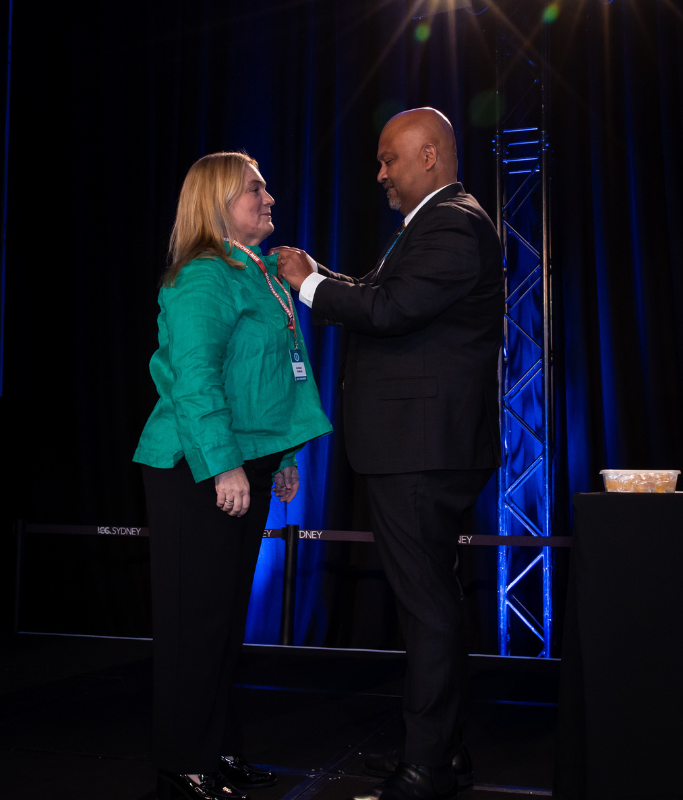
Throughout her career, Amber has been a powerful advocate for social justice, equitable access and equality of opportunity, combining grassroots activism with strategic leadership and sector-wide influence that extends well beyond the workplace and Association level.
As a new teacher, she actively encouraged colleagues to join Federation, emphasising the essential link between teacher working conditions, student welfare and quality learning environments.
Amber was elected as Federation Representative and Women’s Contact from 2000.
Elected as Fairfield Teachers Association’s President in 2004, she strengthened the Association’s engagement in Federation campaigns.
Amber participated in Federation’s Anna Stewart Program, was elected as a Relief Officer and then as a Federation Officer in 2008.
Throughout her various roles, including Multicultural Officer/Organiser, Senior Vice President and Deputy President, her leadership has been instrumental in major campaigns focused on workload, professional standards, equity and the future of the profession.
She has been a respected and authoritative representative of Federation. Her commitment to improving teacher workload, health and safety and gender equity has contributed to enhanced family and domestic violence leave; additional staff development days; and the Determination 1 Industrial Agreement, which includes the one-hour cap on weekly meetings. She also drafted Federation’s Charter of Teachers’ Work, which has been used as a central tenet for any policy development and implementation affecting teachers’ work in public education.
Amber has also been a continual champion of migrant and refugee communities and the teachers who educate them. Her advocacy is grounded in compassion, courage and a fierce commitment to human rights.
Elizabeth Scott
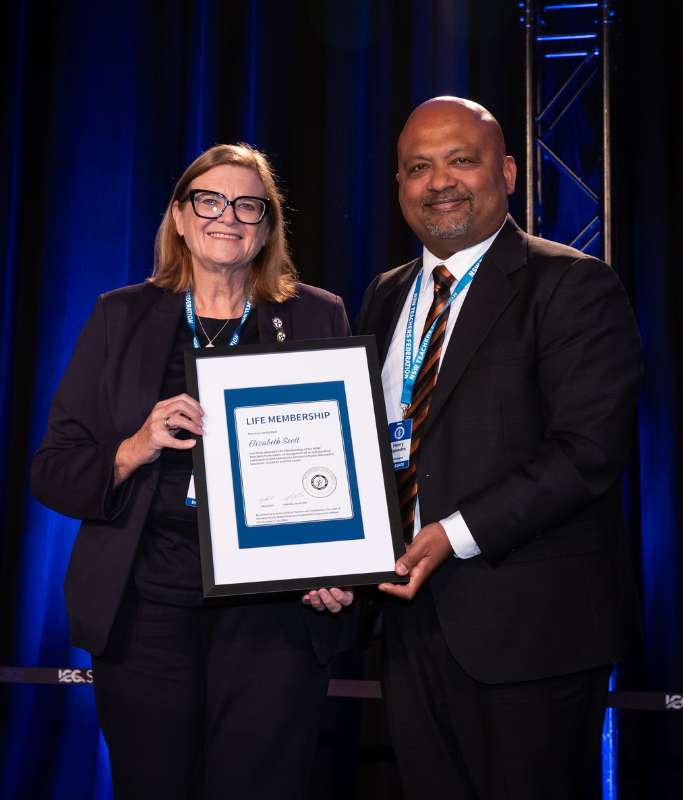
Elizabeth’s service has contributed courageous, values-driven activism that has strengthened the union, empowered members and advanced public education.
Since beginning her teaching career in 1984 Elizabeth has served Illawarra Teachers Association in roles including Casual/Unemployed Contact, Assistant Secretary, Vice President, Councillor for 25 years and 20 years as President.
Elizabeth has played a central role in organising mass meetings in the Illawarra. She’s led lobbying delegations for every major state and federal campaign in the region, ensuring Illawarra voices have been heard by decision-makers and that Federation’s presence across the South Coast has been strengthened.
She has participated in election campaigning, letterbox drops, door-knocking and staffing polling booths.
Elizabeth has mentored many members into activism and encouraged participation in rallies, Council and Annual Conference.
As a long-standing delegate to the South Coast Labour Council, Elizabeth has contributed to regional union strategy and solidarity. She has served on the South Coast Labour Council May Day Committee and spoken at numerous May Day rallies.
Elizabeth’s has been a member of Federation’s Workload Committee, Finance Committee and the Committee of Management for the Centre of Professional Learning.
In 2021, Elizabeth was a key speaker at the More Than Thanks rally on Macquarie Street. Since 2024, she has served on Federation Executive as a Custodian.
At every level, Elizabeth has strengthened the union and has mentored generations of educators who continue her legacy of principled, collective action.
Elizabeth’s service exemplifies Federation’s highest ideals and stands as a powerful testament to sustained, values-driven activism.
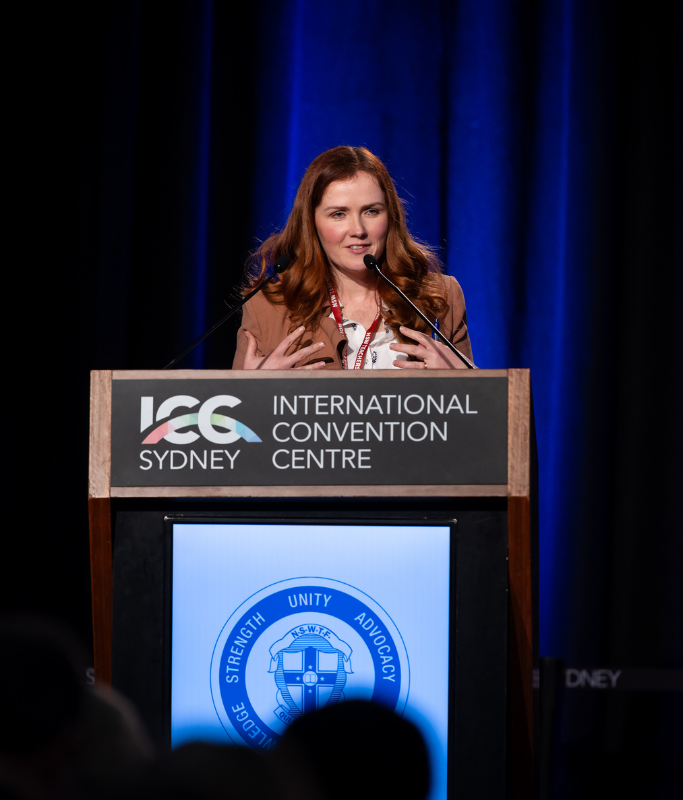
Essential services that have shifted from public to private ownership over the past two decades are driving Australia’s inflation crisis, McKell Institute chief economist Alison Pennington told Annual Conference.
Ms Pennington has calculated the average annualised inflation rate for every item in the consumer price index (CPI) basket over 20 years (2006–26). While average CPI ran at 2.8 per cent a year, the fastest-rising costs driving total inflation included:
- gas: 5.9 per cent per year
- electricity: 5.7 per cent per year
- medical and hospital services: 5.5 per cent per year
- water and sewerage: 4.6 per cent per year
- housing 3.9 per cent year.
They are all privatised services operating outside universal public systems or were services once delivered by government for free or at very low cost.
“So much of the economy now has been handed over to private interests, including services like education,” she said.
Public provision is the answer
Ms Pennington proposes the longest-lasting structural fix to inflation is public provision, because it is deflationary.
“Under times of big inflation, Australian companies are going to be facing … pressures to profit-maximise and raise prices and that’s why public ownership and delivery by our own governments, subject to the democratic will of its people, is the only solution that delivers … non-profiteering, controlling inflation and lifting the living standards of the people,” she said.
Ms Pennington is advocating for government investment in:
- public education — and “weaning private schools off the public teat” as growth in private education has been inflationary (secondary education averaging 5.2 per cent per year and preschool/primary education: 3.9 per cent per year over 20 years)
- nationalising the childcare sector
- expanding Medicare
- public owned renewables
- public-led housing programs.
The social wage has been eroded
Ms Pennington reminded delegates that in the 1980s, workers accepted wage restraint (to deal with inflation) in exchange for Medicare, better public education, better employment and pensions and universal superannuation, under the Prices and Incomes Accord.
But she said much of this social wage (collective good and services provided by government) has been “severely eroded”.
“The social wage that we fought for…has been chopped off and sold off.”
More solutions
Ms Pennington proposed other solutions “to build an economy that works for everyday people”, including:
- lifting compulsory superannuation as an alternative to interest rates
- legally capping what companies can charge
- tax sudden, unearned profit spikes
- introduce a land wealth levy for fortunes over $20 million.
Alison Pennington is the author of the book Gen F’? How Young Australians Reclaim Their Uncertain Futures and is Adjunct Senior Research Fellow in PPE with Latrobe University. Alison has held previous roles in unions, think-tanks, federal public administration and is a former senior advisor to Cabinet Ministers in the Albanese Federal Government.
For another article on Ms Pennington’s research, read Privatisation of gas, education driving total inflation over 20 years, new research finds.
Employees’ share of total income (versus corporations’ share) has dropped from 62.6 per cent in 1975 to 54.2 per cent in 2026.
The economy, government priorities and tax system must be recalibrated to fairly reward workers, recognising them as the lead contributors to economic growth in this nation, Annual Conference declared in the Understanding the economic landscape of the NSW teaching profession decision.
Federation pledges to work closely with the broader union movement in pursuit of a fair economy for all.
“Australian workers and their families are living in a heightened time of cost of living pressures, housing supply shortage, global insecurity, war and militarism, climate crises denialism and food and fuel supply issues,” the decision states. It also notes that while NSW public education teachers are impacted, they also see firsthand the impact on their students and their families that they work with each day.
Federation President Henry Rajendra said the findings from research by McKell Institute chief economist Alison Pennington [see article above] showed the pressure on working households was a policy choice.
“Teachers see the consequences of this every day. Families in our school communities are being squeezed by the rising cost of the essentials. The data also shows education fees in the private system are among the fastest-growing costs in the entire economy, feeding the same inflation the Reserve Bank keeps punishing workers for.” Mr Rajendra said.
“The answer is clear: a strong public education system holds down costs for every family in this state.”
Here is a snapshot of some of the other statements in the decision:
Housing for teachers
“Teachers unable to access quality, sustainable, secure, commutable house ownership will need housing delivered through not-for-profit housing initiatives such as a union member-owned housing cooperative, subsidised build-to rent (to buy) schemes and government supplied Teacher Housing Authority homes.
“The NSW Government needs to increase its efforts to put strategic thought and investment into affordable housing for its key workers.
“Current and future teachers in the public education system are entitled to retire without the burden of mortgage debt and adequate superannuation.”
Climate
“Teachers, students and children are entitled to live, work, play, teach and learn in climate resilient and safe environments…
“Extreme events brought on by the climate crisis, threatens the safety, wellbeing and pursuit of equality and excellence in educational outcomes for our children and students in public education.
“Global instability and the market will not deliver affordable renewable energy, decarbonisation and Australian-owned manufacturing industries and good jobs.
“Government-owned renewable energy is the structural solution to intervening on the climate crisis.
“Governments must provide unambiguous support for public investment in renewable energy generation and storage and a commitment to a nuclear-free, fossil-free future.”
Military spending and AUKUS
“Teachers have been alarmed that the expense of AUKUS will be an extraordinary economic burden on the Australian people for decades to come…
“Education, health, aged care, disability and social services budgets are likely to be the first to be sacrificed when government budgets don’t add up under the weight of AUKUS.”
Federation members and communities remain committed to campaigns for public education to be fully funded.
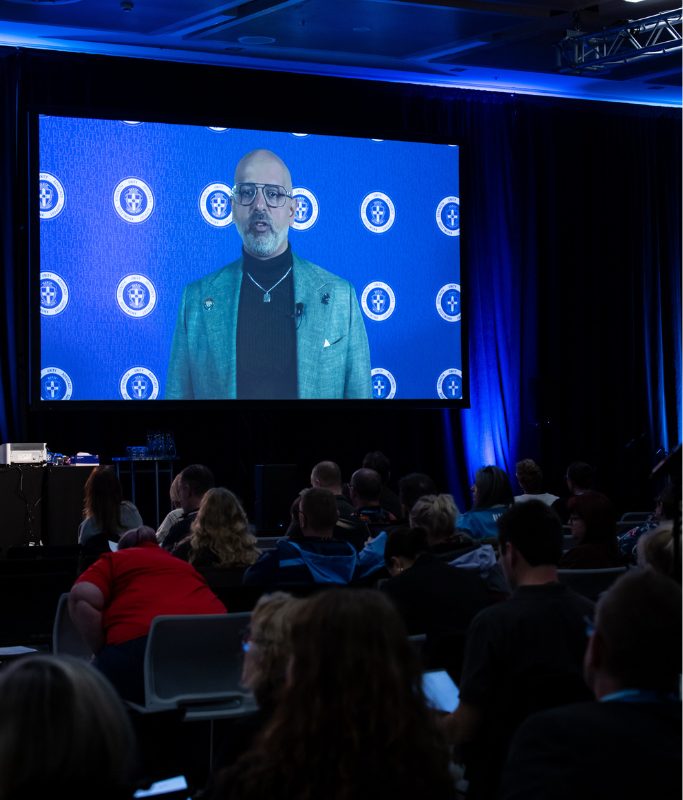
Australian Human Rights Commission’s Race Discrimination Commissioner Giridharan Sivaraman has emphasised the influence that public schools have on shaping future generations of Australians — especially when it comes to affecting equality and discrimination.
In a video address to Federation’s Annual Conference on Sunday 5 July, Mr Sivaraman spoke to the potential for schools to stop the pendulum swinging in the direction of overt discrimination and hate.
“Public schools are so well placed to do this. Within public schools is the power to shape generations…Public schools are the schools that welcome people from all walks of life. New migrants, refugees and children in regional and remote communities,” he said.
“I went to public schools, my children went to public schools, my mother just retired from teaching in one — and I truly believe that public schools are the incubators for the future we want to — we need to — see.”
Federation, the Department of Education, the Public Service Association, the Aboriginal Education Consultative Group, the United Workers Union and the Australian Human Rights Commission are working together to implement the National Anti-Racism Framework. The framework recommends that school curricula include nationally consistent anti-racism content and that primary and secondary schools undertake holistic cultural safety reviews of their education provision.
“The work we have ahead of us … is honestly one of the highlights of my time as the Race Discrimination Commissioner to do this work alongside your union and the Department of Education,” he said.
Mr Sivaraman asked how we drag the pendulum toward a future that’s anti-racist, “where schools aren’t conduits for economic, cultural or racial domination, but are — instead — emancipating people from it, whether they’re black, white or brown”.
Mr Sivaraman acknowledged the vital role that teachers play in helping create such a significant change within Australian society: “We can’t do this without you. As teachers and delegates, you are creating — on the ground — the future we need to ensure systemic change. You are inspiring your students to tackle systemic problems and organising your colleagues to put the pressure on and fight for a system that works, because the ambition of your work — of ensuring every single child can thrive — is not something that can be done off the smell of an oily rag.
“To me, it’s perhaps the single most important piece of anti-racism work in this country and that needs organised workers demanding the right resources, the right supports, and yes — the right wages — to give this work the best chance it can get.
“Anti-racism needs everyone, especially our public schools. Together, we can imagine a future where every child thrives — no matter who they are or where they’re from.”
Annual Conference 2026, Day Two
Annual Conference 2026, Day Three